When the Business Has Evolved but the Positioning Has Not
The company may be more capable, more valuable, and more sophisticated than it was three years ago. If the positioning still describes the earlier business, the market cannot see what changed.

THE SHORT VERSION
A business can evolve operationally long before its positioning catches up.
__________
When the market story reflects an earlier company, the right buyers underestimate the work, sales has to translate the value, and growth keeps leaning on people who know the history.
__________
Repositioning is not about inventing a new identity. It is about making the strongest version of the current business easier to understand and choose.
The business is not what it used to be.
The work is more strategic. The clients are more sophisticated. The problems are larger. The delivery model is stronger. The team has developed expertise that did not exist when the company first described itself.
But the website still leads with the original service.
The sales deck still uses language written for smaller buyers. The founder still explains the company through the story of how it began. The service pages list everything added along the way without showing how the pieces now fit together.
Inside the business, the evolution feels obvious.
Outside it, the company may look almost unchanged.
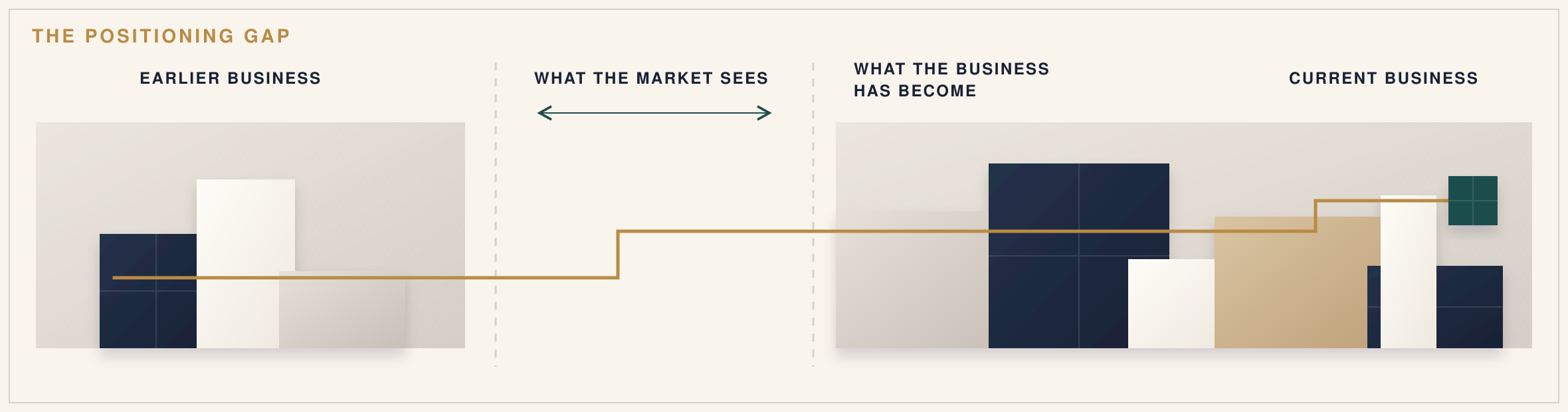
That is a positioning gap: the distance between what the business has become and what the market can currently understand.
The longer that gap remains open, the more the company has to compensate for it through sales effort, founder explanation, referrals, custom proposals, and one-to-one trust.
The business has evolved. Its market story has not.
Growth changes the business before it changes the language
Most businesses do not evolve through one clean strategic decision.
They evolve through accumulated experience.
A client asks for more support. A project exposes a larger problem. The team builds a better method. A new capability is added. A service becomes an ongoing relationship. The business moves upstream because the work increasingly requires access to leadership. A founder who once delivered tasks now diagnoses systems and directs decisions.
Each change makes sense in context.
But the positioning is rarely reconsidered every time the business learns something new.
Instead, language gets layered onto the original story.
A new service is added to the navigation. Another audience appears on the homepage. A broader promise is inserted above a narrower offer. Capabilities accumulate faster than the structure explaining them.
Eventually, the words remain technically true while becoming strategically incomplete.
“The positioning problem is not always that the business is saying something false. It is often that it is still leading with a version of the truth that has become too small.” -Sarah Fuller
The old story can keep working until it becomes the constraint
Outdated positioning often survives because the company is still generating revenue.
Referrals know the backstory. Existing clients understand the depth of the work. The founder can explain the difference in a conversation. Long-standing relationships create trust that the public message does not have to earn on its own.
That can hide the problem.
The business appears to have a lead-generation issue, a website issue, a sales-consistency issue, or a pricing issue. In reality, the market is being asked to evaluate the current company through language built for an earlier one.
The old story becomes a constraint when the next stage requires buyers who do not already know how the business evolved.
Those buyers make decisions from what they can see.
If the visible positioning understates the company, they may assume:
The work is tactical when it is actually strategic.
The company is a vendor when it operates as an embedded partner.
The offer is a collection of services rather than a connected solution.
The team is best suited to smaller or simpler engagements.
The price should reflect the old category rather than the value of the current work.
The company may be ready for a different market while still presenting itself as the business that entered the last one.
Five signs the positioning is describing an earlier business
01
The best work is difficult to find on the website
The company’s most valuable work may live in proposals, client conversations, or the founder’s head, but not in the public story.
The website emphasizes the services that established the business because those pages already exist and still attract traffic. Newer, higher-value work is added as a paragraph, a bullet, or a vague reference to strategy.
The result is a visibility mismatch: the work the business most wants to sell is the work the market is least equipped to discover and understand.
02
Sales begins by correcting the buyer’s first impression
If sales repeatedly says, “We do more than the website makes it seem,” positioning is creating unnecessary resistance.
The first part of the conversation becomes a repair exercise. Sales has to broaden the buyer’s understanding, connect services that appear separate, and explain why the company belongs in a more strategic conversation.
Strong salespeople may do this well. But the business is spending valuable attention overcoming a perception it created itself.
03
The founder is still the most reliable translator
Founders carry the full history of the business.
They know why the offer changed, how the capabilities connect, what makes the approach different, and which parts matter most for a particular buyer. They can move fluidly between the original story and the current reality.
When the positioning has not captured that logic, the founder remains essential to important sales conversations, not only as a relationship builder, but as the person who can finally make the business make sense.
That dependence is not proof that the founder is uniquely persuasive. It may be evidence that the company has not yet turned what the founder knows into shared market language.
04
Pricing conversations keep returning to the wrong comparison
Buyers use positioning to decide what kind of business they are evaluating.
If the company presents itself in a tactical category, the buyer will compare it with tactical alternatives. If the language centers deliverables, the buyer will evaluate quantity. If the offer looks like separate services, the buyer will price each component independently.
The business may be delivering diagnostic judgment, cross-functional architecture, risk reduction, executive access, or operational change. But if the positioning leads with outputs, the market anchors to the wrong value.
Pricing pressure is not always a price problem. Sometimes it is a category problem.
05
New capabilities have made the story broader but not clearer
Growth adds legitimate complexity.
The company may now work across strategy, technology, operations, experience, or revenue. Each capability belongs. The mistake is assuming that listing all of them communicates their combined value.
Without a unifying idea, expansion makes the company sound less focused precisely when it has become more capable.
The problem is not the number of services. It is the absence of a structure that tells the buyer why those services belong together.
A Useful Starting Point
Find the gap between the business you built and the story the market sees.
A Growth Architecture Audit examines the current positioning alongside the offer structure, website, buyer path, CRM, sales process, AI workflows, and revenue priorities. It shows where the company’s external story no longer reflects its actual value and what that mismatch is affecting downstream.
Requesting an Audit begins with a short fit call. If the Audit is the right next step, I will confirm the goals, scope, timing, and payment before work begins.
What outdated positioning costs the business
The cost is not limited to unclear copy.
Positioning shapes who recognizes the company, what they believe it can solve, how they compare it, what they expect to pay, and whether they move forward.
When the positioning trails the business, the gap appears across the growth system.

The right buyers fail to recognize the fit
Sophisticated buyers are looking for signs that a company understands the scale and context of their problem.
If the message speaks to an earlier stage, those buyers may leave before discovering the deeper capability. Meanwhile, smaller or less aligned prospects may continue to inquire because the old positioning still speaks directly to them.
The pipeline can remain active while becoming increasingly misaligned with where the company wants to go.
Good opportunities require too much explanation
Every qualified conversation begins further back than it should.
The team must explain the evolution, redraw the offer, and establish strategic credibility before it can address the buyer’s actual situation. Proposals become longer because they are doing the work the brand and website should have done earlier.
This slows movement and makes conversion more dependent on individual communication skill.
Marketing keeps producing from the wrong center
Content may still orbit the problems, keywords, or service categories that built the earlier company.
That creates a subtle conflict: marketing is asked to attract the next-stage buyer while the source positioning continues to reinforce the previous stage.
More content cannot resolve that contradiction. It simply distributes it more frequently.
The business appears less differentiated as it becomes more sophisticated
The strongest distinction is often created through evolution.
The company has seen patterns, refined its process, combined capabilities, and learned where clients actually struggle. But if the positioning remains centered on a generic service category, none of that accumulated intelligence becomes visible.
The business grows more valuable internally while appearing more interchangeable externally.
Growth remains dependent on institutional memory
Long-tenured employees know what the company really does. Referral partners know which problems to send. Existing clients know how far the team can extend beyond the original engagement.
New employees, new partners, new markets, and new buyers do not share that history.
Without updated positioning, growth depends on people carrying context from one conversation to another. That is difficult to scale and easy to lose.
Repositioning does not mean abandoning what built the business
Companies often delay positioning work because they assume it requires a dramatic reinvention.
It does not.
Effective repositioning preserves the credibility, expertise, client trust, and market recognition the business has earned. It changes the organizing idea around those assets so they support the next stage.
The goal is not to pretend the earlier company never existed.
The goal is to understand what the business learned by becoming the current one.
That requires separating three things:
What remains foundational
Some parts of the original business still belong at the center: a core expertise, a market relationship, a delivery principle, or a problem the company continues to solve unusually well.
These elements create continuity and should not be discarded simply to make the company sound new.
What has become evidence rather than the headline
An original service may still matter, but its role may have changed.
What once defined the company may now be one capability inside a larger solution. It can remain important without remaining the primary lens through which every buyer understands the business.
What now deserves to lead
The current position should reflect the problem the business is best equipped to solve now, the buyers it is most relevant to now, and the value created by the full approach now.
That is the shift: not a rejection of the past, but a more accurate hierarchy.
The positioning reset: from inherited language to current truth
A useful positioning reset begins with evidence, not wordsmithing.
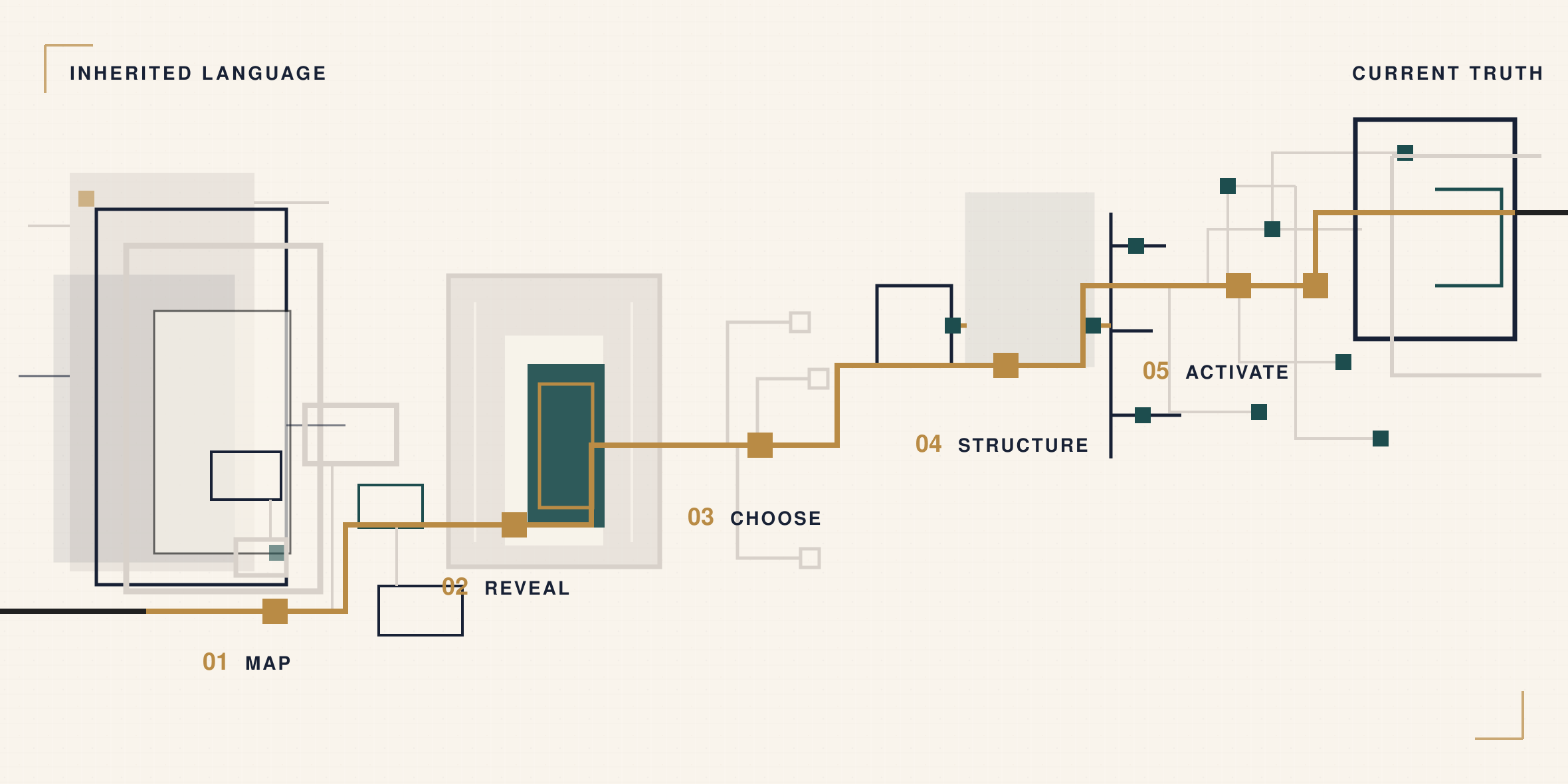
Map what materially changed
Identify how the business has evolved across clients, problems, offers, expertise, delivery, results, economics, and leadership involvement.
Do not begin by asking what the new tagline should be. Begin by establishing what is now true that was not true when the current positioning was written.
Find the value the old category cannot fully explain
Look for the work clients value that is consistently omitted, minimized, or misunderstood.
This may be the diagnostic thinking before implementation, the connection between disciplines, the operating system created around the deliverable, or the leadership judgment that prevents expensive mistakes.
That hidden value often contains the foundation of the next position.
Decide what the business should be known for next
Positioning requires choice.
The company may be capable of many things. The market still needs a clear first understanding. Decide which problem, point of view, approach, or business condition should organize the story.
The first message does not need to contain everything. It needs to make the right people want to understand more.
Rebuild the offer hierarchy around that position
The offer system should make the positioning tangible.
Clarify where a buyer begins, what the core implementation includes, how supporting capabilities fit, and what an ongoing relationship looks like. If every engagement still requires the founder to invent a custom path, the new language will not have enough operational structure beneath it.
Carry the decision through the full growth system
Positioning is not finished when the homepage is rewritten.
The shift must reach service pages, proof, calls to action, sales conversations, proposals, CRM fields, qualification logic, content themes, AI source material, onboarding, and internal language.
Otherwise the company creates a new headline while the rest of the business continues telling the old story.
The market cannot value an evolution it cannot see
A business may have done the hard work already.
It may have built the expertise, strengthened delivery, moved closer to leadership, connected previously separate capabilities, and proven that it can solve a more important problem.
But the market does not award credit for invisible evolution.
It responds to what the company makes clear.
Updated positioning closes the gap between internal reality and external understanding. It gives the website a stronger organizing idea, gives sales a clearer starting point, gives content a more meaningful point of view, gives the CRM better qualification logic, and gives AI accurate source material to extend.
Most importantly, it allows the right buyers to see the company they would actually be hiring, not the earlier version the business has already outgrown.
START HERE
Make the current business visible.
The Growth Architecture Audit identifies where the company’s positioning, offers, website, CRM, workflows, and revenue system no longer reflect the stage the business has reached and what to address first.

Sarah Fuller
Growth Architect
I help founder-led B2B companies connect brand, website, CRM, AI workflows, and revenue operations into a growth system the business can actually use. I diagnose the architecture, rebuild the disconnected parts, test how they work together, document the system, and establish clear ownership for what comes next.