Why Strong Companies Still Struggle to Explain What They Actually Do
The business may be excellent at the work and still make buyers work too hard to understand it. The problem is rarely a lack of expertise. It is usually a lack of structure around the explanation.

THE SHORT VERSION
Expertise creates complexity. Without a clear message structure, that complexity moves directly into the buyer experience.
__________
Most companies explain themselves from the inside out: capabilities, departments, processes, and terminology first; buyer relevance later.
__________
Clarity does not require reducing sophisticated work to a slogan. It requires giving the buyer the right information in the right order.
Ask a capable company what it does and the answer often gets longer as the business gets stronger.
It begins with one service, then expands into several. It includes the industries served, the technology used, the expertise of the team, the flexibility of the delivery model, and the fact that every engagement is different.
All of it may be accurate.
Very little of it may help a buyer understand.
This is one of the most frustrating problems in a growing business: the company is good at the work. Clients trust it. The team can solve meaningful problems. The offer has real depth.
But the explanation still sounds vague, crowded, generic, or smaller than the value being delivered.
That is not evidence that the business lacks substance.
It is evidence that substance and clarity are different capabilities.
Strong companies do not automatically become easy to understand. In many cases, the experience that makes the company valuable also makes the explanation more difficult.
Expertise creates complexity. Buyers still need a clear way in.
The people closest to the work see connections a new buyer cannot see yet.
They understand why several capabilities belong together. They know which problems tend to appear at the same time. They can recognize the difference between a surface request and the deeper issue creating it. They have years of context compressed into the way they talk.
The buyer does not.
The buyer is trying to answer a more immediate set of questions:
Is this relevant to what is happening in my business?
Does this company understand the problem at the right level?
What would it actually help us change?
Why is its approach different from the other options?
What should I do next?
When the explanation begins with everything the company knows instead of what the buyer needs to understand first, expertise becomes noise.
The issue is not that the business knows too much.
The issue is that it has not built an entrance into that knowledge.
“The job of positioning is not to explain the entire business at once. It is to give the right buyer enough clarity to recognize the fit and keep moving.” -Sarah Fuller
Most companies explain themselves from the inside out
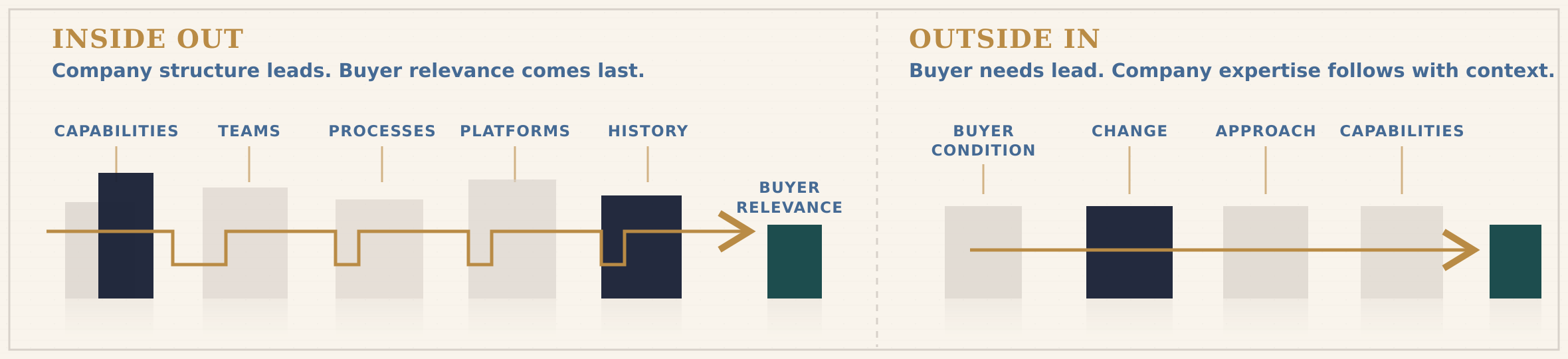
Inside the company, the business is organized around teams, capabilities, processes, platforms, service lines, and internal ownership.
That structure is useful for operating the work.
It is not automatically useful for understanding the value.
An inside-out explanation might begin with:
The full list of services
The company’s history
A proprietary process name
The platforms the team supports
Every industry it has worked in
Broad claims about quality, partnership, or innovation
The buyer is left to assemble those pieces into a reason to care.
An outside-in explanation begins somewhere different:
It names a condition the buyer recognizes. It shows why the problem matters. It defines the change the company helps create. It introduces the approach in a way that makes the capabilities feel connected rather than accumulated.
Both explanations may contain the same facts.
The difference is the order.
Why capable businesses become difficult to describe
The business has more than one true answer
A mature company may legitimately solve several problems for several kinds of clients.
Different leaders describe the company through the part they know best. Sales talks about outcomes. Operations talks about delivery. Technical experts talk about capabilities. The founder talks about the origin and the long-term vision.
None of them is necessarily wrong.
The problem is that the company has not decided which truth should organize the others.
Without that hierarchy, every explanation becomes a negotiation over what deserves to be included.
The strongest value happens between the deliverables
The most visible outputs are easy to name: a website, an implementation, a strategy, a platform, a campaign, a system, a report.
But clients may value something less tangible and more important: the diagnosis that prevented the wrong investment, the ability to connect departments, the judgment that simplified a decision, the structure that made the work usable, or the leadership that kept several moving parts aligned.
If the company describes only what it produces, the buyer misses how it creates value.
Familiar language has become invisible internally
Teams use phrases every day that feel specific because everyone inside the company understands the context.
“End-to-end solutions.” “Strategic partnership.” “Digital transformation.” “Customized service.” “Innovative technology.” “Full-service support.”
These phrases are not always wrong. They are simply asked to carry more meaning than they contain.
Internal familiarity can make language feel clear long after it has stopped creating a distinct picture for anyone outside the business.
Accuracy keeps defeating priority
Strong companies care about representing the work accurately.
That is a good instinct. It becomes a problem when accuracy is interpreted as saying everything at once.
The homepage cannot contain every qualifier. The first sentence cannot acknowledge every exception. The core explanation cannot give equal weight to every capability, audience, and use case.
Clarity requires sequence.
Some information must lead. Some must support. Some should wait until the buyer has enough context to use it.
The message has too many internal owners and no architectural owner
Marketing may write the copy, but sales wants different language. Leadership adds priorities. Service leaders protect their capabilities. Legal removes risk. Technical teams correct nuance.
By the time everyone is represented, the buyer may no longer be centered.
The company needs more than a writer. It needs someone responsible for the architecture of the explanation: what comes first, what connects the offers, what proof belongs where, and how the message carries through the website, sales process, CRM, content, and AI systems.
A Useful Starting Point
Find where the explanation is making the buyer do the work.
A Growth Architecture Audit examines how the business is positioned, how the offers fit together, how the website guides understanding, and whether sales, CRM, content, and AI workflows reinforce the same story. It identifies where complexity is useful and where the current structure is transferring that complexity to the buyer.
Requesting an Audit begins with a short fit call. If the Audit is the right next step, I will confirm the goals, scope, timing, and payment before work begins.
Clear does not mean simplistic
Leaders often resist clearer language because they are protecting the sophistication of the business.
They do not want the company to sound narrow. They do not want to reduce strategic work to a commodity. They do not want to make a promise that ignores important nuance.
Those concerns are valid.
But complexity and sophistication are not the same thing.
Complexity asks the buyer to hold many disconnected ideas at once.
Sophistication gives the buyer a simple organizing idea that reveals more depth as they move through it.
A clear explanation can acknowledge a complicated reality without presenting every part of that reality simultaneously.
The goal is not to make the business sound smaller.
It is to make the value easier to enter.
The Clarity Sequence: what the buyer needs in order
A useful business explanation moves through four stages.

01 Recognize
The buyer should recognize the business condition, tension, or problem.
This is not a dramatic pain statement. It is a precise description of what is happening and why the status quo no longer works.
Recognition creates relevance.
For Sarah Fuller Growth Architecture, the entry point is not “I provide brand, website, CRM, AI, and revenue operations services.”
It is the moment when the business is growing but the systems holding that growth together have become messy, disconnected, or too dependent on the founder.
The capabilities matter after the buyer recognizes the condition.
02 Understand
The buyer should understand what role the company plays in changing that condition.
This is where many businesses fall back into a list of services.
A stronger explanation names the change the company creates and the level at which it works. Does it fix a task, implement a tool, coordinate several systems, reduce risk, redesign an operating model, or lead a transition?
Understanding gives the buyer a useful category for the company—even if the company’s approach crosses traditional categories.
03 Believe
The buyer should see why the promise is credible.
Belief comes from the connection between approach and evidence.
Show how the company thinks, how the work is structured, what it has learned, what it has changed, and why those decisions produced a stronger result. Proof should demonstrate the specific value the positioning claims—not merely show that clients liked the experience.
Belief reduces uncertainty.
04 Act
The buyer should know the appropriate next step.
That step should match the complexity and commitment of the work.
For a considered B2B engagement, the next step may be an Audit request, a fit call, a case study, or a defined diagnostic—not an urgent “buy now” button applied to every page.
Action becomes more likely when recognition, understanding, and belief have already done their work.
A quick clarity test for the current message
Give the homepage, sales deck, or company description to someone intelligent who is not already close to the business.
After a short review, can that person answer these questions in plain language?
01 Who is this company especially relevant to?
02 What is happening when a buyer needs it?
03 What does it help change?
04 Why does its approach make sense?
05 What should the buyer do next?
If the answers require an employee to add context, the message is not carrying enough of the explanation.
If several employees give materially different answers, the company does not yet have shared positioning.
If the answers repeat the service list without describing the value, the explanation is still inside out.
Clarity has to travel through the whole growth system
A clearer homepage is useful. It is not enough.
If the business explains itself one way on the website and another way in sales, the buyer experiences the inconsistency.
If the CRM does not capture the problem, fit, or offer path defined by the positioning, the system cannot report on the story the business says it wants to grow.
If content is organized around disconnected keywords rather than a defined point of view, it will not reinforce the position.
If AI tools are given old copy, generic prompts, and contradictory source material, they will produce more language without producing more clarity.

The explanation becomes durable when it shapes:
The hierarchy of the website
The way offers are named and sequenced
The questions sales asks
The fields and stages inside the CRM
The proof selected for each decision
The themes used in content
The source material and rules given to AI
The language leaders and team members repeat
This is why messaging is not a copy problem alone.
It is an architecture problem.
Strong work should not require an insider to explain it
The goal is not to remove every conversation from the sales process.
The goal is to ensure those conversations can begin at the right level.
The website should not force sales to correct the first impression. The founder should not be the only person capable of connecting the pieces. A referral should not need to provide the missing explanation. A proposal should not have to introduce the company from the beginning.
Strong companies earn depth through the work.
Clear companies make that depth accessible.
When the business builds a structured explanation around what the buyer needs to recognize, understand, believe, and do, the market can finally see the strength that already exists.
Make the business easier to understand and easier to choose.
The Growth Architecture Audit identifies where positioning, offers, website, CRM, content, AI workflows, and revenue systems are telling different versions of the story and what to align first.

Sarah Fuller
Growth Architect
I help founder-led B2B companies connect brand, website, CRM, AI workflows, and revenue operations into a growth system the business can actually use. I diagnose the architecture, rebuild the disconnected parts, test how they work together, document the system, and establish clear ownership for what comes next.