Your Website Is Not a Brochure. It Is Part of Your Revenue Infrastructure.
A strong website does more than present the business. It helps the right buyers understand, self-select, act, enter the CRM correctly, and move into a revenue process the company can see and improve.


THE SHORT VERSION
A brochure website presents information. Revenue infrastructure creates movement and carries usable information into the rest of the business.
__________
The website should help the right buyer understand the fit, choose a path, take an appropriate action, and enter a visible follow-up process.
__________
A polished site can still underperform when the positioning, conversion paths, forms, CRM, automation, sales ownership, and reporting were designed separately.
Many website projects end at the moment the site goes live.
The pages are published. The design is polished. The navigation works. The forms send an email. The leadership team approves the new look.
The project is considered complete.
But publishing is not the end of the website’s job.
It is the point at which the website begins interacting with the market.
The site will shape what buyers understand, which offers they consider, whether they recognize the fit, what action they take, what information enters the business, how quickly someone responds, and what the company can learn about demand.
That makes the website more than a marketing asset.
It is part of the revenue infrastructure.
The brochure mindset ends at presentation
A brochure website answers a limited question:
How should the business present itself online?
That question matters. Credibility, visual quality, clear copy, useful navigation, accessibility, and mobile experience all influence whether a buyer trusts the company enough to continue.
But the revenue question is larger:
How should the website help the right buyer move—and how should the business respond when that movement happens?
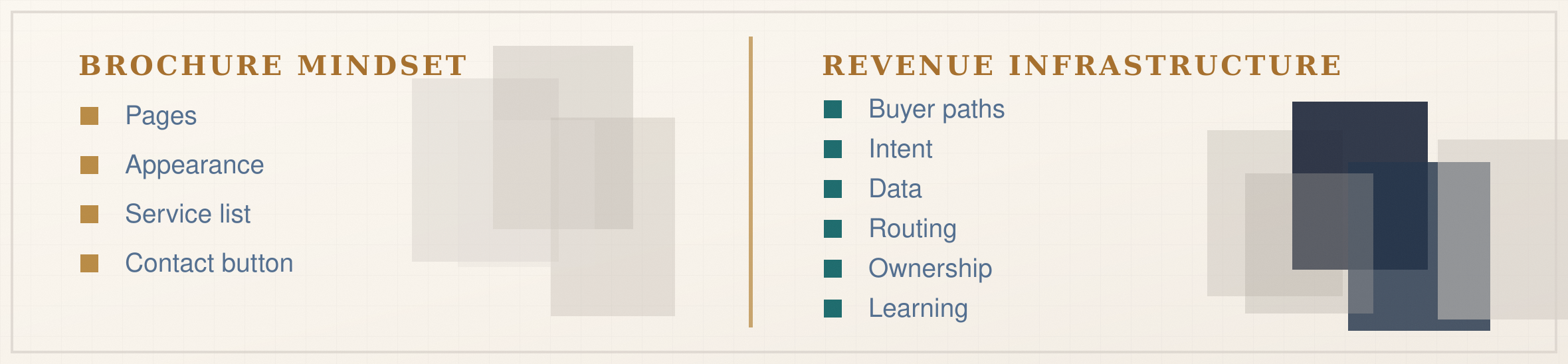
The brochure mindset tends to focus on:
What pages should we have?
What should the site look like?
Which services should we list?
What photography should we use?
Where should the contact button go?
Revenue infrastructure adds another set of decisions:
Which buyers need different paths?
What must each buyer understand before acting?
Which actions indicate education, evaluation, or purchase intent?
What information should a form capture?
Where should that information go?
Who owns the response?
What should happen automatically?
Which activity should sales be able to see?
What can the business learn from where buyers stop or move forward?
The website becomes strategic when those decisions are designed together.
“A website is not part of the revenue infrastructure because it can generate leads. It is part of the infrastructure because it shapes, captures, routes, and reveals buyer intent.” -Sarah Fuller
A beautiful website can still be operationally disconnected
Visual quality is visible. System quality is easier to miss.
A site may feel premium while every form submission arrives in one inbox with the same subject line.
It may have strong service pages but no clear path for a buyer who understands the problem and is not yet ready to request a conversation.
It may collect a name, email, and open text field while omitting the information sales needs to understand fit or urgency.
It may send contacts into the CRM without the source, offer, page, campaign, or problem category that explains why they acted.
It may trigger an automatic confirmation while leaving internal ownership undefined.
It may report traffic without showing which journeys create qualified movement.
None of these problems can be solved by visual design alone.
The design may be doing its job. The connections around it are incomplete.
The website has six revenue responsibilities
01 Create immediate understanding
The right buyer should be able to recognize whether the business is relevant without reconstructing the offer from multiple pages.
That requires clear positioning, a useful hierarchy, and language organized around the buyer’s condition, not the company’s internal departments.
The website does not need to explain everything immediately. It needs to establish the right first understanding so the buyer knows where to go next.
02 Build the right buyer paths
Not every visitor arrives with the same knowledge or intent.
One person may be trying to name the problem. Another may be comparing approaches. A referral may already trust the company and need proof. An existing client may be looking for a specific capability. A high-fit buyer may be ready to request the starting engagement.
A strong site gives those visitors appropriate paths without turning the navigation into a directory of everything the company does.
The architecture should move buyers from recognition to understanding, proof, offer fit, and action.
03 Create meaningful conversion points
A contact button is not a conversion strategy.
The website should provide actions that match the buyer’s stage and the seriousness of the engagement.
That may include reading a case study, exploring an offer, reviewing a process, requesting an Audit, submitting a qualified inquiry, or booking a short fit call after the request has been reviewed.
The action should feel like the logical next step in the buyer’s decision, not an interruption applied to every section.
04 Capture information the business can use
Every form field should have a reason to exist.
Too few fields can leave sales with no context. Too many can create unnecessary friction. Generic fields may collect contact information without revealing the buyer’s situation, offer interest, timing, or fit.
The form should capture enough information to support the next decision while respecting where the buyer is in the journey.
The data should enter the CRM in defined fields, not remain buried in an email or an unstructured notes box.
05 Route intent into a visible follow-up process
Submission is not conversion if nothing reliable happens after it.
The website should route the inquiry to the correct record, owner, pipeline, stage, and response path. The buyer should receive a useful confirmation. The internal team should know what happened, what is expected next, and how quickly to respond.
The process may include automation. It still needs ownership.
Automation can acknowledge, assign, notify, and create tasks. It cannot compensate for an undefined decision process.
06 Produce signals the business can learn from
Traffic matters only in context.
The business should be able to see which sources, pages, offers, and actions create meaningful movement. It should distinguish broad attention from qualified intent. It should know where high-fit buyers enter, where they hesitate, and which paths lead to real opportunities.
That does not require measuring everything.
It requires measuring the decisions the website was designed to support.
A Useful Starting Point
See where the buyer path stops being connected.
A Growth Architecture Audit examines how the website connects to positioning, offers, conversion paths, forms, CRM fields, automation, sales ownership, AI workflows, and revenue visibility. It identifies what is working, what is broken, what is missing, and what should be addressed first.
Requesting an Audit begins with a short fit call. The fit call confirms whether the Audit is appropriate; it is not a free diagnostic session. If the Audit is the right next step, I will confirm the goals, scope, timing, and payment before work begins.
The Website Revenue Path
A connected website creates a visible path from attention to learning.

01 Arrive
The buyer enters through search, social content, a referral, an event, a campaign, a direct recommendation, or a return visit.
The source creates context. The landing experience should respect that context rather than treating every visitor as if they began on the homepage.
02 Understand
The buyer should quickly understand what the company helps change, who the work is for, and why the approach is relevant.
If this step fails, more traffic only sends more people into confusion.
03 Self-select
The site should help the buyer determine whether the business, problem, offer, timing, and level of investment are aligned.
Good self-selection improves conversion quality. It gives the right buyers confidence while allowing poor-fit buyers to recognize that another path may be more appropriate.
04 Act
The buyer takes a meaningful next step: reads proof, explores the offer, requests the Audit, submits an inquiry, or enters another defined conversion path.
The action should reveal something about intent, not merely generate a click.
05 Route
The website passes usable information into the CRM and operating process.
The record should show where the buyer came from, what path they took, which offer or problem they selected, and what internal action is required.
06 Follow up
The business acknowledges the inquiry, assigns ownership, creates the next task, and responds with the right context.
The buyer experiences continuity rather than a reset. They should not have to repeat everything the website already asked them to provide.
07 Learn
The business connects website behavior with qualification, opportunity movement, and revenue outcomes.
That feedback improves the message, page structure, conversion points, form logic, campaigns, follow-up, and investment decisions.
The path becomes a loop: learning informs the next version of the website and the systems around it.
Where the revenue path usually breaks
The website and CRM use different definitions
The site may organize offers one way while the CRM uses outdated service categories. Form options may not match pipeline paths. Marketing may track campaign language that sales never sees.
The handoff creates translation work, lost context, and unreliable reporting.
Every form goes to the same place
A general inbox may be sufficient for low-volume contact. It becomes a risk when high-intent inquiries, partnership requests, support questions, recruiting messages, and spam all arrive through one undifferentiated channel.
The business cannot prioritize what the site has not helped classify.
Confirmation is treated as the end of the journey
“Thank you. We will be in touch” confirms that a form worked.
It does not set expectations, preserve momentum, direct the buyer to useful proof, explain what happens next, or help the company manage response ownership.
The confirmation experience is part of the revenue path.
Analytics measure attention but not movement
Pageviews, users, time on site, and clicks can be useful. They do not automatically show whether the site is creating qualified opportunities.
If website activity cannot be connected to form type, offer interest, source, fit, pipeline movement, and revenue, the business sees attention without seeing its commercial meaning.
No one owns what happens after launch
Websites drift when content, technology, data, conversion, and follow-up have separate owners—or no owner.
Pages become outdated. Forms break quietly. CRM fields change without corresponding website updates. New offers are added without redesigning the path. Automations continue running after the process changes.
Revenue infrastructure needs operational ownership after launch.
More traffic will not repair a disconnected path
When a website underperforms, the instinct is often to increase traffic.
Publish more content. Run more campaigns. invest in search. Post more frequently. Attend more events. Add AI-generated pages.
Traffic can create opportunity.
It also multiplies whatever already happens after arrival.
If the message is unclear, more visitors encounter unclear positioning.
If the buyer path is weak, more people leave without finding the right next step.
If forms capture poor data, the CRM accumulates more incomplete records.
If ownership is missing, the team receives more inquiries it cannot manage consistently.
If reporting is disconnected, leadership spends more money without learning which activity produced qualified movement.
Before the company invests in more attention, it should understand what the existing path does with the attention it already has.
AI can accelerate the website. It cannot architect it.
AI can help draft pages, generate variations, organize source material, support search optimization, personalize experiences, summarize inquiries, and assist follow-up.
Those uses can be valuable.
But AI needs a defined system to work within.
It needs clear positioning, approved source material, offer logic, buyer paths, data rules, tone, proof, conversion goals, and ownership boundaries.
Without that architecture, AI can produce more pages and more language while making the website less coherent.
Speed is only an advantage when the direction is correct.
What changes when the website becomes infrastructure
The website stops functioning as a static explanation of the company and begins supporting the way the company grows.
The right buyers understand the fit sooner.
Navigation and page hierarchy reflect buyer decisions rather than internal departments.
Calls to action match intent.
Forms create usable CRM data.
Automation preserves context and response standards.
Sales can see what brought the buyer in and what they cared about.
Leadership can connect digital activity to pipeline quality and revenue movement.
The site can evolve because the business has a way to learn from it.
In one growth-stage B2B technology company, rebuilding the website required more than new pages. Positioning, capability structure, conversion paths, campaign landing pages, event capture, CRM fields, automations, sales enablement, and reporting had to reinforce the same revenue process.
The value did not come from making the site look more sophisticated.
It came from making the website and the business behind it work as one system.
You can read the full Case Study here.
The website should make the next stage easier to operate
A website is not successful because it is finished.
It is successful when the right people can understand the business, take an appropriate next step, enter a reliable process, and receive a coherent experience from first visit through follow-up.
That requires design, copy, conversion, data, CRM, automation, sales, and measurement to share an architecture.
The brochure is what the buyer sees.
The infrastructure is what makes the experience work.
Find the break in the revenue path.
The Growth Architecture Audit shows where the website, CRM, buyer journey, automation, sales process, and revenue visibility are connected and where the current system is losing context, momentum, or opportunity.

Sarah Fuller
Growth Architect
I help founder-led B2B companies connect brand, website, CRM, AI workflows, and revenue operations into a growth system the business can actually use. I diagnose the architecture, rebuild the disconnected parts, test how they work together, document the system, and establish clear ownership for what comes next.