What Your Website Needs to Do Before You Spend More on Traffic
More attention is valuable only when the website can turn it into understanding, qualified movement, reliable follow-up, and useful learning. Before increasing traffic, make sure the system receiving it is ready.

THE SHORT VERSION
More traffic multiplies the current website experience. It does not repair unclear positioning, weak buyer paths, poor data capture, inconsistent follow-up, or disconnected reporting.
__________
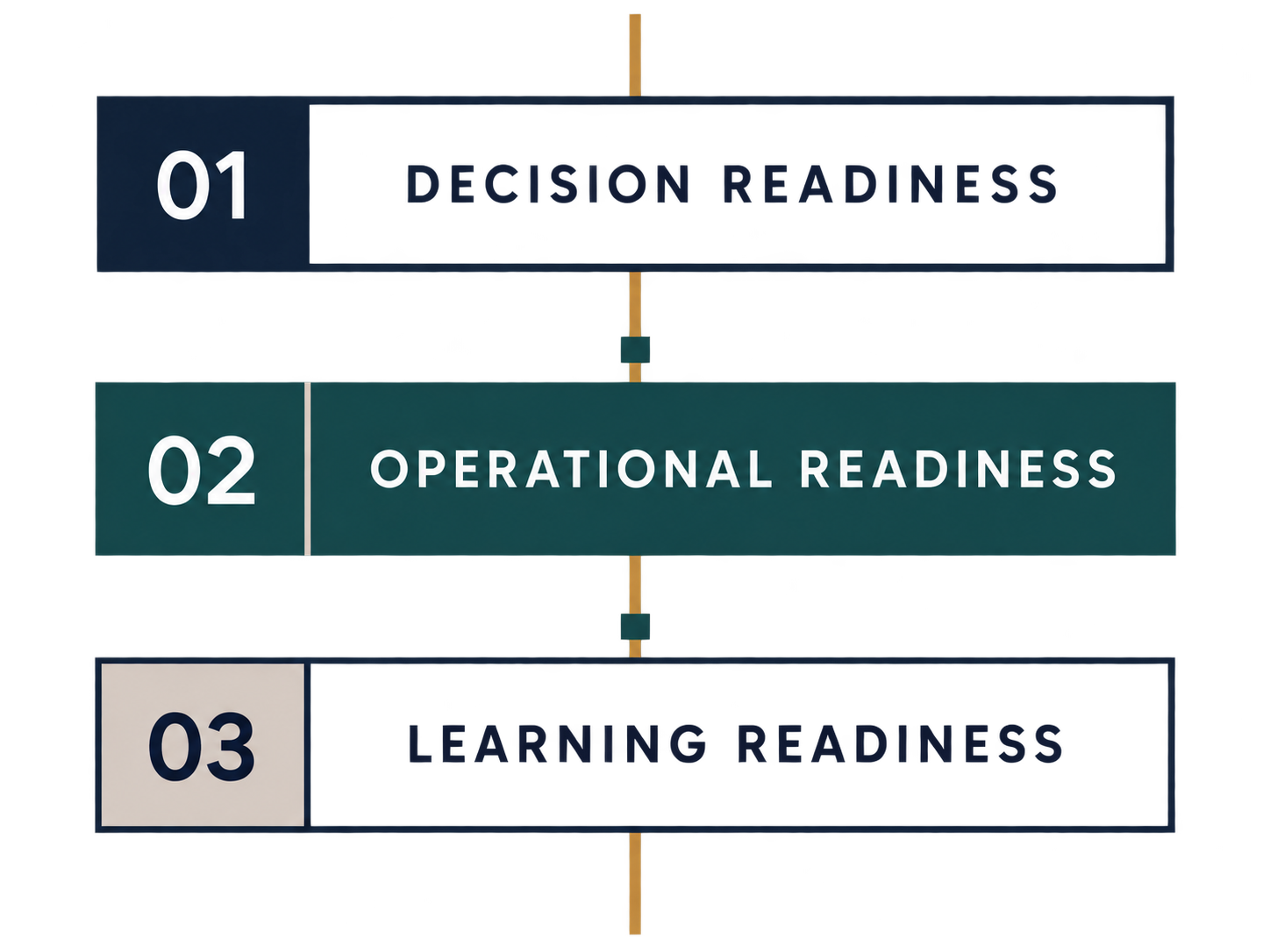
A traffic-ready website needs decision readiness, operational readiness, and learning readiness.
__________
The first question is not “How do we get more visitors?” It is “What happens to the right visitor after they arrive?”
The company wants more leads.
So the conversation moves quickly to traffic.
Invest in search. Run paid campaigns. Publish more content. Increase social activity. Sponsor an event. Add landing pages. Use AI to create more articles. Bring more people to the website.
The logic feels straightforward:
More visitors should create more opportunities.
Sometimes they do.
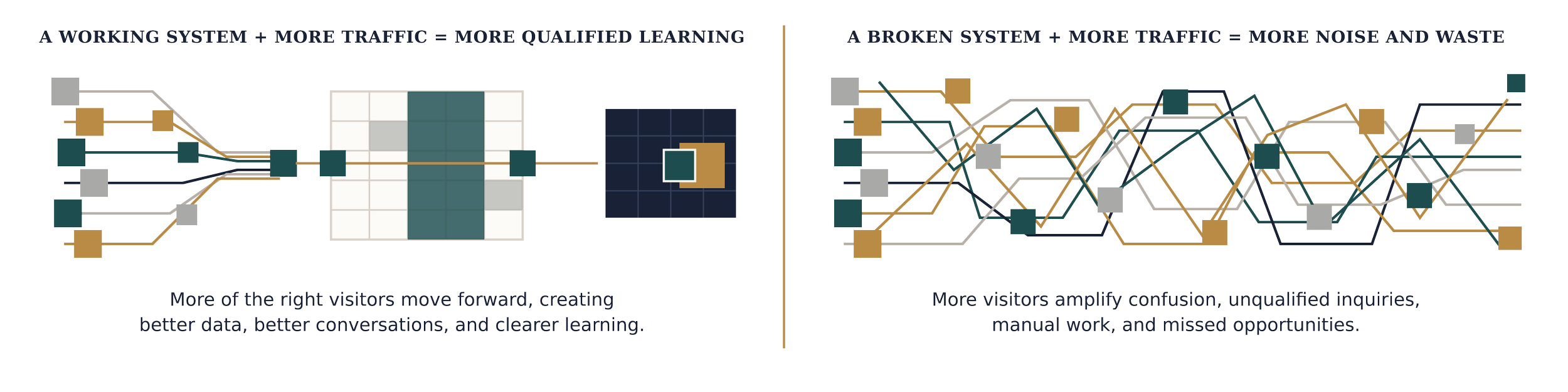
But traffic is not a correction. It is a multiplier.
It sends more people into whatever experience already exists.
If the website creates clarity, guides the right buyers, captures useful information, routes intent correctly, and supports reliable follow-up, more traffic can accelerate a working system.
If the website is unclear, disconnected, or operationally incomplete, more traffic accelerates waste.
Before spending more to increase attention, the business should understand what happens to the attention it already has.
Traffic amplifies the system it enters
A campaign can deliver the right audience to the right page.
It cannot guarantee that the page makes the offer understandable.
SEO can increase visibility for a valuable search term.
It cannot create a clear buyer path after the click.
Social content can generate interest.
It cannot ensure that the website continues the promise that earned the visit.
An event can produce a list of contacts.
It cannot decide how those contacts should enter the CRM, who owns the response, or what happens next.
Traffic acquisition and conversion infrastructure are different responsibilities.
Both matter. Their order matters too.
“Paying for attention before the website can create, capture, and continue qualified movement is not a traffic strategy. It is a more expensive way to discover the same broken path.” -Sarah Fuller
More visitors can make an unclear problem harder to diagnose
When traffic increases, activity increases.
Pageviews rise. Form submissions may rise. Sales receives more names. Marketing has more campaign data. The team becomes busier.
That can look like progress even when opportunity quality does not improve.
Several problems become easier to hide:
Poor-fit inquiries are counted as conversions.
High-intent buyers and general contacts enter the same process.
Source data is lost between the form and CRM.
Slow or inconsistent follow-up is mistaken for low campaign performance.
Sales rejects leads without recording why.
Website reporting stops at the form rather than following opportunity movement.
Leadership cannot distinguish a traffic problem from a positioning, conversion, or process problem.
More volume creates more noise around a system the company could not already see clearly.
That is why traffic readiness is not only about improving conversion rate.
It is about making the whole path observable enough to improve.
The website should answer six questions before you increase traffic
01
Will the right visitor recognize the fit quickly?
The landing experience should make it clear who the business is for, what condition creates the need, and what the company helps change.
If the message is broad, visitors must search for relevance. Many will not stay long enough to find it.
More traffic cannot compensate for weak recognition. It simply increases the number of people asked to translate the positioning themselves.
02
Can the visitor find a path that matches their intent?
A first-time visitor, a referred buyer, a returning evaluator, and an existing contact do not need the same information in the same order.
The site should help each person move toward the appropriate offer, proof, decision, or next step without turning the navigation into an inventory of internal departments.
Traffic readiness requires more than a homepage. It requires a coherent journey beyond the landing page.
03
Does the website build enough confidence to support action?
The visitor needs proof that matches the promise.
That may include a case study, documented decisions, relevant outcomes, a visible method, credible expertise, implementation clarity, or evidence that the company understands the problem at the right level.
If the campaign makes a strong promise and the website provides generic proof, the experience loses momentum.
04
Is the next step appropriate and clearly defined?
The call to action should match the buyer’s readiness and the seriousness of the engagement.
The website should explain what the next step is, who it is for, what happens after the request, and what the buyer should expect.
A high-consideration service rarely benefits from a vague “contact us” button or an aggressive booking request placed before the buyer understands the engagement.
05
Can the business use the information it captures?
The form should collect enough structured context to support qualification, routing, and follow-up.
The CRM should preserve source, campaign, page, offer interest, problem category, timing, and other information the business actually uses.
If every submission becomes a generic contact record, the company loses the context it paid to create.
06
Will the company respond consistently and learn what happened?
The buyer should receive a useful confirmation. The correct person should be notified. Ownership should be clear. A task or next step should exist. Response expectations should be defined.
The business should also be able to see whether the inquiry was qualified, whether it became an opportunity, why it moved or did not move, and whether the source produced revenue.
Without that feedback, the company can continue buying traffic while remaining unable to tell which investment created value.
A Useful Starting Point
Test the receiving system before increasing the volume.
A Growth Architecture Audit examines how traffic enters the website, how buyers understand and move, what the forms capture, how data enters the CRM, how follow-up is owned, and whether reporting connects attention to opportunity quality and revenue.
Requesting an Audit begins with a short fit call. The fit call confirms whether the paid Audit is appropriate; it is not a free diagnostic session. If the Audit is the right next step, I will confirm the goals, scope, timing, and payment before work begins.
The Traffic Readiness Standard
A website is ready for increased traffic when three layers are working together.
Layer 01:
Decision readiness
Decision readiness means the website can help the right visitor make progress.
The site should:
Continue the promise that brought the visitor in
Establish relevance quickly
Explain the problem and value clearly
Create a coherent offer path
Provide proof at the right decision points
Make the appropriate next step visible
Work clearly across desktop and mobile
This layer is not measured only by whether the visitor submits a form.
It is also reflected in whether qualified visitors continue, return, engage with proof, explore the right offer, and arrive at the conversion point with enough confidence to act.
Layer 02:
Operational readiness
Operational readiness means the business can receive and continue the movement the website creates.
The system should:
Capture useful structured information
Preserve source and campaign context
Create or update the correct CRM record
Route the inquiry to the appropriate pipeline, stage, and owner
Trigger a useful confirmation
Establish internal response expectations
Create the next task or action
Prevent high-intent requests from disappearing into a general inbox
This layer is where many website projects stop too early.
The form works technically, so the conversion path is considered complete. But the real business process begins after submission.
Layer 03:
Learning readiness
Learning readiness means the company can evaluate the quality and commercial meaning of the traffic.
The business should be able to see:
Which source and campaign produced the visit
Which page or path created action
Which inquiries were qualified
Which offers or problem categories attracted the best-fit buyers
Where opportunities stalled or progressed
Why leads were lost or disqualified
Which activity contributed to pipeline and revenue
What should change in the message, page, campaign, form, or follow-up
Traffic becomes an investment when the business can learn from it.
Without this layer, the company may optimize for clicks and form volume while remaining blind to revenue quality.
Readiness is not perfection
The website does not need to be flawless before the business promotes it.
Waiting for perfect copy, perfect tracking, perfect automation, and perfect data can become another form of delay.
Traffic readiness means the core system is coherent enough to produce useful movement and reliable learning.
At minimum:
The right audience can recognize the fit.
The offer and next step are understandable.
The site contains credible proof.
The conversion works on desktop and mobile.
The form captures the information required for the next decision.
The CRM retains source and intent.
A person owns follow-up.
The company records qualification and outcome.
The business can improve from there because it has something trustworthy to observe.
Diagnose the constraint before choosing the traffic channel
Different symptoms require different investments.
If the right people are not arriving
The business may need stronger distribution, search visibility, partnerships, content, events, paid media, or referral activation.
That is a traffic problem.
If the right people arrive but do not continue
The issue may be message relevance, landing-page continuity, page hierarchy, offer clarity, mobile experience, performance, or proof.
That is an experience problem.
If visitors act but the inquiries are poor fit
The issue may be positioning, audience targeting, self-selection, CTA design, form questions, campaign promise, or offer structure.
That is a qualification problem.
If good inquiries arrive but do not become opportunities
The issue may be routing, response time, sales context, ownership, follow-up, or the transition from marketing to sales.
That is an operational problem.
If opportunities exist but leadership cannot trace the source
The issue may be CRM structure, attribution, stage definitions, data discipline, reporting, or disconnected tools.
That is a visibility problem.
Calling all five situations a traffic problem leads the business to spend money in the wrong place.
Each traffic source needs continuity after the click
The website does not receive “traffic” as one uniform group.
It receives people carrying context from somewhere else.
01 Search visitors arrive with a question or intent.
02 Social visitors arrive from a specific idea, story, or point of view.
03 Event visitors arrive with a memory of the speaker, conversation, or experience.
04 Referral visitors arrive with borrowed trust.
05 Paid visitors arrive through a specific promise the business purchased the opportunity to make.
The landing experience should continue that context.
Sending every source to the same general homepage can force visitors to begin again. A relevant landing page, proof path, offer page, or campaign-specific transition preserves momentum and makes the source more measurable.
Traffic strategy should not end at the link.
Do not scale what the business cannot yet see
Founders often know the website is underperforming because the results feel inconsistent.
They do not know where the inconsistency begins.
Marketing reports traffic. The website reports forms. The CRM reports opportunities. Sales holds context in conversations. Revenue appears later. No single view connects the path.
Increasing traffic in that environment can create more activity without creating more knowledge.
Before scaling attention, the business should be able to answer:
Which sources bring the right buyers?
Which message or page helps them move?
Which action indicates meaningful intent?
What information reaches sales?
How quickly and consistently does the team respond?
Which inquiries become qualified opportunities?
Which opportunities become revenue?
What did the business learn that should change next?
If those answers are unavailable, the next investment may need to be in architecture before acquisition.
Spend more when the system can turn attention into intelligence
The goal is not to avoid traffic investment.
The goal is to make that investment more valuable.
When the website is decision-ready, operationally ready, and learning-ready, additional traffic does more than increase visits.
Attention becomes movement and intelligence.
It gives the right buyers a stronger path.
It creates better-qualified movement.
It gives sales useful context.
It helps leadership see which messages, sources, offers, and experiences create revenue.
And it gives the business evidence to improve the next campaign rather than guessing.
More traffic should create more than activity.
It should create movement the business can continue and intelligence the business can use.
START HERE
Make sure the system is ready to receive more.
The Growth Architecture Audit identifies whether the current constraint sits in traffic, website experience, qualification, CRM routing, follow-up, or revenue visibility and establishes what the business should address before increasing investment.

Sarah Fuller
Growth Architect
I help founder-led B2B companies connect brand, website, CRM, AI workflows, and revenue operations into a growth system the business can actually use. I diagnose the architecture, rebuild the disconnected parts, test how they work together, document the system, and establish clear ownership for what comes next.