What a CRM Should Actually Tell a Growing Business
A CRM should do more than store names and record activity. It should show what demand is entering the business, which opportunities fit, what is moving, what is stalled, who owns the next action, and where revenue is at risk.

THE SHORT VERSION
A CRM is valuable when it improves decisions, not when it merely contains more records.
__________
Leadership should be able to see demand, fit, intent, movement, ownership, risk, and forecast without asking someone to reconstruct the story manually.
__________
When fields, stages, definitions, follow-up, and reporting are disconnected, the CRM can look active while hiding the information the business actually needs.
Most growing businesses have a CRM.
They have contacts, companies, deals, stages, activities, notes, email sync, dashboards, and reports.
People enter information. Automations run. Opportunities move. Leadership receives a pipeline number.
And the business still cannot answer basic revenue questions with confidence.
Where is qualified demand coming from?
Which opportunities are real?
What is stalled?
What needs attention today?
Why are deals being lost?
Which services are creating the strongest pipeline?
What is likely to close—and what is merely sitting in a stage?
The problem is not always a lack of data.
It is often a lack of architecture around what the data is supposed to reveal.
A CRM should not function as a digital filing cabinet for sales activity.
It should help the business see revenue movement clearly enough to act.
Data stored is not the same as visibility created
A CRM can contain thousands of records and still produce very little usable understanding.
Names exist without meaningful segmentation. Deals have values without reliable timing. Activities are logged without a defined next action. Lead sources are inconsistent. Stages mean different things to different people. Notes contain important context that cannot be reported. Dashboards summarize data the team does not trust.
Technically, the information is in the system.
Operationally, it is unavailable.
Revenue visibility requires more than capture.
The business has to decide:
Which information matters
When it should be collected
Where it should live
Who owns it
What each field and stage means
What should happen automatically
Which exceptions require attention
How leadership will use the information to make decisions
Without those decisions, the CRM becomes a place where people document the past rather than manage what should happen next.
“The job of a CRM is not to prove that activity happened. It is to make the next revenue decision easier to see.” -Sarah Fuller
The CRM should reduce questions not create another layer of them
In an underbuilt revenue system, leadership meetings often become manual reporting sessions.
Someone exports a spreadsheet. Sales explains why the pipeline total is misleading. Marketing reconstructs source information. Opportunity owners search email threads for context. The founder asks which deals are actually likely to close. Everyone has a slightly different answer.
The CRM exists, but the business still depends on memory and interpretation.
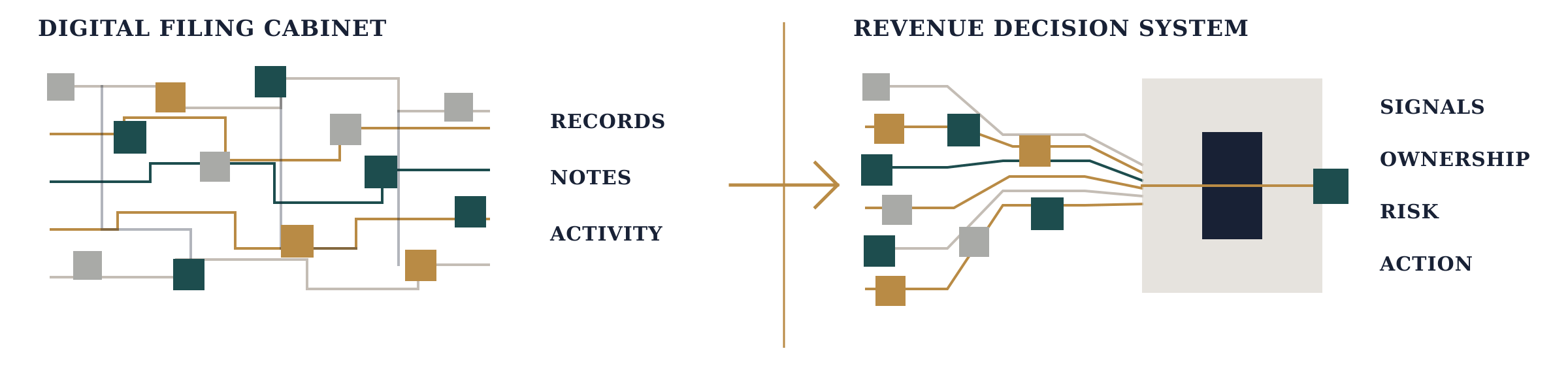
A strong CRM does not eliminate judgment.
It gives judgment a more reliable operating surface.
It separates known facts from assumptions. It makes missing information visible. It creates shared definitions. It shows where attention is required without forcing leaders to inspect every record individually.
The result is not merely cleaner data.
It is a business that can make revenue decisions with less delay and less translation.
The Seven Revenue Answers a CRM should provide
01
Demand: What is entering the business?
The CRM should show the sources, campaigns, referrals, events, website paths, partnerships, outbound activity, and existing relationships creating inquiries or opportunities.
It should distinguish raw lead volume from commercially meaningful demand.
Leadership should be able to see not only which sources generate names, but which sources generate fit, pipeline, and revenue.
02
Fit: Which opportunities belong in the pipeline?
Not every inquiry should become an active opportunity.
The CRM should capture the characteristics that define fit: company type, size, problem, use case, timing, investment readiness, geography, decision access, or other conditions relevant to the offer.
Qualification should not live only in a salesperson’s intuition.
The system should make it possible to see why an opportunity is considered a fit and why another was disqualified.
03
Intent: What does the buyer appear to need now?
Interest is not one category.
A buyer reading an article, requesting a case study, attending an event, asking about a specific offer, or submitting a detailed project inquiry is showing different intent.
The CRM should preserve the context that brought the buyer in: the problem, offer, page, action, or conversation that created movement.
Without intent, sales receives a name and has to restart the discovery process from zero.
04
Movement: What is progressing—and what is not?
Pipeline stages should represent meaningful buyer or business milestones, not vague levels of optimism.
The CRM should show how long opportunities remain in each stage, what evidence is required to move, which transitions are slowing, and where deals repeatedly stall.
Movement is more informative than activity.
A deal can contain many calls and emails without becoming more likely to close.
05
Ownership: Who is responsible for what happens next?
Every active opportunity should have a clear owner and a defined next action.
The system should make missing ownership, overdue follow-up, and undefined next steps visible.
Automation can assign, notify, and create tasks. It cannot resolve uncertainty about who is accountable for the relationship or decision.
Ownership turns information into action.
06
Risk: Where is revenue becoming less likely?
The CRM should help the team identify risk before the opportunity is lost.
Risk signals may include inactivity, missing decision-makers, unclear timing, repeated rescheduling, an aging proposal, an absent next step, a stage that has exceeded the expected duration, or a deal value unsupported by verified scope.
The goal is not to predict every outcome perfectly.
It is to make weakening opportunities visible early enough to respond.
07
Forecast: What is likely and what evidence supports it?
A forecast should be more than the total value of open deals multiplied by generic stage probabilities.
It should reflect reliable close dates, meaningful stages, verified next actions, buyer commitment, historical movement, and the actual conditions required to close.
Leadership should be able to distinguish committed, likely, possible, and speculative revenue without reopening every opportunity.
The forecast becomes trustworthy when the architecture beneath it is trustworthy.
A Useful Starting Point
Find out what the CRM can see and what it is hiding.
A Growth Architecture Audit examines the connection between lead capture, CRM fields, pipeline stages, qualification, automation, follow-up, sales ownership, reporting, AI workflows, and revenue visibility. It identifies what the system can answer now, where context is being lost, and what should be rebuilt first.
Requesting an Audit begins with a short fit call. The fit call confirms whether the paid Audit is appropriate; it is not a free diagnostic session. If the Audit is the right next step, I will confirm the goals, scope, timing, and payment before work begins.
A CRM can look busy while the revenue process remains unclear
Activity is easy to count.
Emails sent. Calls logged. Meetings held. Tasks completed. Deals created. Notes added.
Those numbers may describe effort without describing progress.
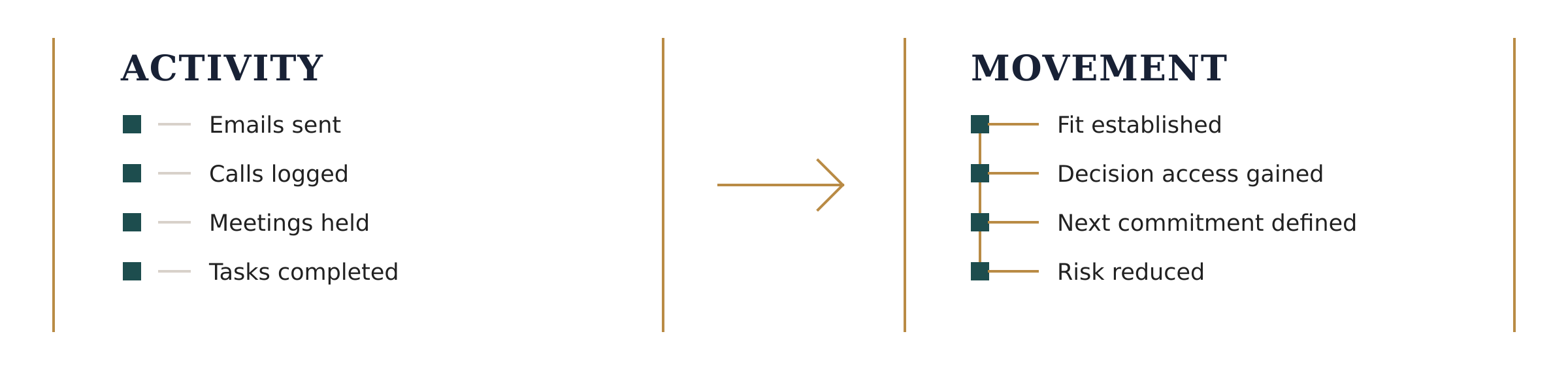
The business needs to know whether activity produced a meaningful change:
Did the buyer confirm the problem?
Was fit established?
Did the decision process become clearer?
Was access to the right stakeholder gained?
Did the opportunity move to a defined next commitment?
Did risk increase or decrease?
If the CRM rewards documentation without distinguishing movement, the team can appear highly active while pipeline quality remains weak.
The architecture beneath trustworthy CRM reporting
Reliable reporting begins before the dashboard.
Shared definitions
The team needs one meaning for lead, qualified lead, opportunity, stage, next action, closed-won, closed-lost, source, and revenue type.
If the definitions vary, the reports combine different realities into one number.
Useful fields
Fields should support qualification, routing, decisions, segmentation, automation, and reporting.
They should not exist simply because the platform makes them available.
Important context should be structured when the business needs to filter, trigger, compare, or report on it. Notes remain useful for nuance; they should not carry the entire revenue model.
Evidence-based stages
Each stage should reflect something that has actually changed in the buying process.
Stages should have clear entry criteria, exit criteria, expected actions, and aging expectations. “Interested,” “warm,” and “promising” may describe a feeling without creating operational consistency.
Defined ownership
Every record, handoff, exception, and follow-up path needs an owner.
Shared responsibility often becomes invisible responsibility.
Purposeful automation
Automation should reduce repetitive work, preserve standards, and surface exceptions.
It should not move deals forward without evidence, create tasks no one uses, or send communication disconnected from the buyer’s actual situation.
Decision-focused dashboards
A useful dashboard helps a specific person make a specific decision.
Leadership, sales, marketing, operations, and account management may need different views. A single crowded dashboard rarely serves all of them well.
The pipeline should describe reality not aspiration
Growing companies often hesitate to close stale opportunities.
The relationship still feels possible. The prospect may return. The team has already invested time. Removing the deal makes the pipeline smaller.
So the opportunity remains open.
The pipeline begins to represent hope rather than current buying motion.
That weakens several decisions at once:
The forecast appears stronger than it is.
Follow-up priorities become less clear.
Conversion rates lose meaning.
Stage aging becomes unreliable.
Leadership misreads future capacity or cash flow.
Marketing cannot see which sources create genuine opportunity.
Closing an opportunity as lost does not erase the relationship.
It creates an honest record of the current revenue process. The contact can remain in an appropriate nurture, reactivation, or future-opportunity path without distorting the active pipeline.
Lost revenue should produce usable intelligence
“Not interested,” “went another direction,” and “no response” are rarely enough.
The CRM should help the business distinguish among conditions such as:
Poor fit
No priority or urgency
No budget or investment alignment
Wrong timing
Missing decision access
Competitor selected
Internal solution chosen
Scope or offer mismatch
Trust or proof gap
Follow-up failure
No decision
The purpose is not to create an exhaustive list of reasons.
It is to identify patterns the business can act on.
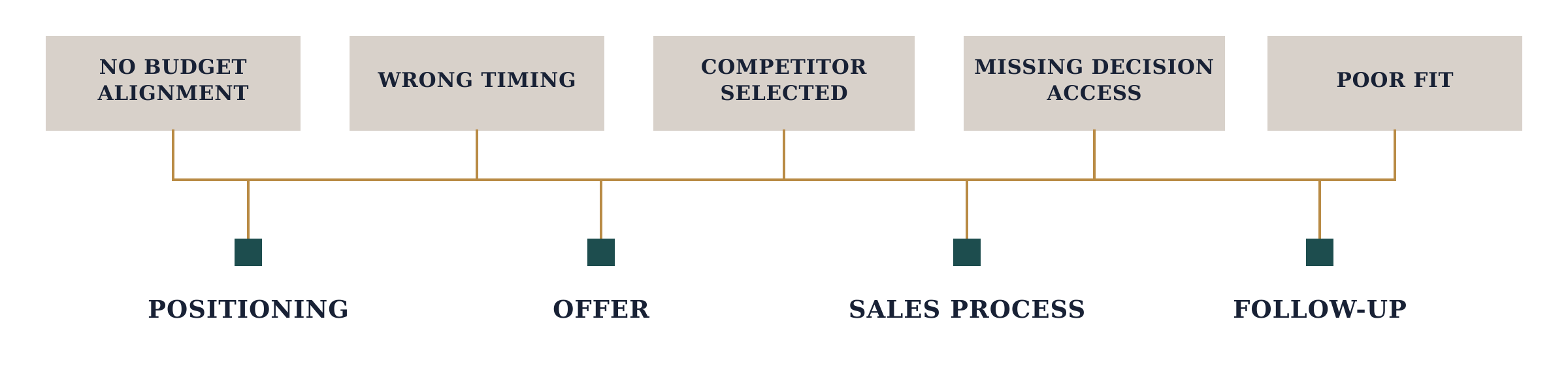
If the company repeatedly loses because buyers do not understand the difference, that is a positioning issue.
If good-fit opportunities stall after proposals, that may be a proof, process, or decision issue.
If event leads disappear before qualification, the capture and follow-up architecture may be broken.
Lost data becomes valuable when it changes what the business does next.
Marketing and sales should see the same revenue story
Marketing may report traffic, campaign response, content engagement, downloads, and form submissions.
Sales may report conversations, pipeline, proposals, and closed revenue.
When the CRM does not connect those stages, each team can be correct within its own view while leadership remains unable to see the full path.
The system should connect:
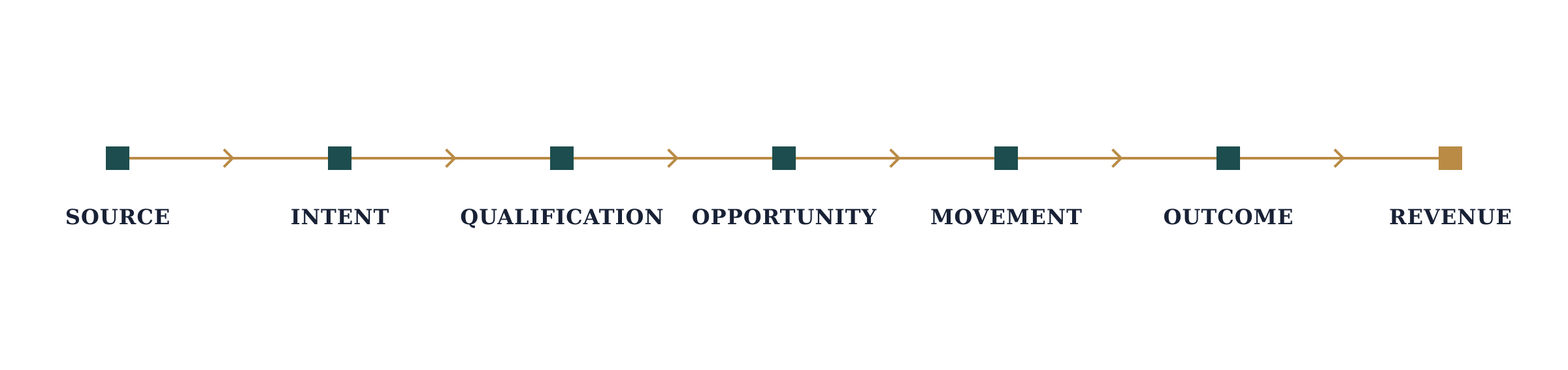
That connection allows the business to ask better questions.
Which sources create the highest-fit opportunities?
Which messages attract interest but not readiness?
Which offers move most efficiently?
Where does context disappear during the handoff?
Which losses should change marketing, sales, the offer, or the operating process?
Revenue architecture turns attribution from a marketing report into a business learning system.
AI makes CRM architecture more important not less
AI can summarize records, draft follow-up, score patterns, identify missing information, recommend next actions, and surface risk.
Those capabilities can be useful.
They are only as reliable as the definitions, data, context, and decision rules beneath them.
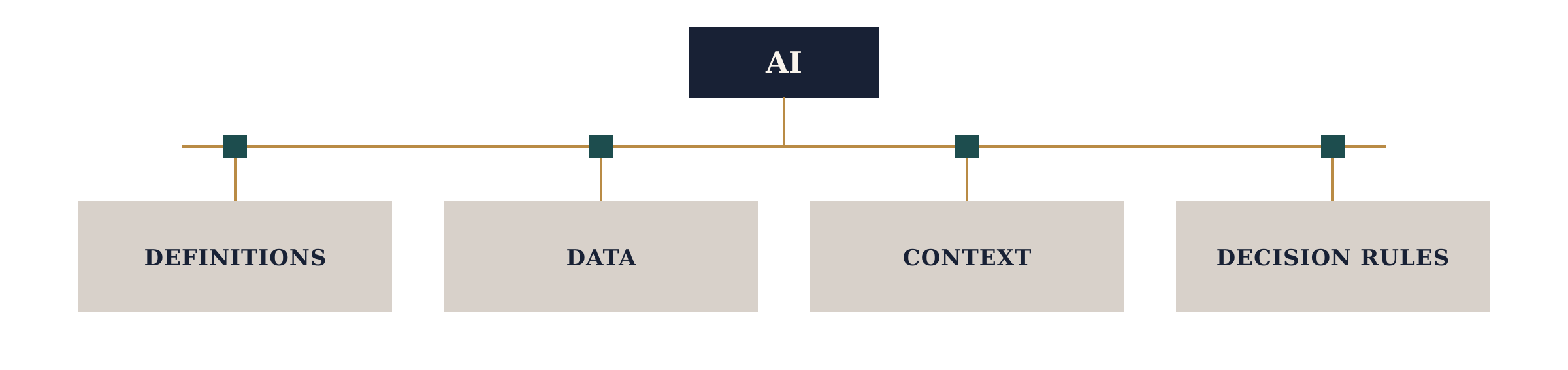
If stages are inconsistent, sources are missing, notes contradict fields, and lost reasons are vague, AI can make weak data feel more authoritative without making it more true.
Before the business automates more decisions, it should make sure the CRM represents the revenue process accurately.
What leadership should be able to see without asking for a spreadsheet
A growing business should be able to open its revenue system and understand:
What qualified demand entered the business
Where it came from
What buyers appear to need
Which opportunities fit
Where each opportunity is in the decision process
What has moved recently
What has stalled
What needs attention now
Who owns the next action
Where revenue is at risk
Why opportunities are being lost
What is likely to close
Which sources, offers, and paths create the strongest revenue
Not every answer belongs on one dashboard.
But the architecture should make every answer available without requiring the business to rebuild the truth by hand.
The best CRM is the one the business can use to decide
Platform choice matters.
The system has to fit the complexity, team, integrations, budget, and future needs of the business. Pipedrive, HubSpot, Salesforce, and other platforms create different capabilities and tradeoffs.
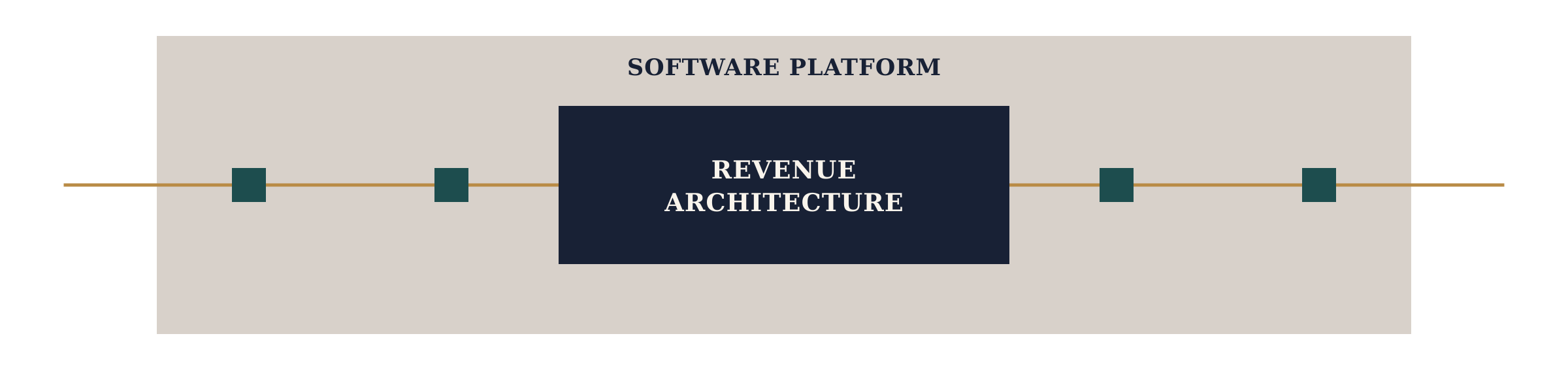
But software cannot replace revenue architecture.
A powerful platform with unclear stages, inconsistent ownership, weak fields, and untrusted reporting will remain difficult to use.
A well-structured system makes the business easier to operate because it gives people a shared view of what is happening and what should happen next.
That is the standard.
Not more data.
Better decisions.
Turn the CRM into a revenue decision system.
The Growth Architecture Audit identifies where lead capture, pipeline architecture, qualification, automation, follow-up, ownership, and reporting are disconnected and what the business should address first.

Sarah Fuller
Growth Architect
I help founder-led B2B companies connect brand, website, CRM, AI workflows, and revenue operations into a growth system the business can actually use. I diagnose the architecture, rebuild the disconnected parts, test how they work together, document the system, and establish clear ownership for what comes next.