Why Your CRM Is Full of Data but Still Gives You No Visibility
Contacts, deals, notes, activities, and dashboards do not automatically create clarity. If the data is inconsistently defined, poorly structured, disconnected, stale, unowned, or reported without context, the CRM can be full while leadership is still operating in the dark.

THE SHORT VERSION
The presence of CRM data does not guarantee that the business can use it to make decisions.
__________
Visibility fails when definitions vary, important context is buried, records are disconnected, pipeline data is stale, ownership is unclear, or reports answer the wrong questions.
__________
Reliable CRM visibility requires a complete chain: the data must be defined, structured, connected, current, owned, and interpreted.
The CRM is full. Leadership is still asking for a spreadsheet.
There are thousands of contacts. Years of activity. Open deals. Saved reports. Custom fields. Email history. Notes from conversations no one fully remembers.
Yet the important questions still trigger a manual investigation.
Which opportunities are genuinely active?
Where did the best-fit demand come from?
What is likely to close this quarter?
Which deals are stalled?
Who owns the next action?
Why did qualified opportunities disappear?
Someone exports the data. Someone messages the sales team. Someone checks a separate spreadsheet. The founder supplies context that never made it into the system. The numbers are adjusted until they feel closer to reality.
The business has data.
It does not have visibility.
More data can create false confidence
A nearly empty CRM makes the problem obvious.
A busy CRM can hide it.
The volume of records, fields, activities, and reports creates the appearance of operational maturity. Because so much information exists, leadership reasonably assumes the answers must be in there somewhere.
Sometimes they are.
But they may be distributed across free-text notes, outdated fields, duplicated contacts, private inboxes, unconnected companies, inconsistent stages, and dashboards built on assumptions no one has reviewed.
The information exists in fragments.
The decision does not.
This is the difference between data presence and decision visibility.
Data presence means the system has recorded something.
Decision visibility means the right person can understand what is true, why it matters, and what should happen next without reconstructing the story manually.
“A CRM does not create visibility because the data exists. It creates visibility when the data is defined, structured, connected, current, owned, and interpreted.” -Sarah Fuller
The dashboard is not the source of truth
When reporting feels unreliable, the dashboard is often blamed first.
The team adds a filter. Changes the chart. Builds another view. Buys a reporting tool. Creates a leadership spreadsheet beside the CRM.
But a dashboard can only summarize the operating choices underneath it.
If two people use the same field differently, the chart will combine different meanings.
If important context lives only in notes, the report cannot count it.
If deals remain open after momentum has ended, pipeline value will be inflated.
If lead source is overwritten or lost between systems, attribution will be incomplete.
If no one owns record quality, every report begins with an argument about whether the data can be trusted.
The dashboard is the last layer.
Visibility is won or lost much earlier.
Six reasons a full CRM still produces no visibility
01
The business has labels without shared definitions
Fields and stages may look standardized while carrying different meanings across the team.
One person marks a contact as qualified after an introductory call. Another waits until budget and timing are confirmed. One salesperson moves a deal when a proposal is sent. Another moves it when the buyer agrees to a decision process.
The records use the same labels.
They do not describe the same reality.
Reporting cannot resolve a definition the business has never agreed on.
02
The most valuable context is buried in places that cannot be reported
The buyer's actual problem is in a call note. Buying authority is mentioned in an email. The reason a deal stalled is known by the founder. The service line is implied by the proposal. The next action exists in someone's calendar.
Humans can read those fragments and understand the story.
The CRM cannot reliably classify, compare, route, or report them.
Free text is valuable for nuance. It is weak infrastructure for information the business needs to use consistently.
03
The records exist, but the relationships between them do not
A person may be present without a connected company. An opportunity may be disconnected from its original inquiry. An activity may be logged against a contact but not the active deal. A referral source may be stored as a note rather than a related record.
The system contains the pieces but cannot trace the path.
This makes it difficult to connect demand to qualification, opportunity to offer, sales activity to movement, and closed revenue back to its origin.
04
The data describes the past, not the current state
A deal was active three months ago. A close date was entered once. A contact changed roles. An owner left the company. A follow-up task was completed without a new one being created.
Nothing in the CRM is technically missing.
It is simply no longer true.
Stale data is particularly dangerous because it looks more authoritative than a blank field. Leadership may forecast against it, sales may prioritize around it, and automation may act on it.
05
Data quality is everyone's responsibility and no one's job
The CRM was implemented. Training happened. Fields were added. Then the business kept changing.
New offers appeared. Teams evolved. Sources multiplied. Workarounds became habits. No one was given clear authority to protect definitions, resolve exceptions, retire obsolete fields, or challenge records that no longer reflected reality.
Without ownership, data quality becomes a periodic cleanup project rather than an operating discipline.
06
The reports show activity instead of supporting decisions
Many dashboards show what is easy to count.
Emails sent. Calls logged. Deals created. Pipeline value. Tasks completed.
Those metrics may describe effort. They do not automatically explain performance.
Leadership needs to know what is changing, where movement is weakening, what is exposed, and which decision requires attention.
A report can be technically accurate and still operationally useless.
A Useful Starting Point
Diagnose the visibility break before adding another dashboard.
A Growth Architecture Audit examines how CRM definitions, fields, stages, record relationships, ownership, automation, integrations, and reporting work together. It identifies where context is being lost, where data has become unreliable, and which architecture decisions will restore useful revenue visibility.
Requesting an Audit begins with a short fit call. The fit call confirms whether the paid Audit is appropriate; it is not a free diagnostic session. If the Audit is the right next step, I will confirm the goals, scope, timing, and payment before work begins.
The Visibility Chain
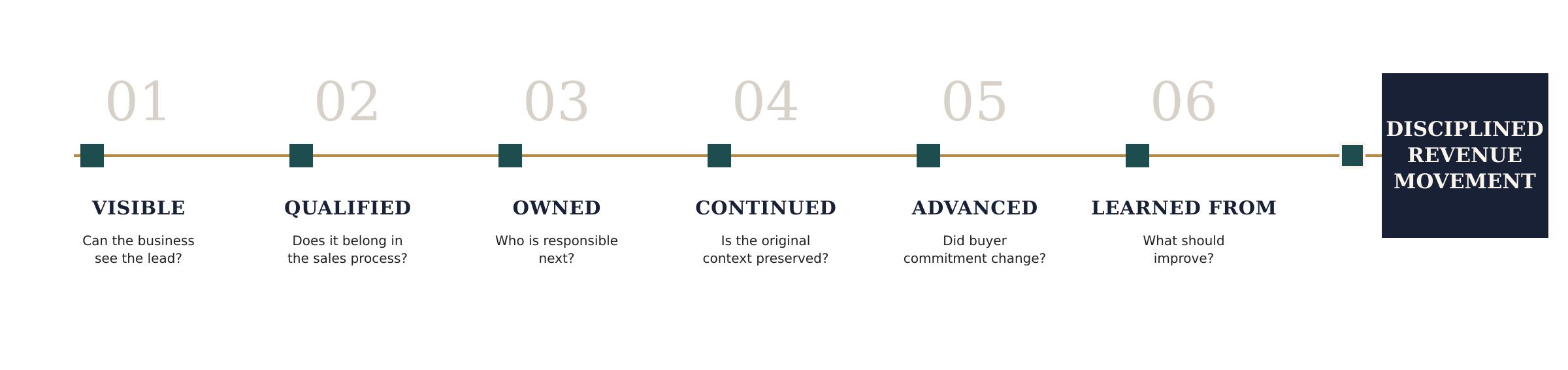
Reliable reporting is the result of six connected conditions.
If any one condition breaks, the weakness travels into every view, forecast, automation, and leadership decision that follows.
01 Defined
The business agrees on what important fields, statuses, and stages mean.
Definitions should be specific enough that two capable people looking at the same situation would usually make the same classification.
“Qualified” needs criteria.
“Active” needs a time boundary or required next action.
“Proposal” needs evidence of buyer engagement, not merely proof that a document was sent.
The goal is not to eliminate judgment.
It is to prevent the same word from representing several different realities.
02 Structured
Information the business needs to filter, route, automate, compare, or report should live in a deliberate field or relationship.
That does not mean turning every detail into a dropdown.
It means separating reportable operating data from useful narrative context.
A discovery note can preserve nuance. Structured fields can still capture the primary problem, relevant offer, timing, decision role, fit status, next step, and loss reason.
Good structure reduces interpretation without making the CRM burdensome to use.
03 Connected
The system preserves the commercial path.
The original source connects to the person. The person connects to the company. The company connects to the opportunity. The opportunity connects to the offer, activities, outcome, and revenue.
Connected data allows the business to follow cause and effect.
Without those relationships, every report sees an isolated event instead of a revenue journey.
04 Current
The record reflects what is true now.
Active opportunities have a future next action. Close dates change when the decision process changes. Stalled deals are surfaced. Former owners are reassigned. Closed-lost opportunities are actually closed.
Currency should not depend entirely on someone remembering to clean the system.
Useful architecture combines clear operating expectations with reminders, exception views, automation, and review rhythms.
05 Owned
Someone is accountable for the next action, the record, and the health of the system.
Those are related but different forms of ownership.
A salesperson may own the opportunity. A revenue operations lead may own stage governance. Marketing may own source definitions. Leadership may own the decisions that reports are built to support.
Visibility deteriorates when accountability is implied rather than named.
06 Interpreted
The CRM turns the underlying data into a view designed for a decision.
Leadership, sales, marketing, and operations do not need the same report.
Leadership needs exposure, movement, confidence, and emerging constraints.
Sales needs priorities, overdue actions, stalled opportunities, and the context required to advance them.
Marketing needs source quality, fit, progression, and revenue outcomes, not only lead counts.
Operations needs exceptions, adoption, process failure, and data-quality risk.
Interpretation is what converts a correct record into a useful next move.
Visibility is a chain, not a cleanup checklist
These six conditions are sequential.
If the definition is unclear, the structured field will be used inconsistently.
If the field is correct but the record relationships are broken, the business cannot trace the outcome.
If everything is connected but stale, the report describes an earlier reality.
If no one owns the system, the quality will decline again.
If the data is sound but the report is not tied to a decision, the business still has information without direction.
This is why isolated CRM improvements often disappoint.
A new dashboard cannot compensate for six layers of weak architecture beneath it.
Data migration is not the same as creating a clean system
Moving to a new CRM can feel like a chance to start again.
It can also move years of ambiguity into a cleaner interface.
A migration should not begin with “How do we copy everything?”
It should begin with:
What information still has operating value?
Which records should be merged, archived, or excluded?
Which definitions need to change before fields are mapped?
Which history must remain accessible?
Which relationships must be preserved?
Which gaps should remain explicitly unknown rather than guessed?
What will be validated before the new system becomes authoritative?
The aim is not perfect historical data.
The aim is a trustworthy system for the decisions the business needs to make next.
Moving bad data faster does not repair it.
Empty, wrong, and unknown are not the same condition
CRM cleanup often focuses on completion rates.
How many records have a value in this field?
But a completed field can be more dangerous than an empty one if the value is wrong, outdated, or based on an assumption.
The system should distinguish:
Empty
No value has been entered. The gap is visible and may be resolved.
Wrong
A value exists but does not reflect reality. The record creates false confidence.
Unknown
The business does not currently know the answer. That uncertainty is legitimate and should not be hidden by a convenient default.
Strong architecture makes uncertainty visible.
It does not manufacture certainty to improve field-completion statistics.
Data quality must be designed into the work
Teams rarely maintain a CRM because they were told to care more about data.
They maintain it when the system supports the work they already need to do.
The required fields appear at the right moment. The stage change matches a real commercial event. The next action helps the owner manage the relationship. The exception report makes a risk visible. The leadership review uses the same definitions the team is expected to follow.
Data quality weakens when entry feels like administration performed for someone else's dashboard.
It strengthens when the data gives the person entering it a clearer next move.
This requires restraint.
More mandatory fields do not automatically create better data. They can create placeholders, shortcuts, and resistance.
Ask for the minimum information necessary at each point in the process, then make the resulting value visible to the people doing the work.
Every report should have a decision owner
Before building a dashboard, ask:
Who will use this?
What decision are they responsible for?
What would change based on what they see?
How current must the information be?
What definition sits behind each number?
What exception should become impossible to miss?
A leadership report may need to show revenue concentration, stage confidence, forecast exposure, aging, and changes in qualified pipeline.
A sales operating view may need to show overdue actions, opportunities without future activity, time in stage, missing decision access, and deals requiring support.
A marketing view may need to compare source, buyer fit, qualification, progression, and revenue without treating all captured names as equivalent.
One universal dashboard usually produces a shallow compromise.
Shared data can support several decision-specific views.
AI will amplify the architecture you already have
AI can summarize notes, classify conversations, recommend follow-up, identify patterns, and make CRM information easier to retrieve.
It does not remove the need for operating definitions and trustworthy connections.
If the underlying stages are inconsistent, an AI summary will describe inconsistent stages more efficiently.
If relationships are missing, the model will have an incomplete commercial history.
If the pipeline is stale, an AI forecast may sound confident while relying on old assumptions.
AI can reduce administrative friction and surface useful signals.
But it needs governed data, clear business logic, and human accountability.
The better the architecture, the more useful the intelligence becomes.
Leadership should not have to reconstruct the business every week
Some manual interpretation will always be valuable.
Important deals require judgment. Context changes. Numbers deserve discussion.
But leadership should not need a recurring investigation to establish the basic state of revenue.
The CRM should make it possible to see:
Which demand is relevant
Which opportunities are real
What has changed
What is stalled or exposed
Who owns the next action
Where the system is losing context
What the business needs to decide now
That is visibility.
Not a database with more rows.
Not a dashboard with more charts.
A connected operating picture the business can trust enough to act on.
Turn stored data into revenue visibility.
The Growth Architecture Audit identifies where definitions, fields, relationships, ownership, automation, migration decisions, and reporting are preventing the CRM from becoming a reliable decision system. It then establishes what the business should rebuild first.

Sarah Fuller
Growth Architect
I help founder-led B2B companies connect brand, website, CRM, AI workflows, and revenue operations into a growth system the business can actually use. I diagnose the architecture, rebuild the disconnected parts, test how they work together, document the system, and establish clear ownership for what comes next.