Before You Automate a Process, Decide Whether It Should Exist
Automation can make a process faster without making it necessary. Before the business invests in tools, integrations, or AI, it should decide whether the work creates value, satisfies a real obligation, or merely preserves an old workaround.

THE SHORT VERSION
Automation improves the execution of a process. It does not prove that the process deserves to exist.
__________
Many workflows survive because of old systems, duplicate reporting, unclear ownership, historical approvals, or workarounds no one has questioned.
__________
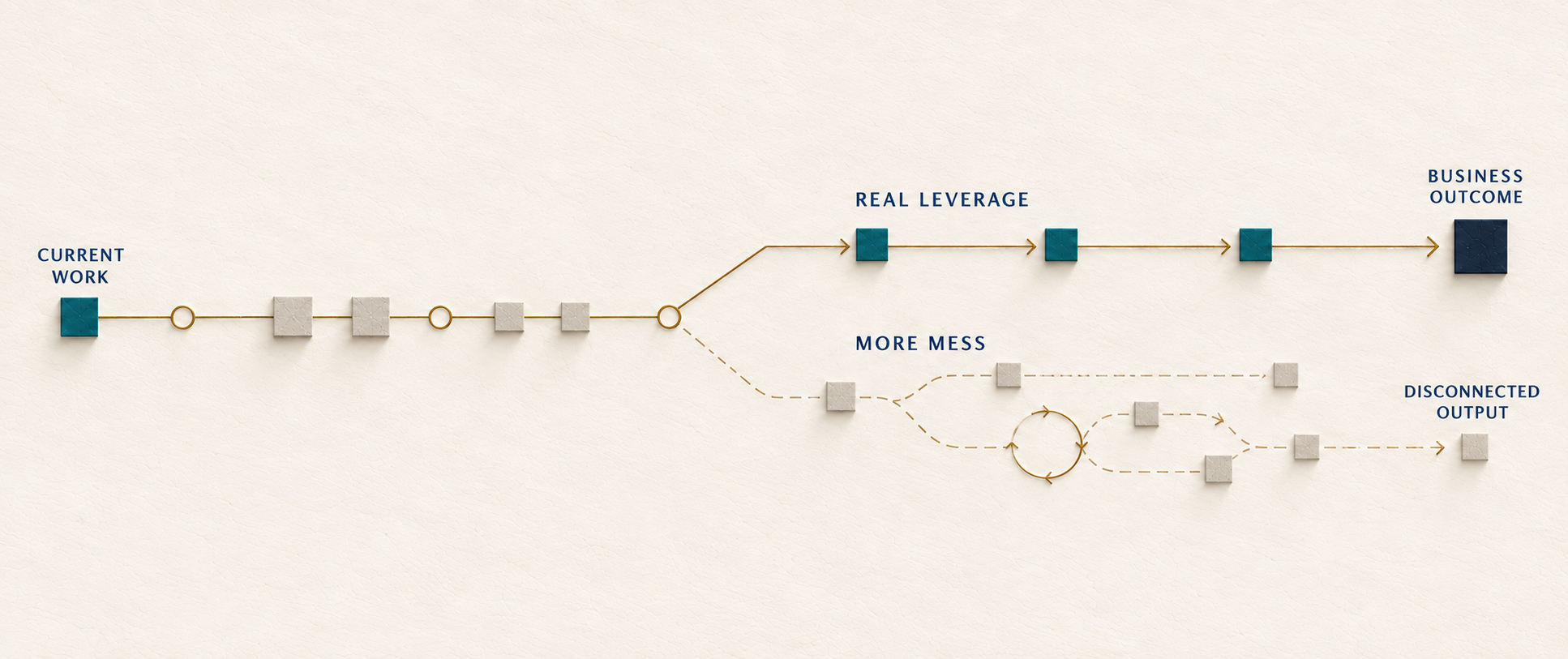
The right sequence is to test the process, then retire it, reduce it, redesign it, or automate only the useful work that remains.
The business wants to automate a process. No one has asked why the process exists.
It may have started years ago because two systems could not share information. A leader may have requested a report that is no longer used. An approval may have been added after one unusual mistake. A spreadsheet may have become permanent because it once solved a temporary problem.
Now the process takes too long.
The team wants AI, an integration, or an automated workflow to make it faster.
But speed is not the first question.
The first question is whether the business should keep doing the work at all.
Automation turns a process into infrastructure
Manual work has friction.
That friction can be expensive, but it also makes the work visible. Someone feels the repetition. Someone notices the duplicated entry. Someone asks why three approvals are required.
Automation removes some of that friction.
It can also remove the moment when anyone stops to question the process.
Once the workflow runs quietly in the background, the business may continue collecting information no one uses, producing reports no one reads, creating records no one owns, and moving work through approvals that no longer protect anything important.
The unnecessary process becomes reliable.
Then it becomes infrastructure.

“Automation should be the reward for a process that has earned the right to remain. It should not be the reason an unnecessary process survives” -Sarah Fuller
A faster process can still be the wrong process
The usual automation case sounds persuasive.
The team spends six hours a week on the task. The new workflow could reduce that to thirty minutes. The annual time savings appear significant.
But the calculation assumes the task must continue.
What if the report can be removed?
What if the information already exists in another system?
What if the approval can be replaced with a clear operating rule?
What if the process is compensating for an upstream failure?
What if no decision changes after the work is completed?
Reducing six hours to thirty minutes is useful.
Eliminating the unnecessary thirty minutes is better.

Six reasons unnecessary processes survive
01
The original reason disappeared, but the process remained
A workflow may have been created for a former client requirement, an old organizational structure, a previous software limitation, or a leader who has since left.
The context changed.
The process did not.
Because the task is familiar, the business treats repetition as proof of necessity.
02
The process creates evidence of activity
Reports, trackers, status updates, and approval chains can make work feel controlled.
But documentation is only valuable when someone uses it to decide, act, protect, or learn.
Producing evidence that work happened is not the same as improving the outcome.
03
It compensates for a broken system upstream
A team manually cleans information because the original capture is inconsistent. Someone re-enters data because systems are disconnected. Leadership requests a spreadsheet because the CRM report cannot be trusted.
Automating the workaround may reduce labor while preserving the underlying failure.
04
Ownership is unclear, so more checkpoints were added
When no one is confidently accountable for the result, the business often adds reviews, handoffs, and approvals.
More people touch the work.
No one fully owns it.
The process grows because responsibility remains undefined.
05
The cost is distributed and therefore difficult to see
Ten minutes here. Fifteen minutes there. A weekly export. A copied update. A manager's approval. A founder's clarification.
No single step appears expensive.
Across the organization, the process consumes meaningful capacity and attention.
06
Removing work feels riskier than adding technology
Automation sounds like improvement.
Elimination requires a decision.
Someone has to confirm that the report, field, approval, meeting, or handoff is no longer necessary. When the purpose is unclear, the business may preserve the work simply because removing it feels harder to defend.
A Useful Starting Point
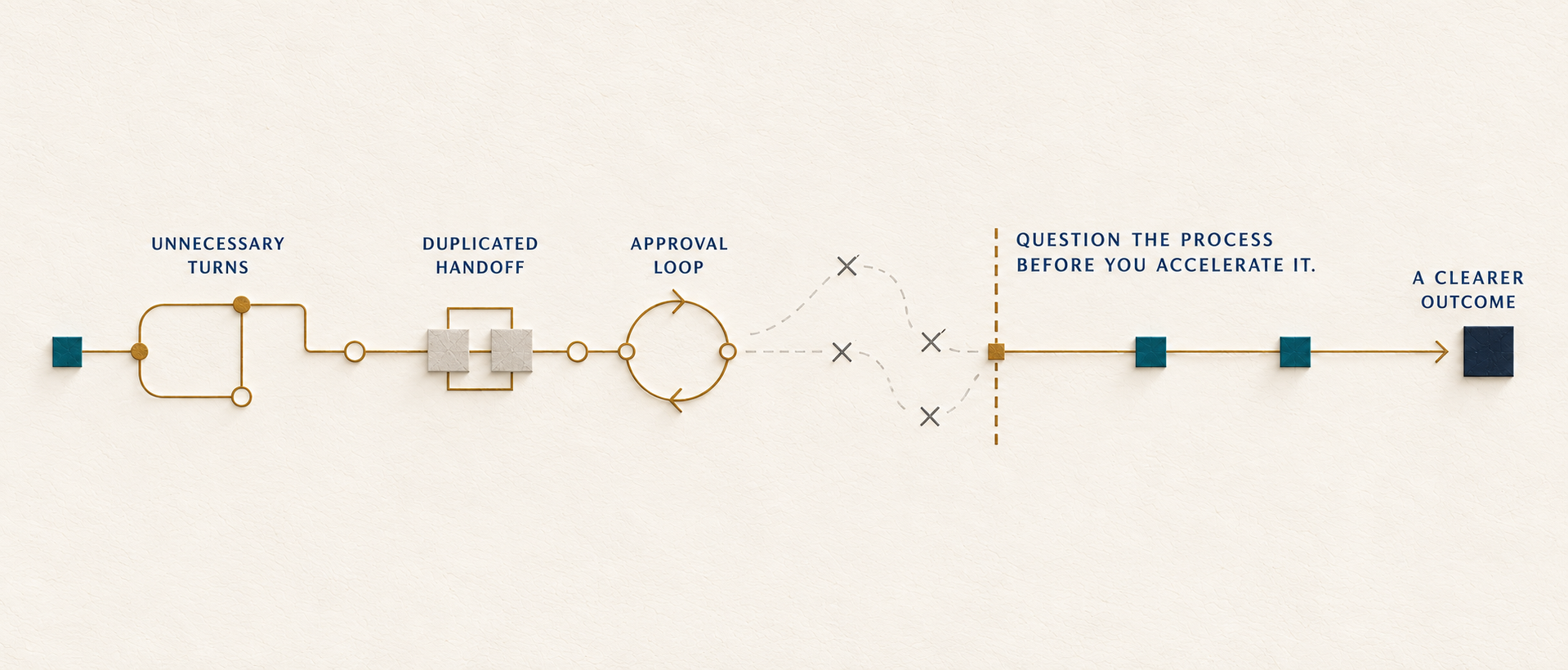
Remove the unnecessary work before you automate what remains.
A Growth Architecture Audit examines how information, approvals, handoffs, tools, CRM, AI, and human judgment move through the business. It identifies which work creates value, which steps compensate for disconnected systems, which controls are still necessary, and where automation can create leverage without preserving avoidable complexity.
Requesting an Audit begins with a short fit call. The fit call confirms whether the paid Audit is appropriate; it is not a free diagnostic session. If the Audit is the right next step, I will confirm the goals, scope, timing, and payment before work begins.
The Process Value Test
Before designing an automation, test whether the process has earned the right to remain.

01
What outcome does the process create?
Name the result in business terms.
Does the process help the business make a decision, continue a customer relationship, protect quality, satisfy a real obligation, reduce risk, create revenue, or improve delivery?
“Complete the weekly tracker” is an activity.
“Show leadership which client commitments are at risk” is an outcome.
If the outcome cannot be named, the process should not move directly into automation.
02
Who uses the outcome, and what do they do differently?
A report has no value simply because it is delivered.
Who reads it? What decision does it change? What action follows? What risk does it prevent?
If no one can identify the user and the resulting action, the work may be producing information without creating value.
03
Is the process solving the need or compensating for another failure?
Look upstream.
Does the process exist because information is captured incorrectly, systems do not connect, ownership is unclear, a field is not trusted, or the formal workflow does not reflect how the team actually works?
Fixing the source may remove the need for the downstream process entirely.
04
What is the minimum responsible version?
If the outcome and obligation are real, determine the least complex way to satisfy them.
Can the business collect less information?
Remove an approval?
Combine two steps?
Replace a meeting with an exception view?
Allow one system to remain authoritative?
The goal is not the minimum possible process.
It is the minimum responsible process: enough structure to create the outcome, protect the business, and preserve necessary judgment without carrying avoidable work.
05
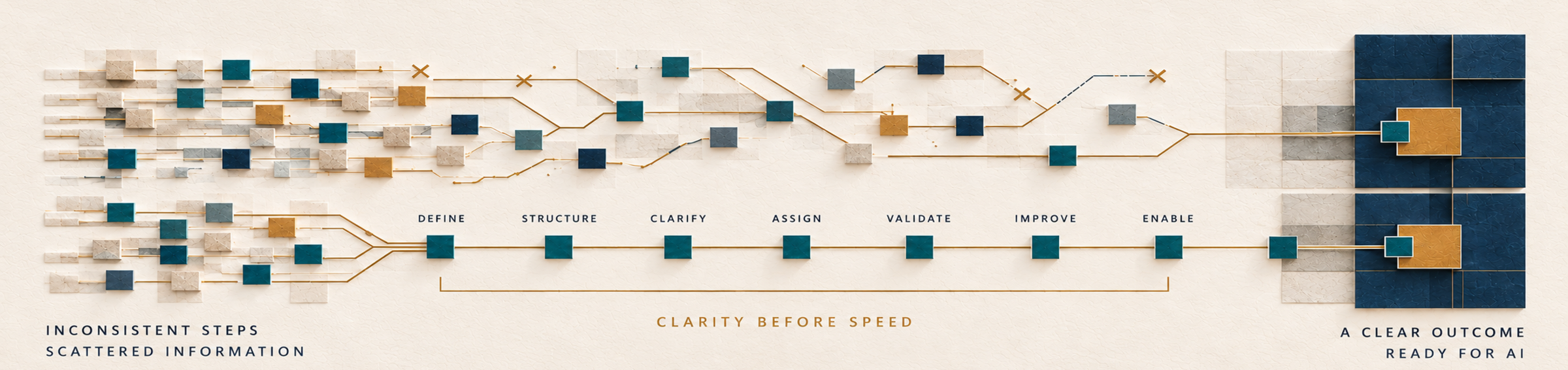
Is the remaining process clear enough to own and improve?
The workflow should have a defined trigger, required inputs, sequence, decision points, owner, exception path, and measure of success.
If it cannot be explained, it is not ready to be automated.
Clarity is what makes the remaining process controllable after the technology begins doing part of the work.
The decision path: Retire, Reduce, Redesign, Automate
Not every process should reach automation.

Retire
Remove the process when the original need no longer exists, the output is unused, or the work creates no meaningful obligation or outcome.
The best automation may be deletion.
Reduce
Keep the purpose, but remove unnecessary information, repetition, approvals, meetings, handoffs, or reporting.
Less process creates less to maintain.
Redesign
Rebuild the workflow when the outcome matters but the current path is fragmented, duplicative, unclear, or dependent on workarounds.
Fix the architecture before adding speed.
Automate
Automate the stable, repeatable parts of a process that now has a clear purpose, reliable inputs, defined ownership, visible exceptions, and a useful outcome.
Automation comes last because it multiplies the decisions made in the first three stages.
Do not automate handoffs created by disconnected systems
Many workflow requests begin with the same condition.
Information has to move from one system into another.
The team copies a form response into the CRM. A spreadsheet is updated from the project platform. Someone converts a sales conversation into a delivery brief. A report combines numbers from several tools.
An integration can reduce manual transfer.
But the business should still ask why the handoff exists.
Are both systems necessary?
Which one owns the information?
Does the same field need to exist in both places?
Is the second record used for a distinct purpose?
Should the downstream team access the original context instead?
The goal is not to connect every tool to every other tool.
It is to create the shortest reliable path from information to action.
Approval is not the same as control
Approvals are often added to reduce risk.
Sometimes they are necessary.
High-cost decisions, contractual commitments, regulated work, sensitive communications, and meaningful exceptions may require explicit authority.
But many approvals do not create control.
They create delay, diffuse accountability, and encourage reviewers to click through work they assume someone else has already checked.
Before automating an approval, ask:
What specific risk is this approval designed to control?
Does the approver have the context and authority to evaluate it?
What evidence should they review?
Could a defined rule approve the standard case and surface only the exception?
Who remains accountable after approval?
A fast approval chain can still be governance theater.
Automation has an operating cost
Automated work is not free after launch.
Triggers change. Fields change. People change roles. Tools update. Exceptions appear. Prompts drift. Integrations fail. The business evolves beyond the assumptions built into the original logic.
Every automation creates something the organization must own.
That ownership includes:
Monitoring whether the workflow ran
Reviewing the quality of the outcome
Resolving exceptions
Updating rules and source information
Managing access and risk
Documenting changes
Knowing when to stop or replace the workflow
The value of the automation should exceed both the manual work it removes and the operating burden it creates.
This is another reason to simplify first.
The business should not maintain technology for work it never needed.

Measure work removed, not only time saved
Automation cases often calculate hours saved.
That is useful, but incomplete.
A stronger review asks:
Which steps disappeared?
Which duplicate records were eliminated?
Which decisions became clearer?
Which exceptions became visible?
Which handoffs stopped losing context?
Which approval delays were removed?
Which errors no longer enter the system?
Which human capacity moved into higher-value work?
Time savings can occur while complexity remains intact.
Removed work is evidence that the operating system became simpler.

Preserve the exception instead of designing around every possibility
Some workflows become complicated because the business tries to account for every unusual situation inside the standard path.
The result is a process with too many branches, fields, rules, and approvals for everyday use.
A better design may create one clear standard path and one visible exception route.
The standard path handles the repeatable work.
The exception route sends uncertainty to a named owner with the context required to decide.
This keeps the workflow usable without pretending that judgment can be eliminated.

AI may help identify or summarize the exception.
It should not hide it inside increasingly complex automation logic.
The cleanest workflow often has fewer steps and stronger ownership
Growing businesses do not usually suffer from a shortage of activity.
They suffer from too many disconnected actions, unclear decisions, duplicate records, informal handoffs, and founder intervention.
Automation can relieve pressure.
But the real improvement often comes earlier:
The report is retired.
The duplicate field is removed.
The approval becomes an exception rule.
The handoff is replaced with shared access to the original context.
One owner becomes accountable for the outcome.
The process becomes shorter because the architecture becomes clearer.
Then automation can support the work that remains.
Efficiency begins with subtraction
The most visible automation creates a new capability.
The most valuable operating decision may remove one.
Before the business builds a workflow, buys a tool, connects another platform, or introduces AI, it should be willing to ask whether the process still deserves time, attention, and ownership.
If it does not, retire it.
If the purpose remains but the work is excessive, reduce it.
If the outcome matters but the path is broken, redesign it.
Only then automate the stable work that remains.
Speed should follow clarity.
Technology should follow architecture.
And no process should become permanent simply because the business found a faster way to keep doing it.
Remove the work that growth no longer needs.
The Growth Architecture Audit identifies which workflows create value, which compensate for disconnected systems, which controls are still necessary, and where automation can create useful leverage after the complexity has been removed.

Sarah Fuller
Growth Architect
I help founder-led B2B companies connect brand, website, CRM, AI workflows, and revenue operations into a growth system the business can actually use. I diagnose the architecture, rebuild the disconnected parts, test how they work together, document the system, and establish clear ownership for what comes next.