Where AI Creates Real Leverage and Where It Creates More Mess
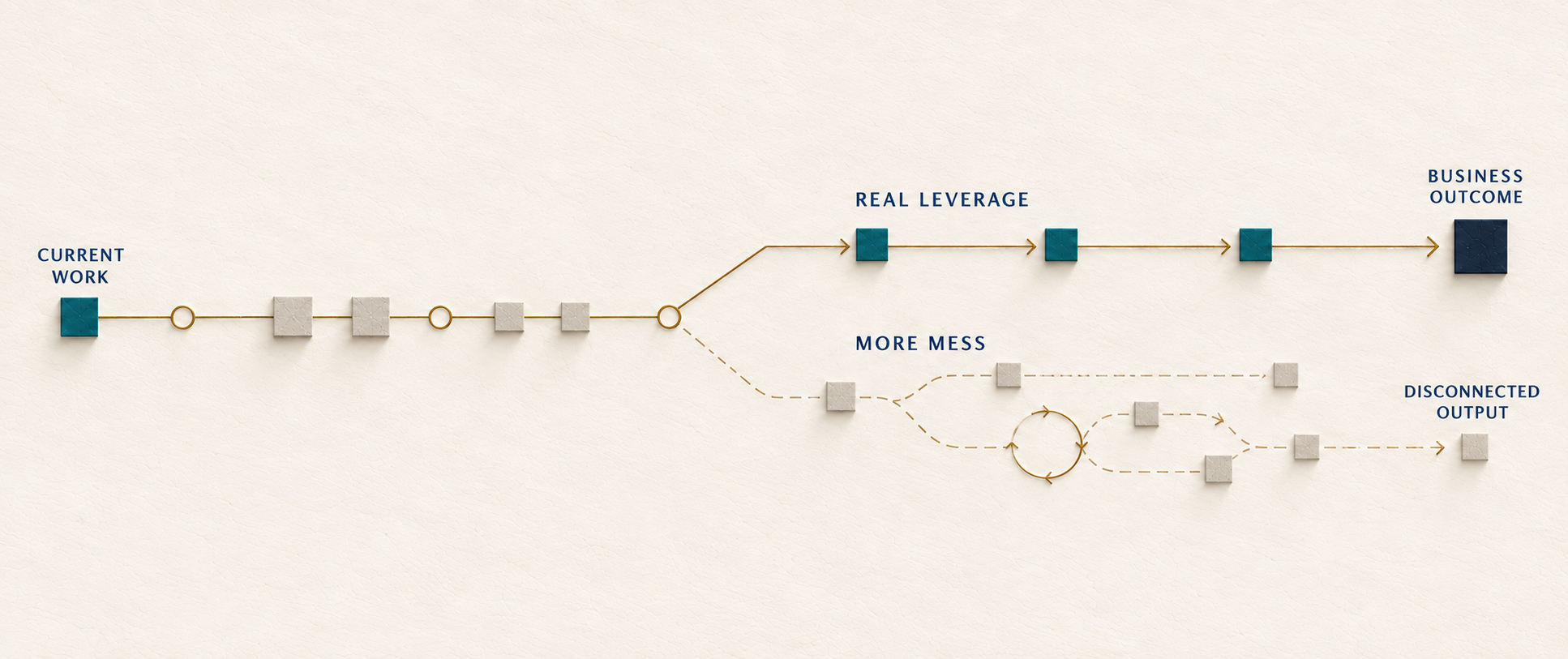
AI creates leverage when it removes meaningful friction from a clear, owned workflow. It creates more mess when it adds output, tools, review work, and risk to a system the business already struggles to control.

THE SHORT VERSION
Faster output is not the same as operational leverage.
__________
AI is most useful when the outcome is clear, the information is trustworthy, the judgment boundary is visible, and the output enters a workflow someone owns.
__________
If AI creates more material to review, more tools to manage, more disconnected records, or more decisions no one is accountable for, it has increased operational load rather than reduced it.
AI makes it possible to produce more.
More drafts. More summaries. More research. More reports. More outreach. More ideas. More activity entering the business at extraordinary speed.
That can be useful.
It can also create an entirely new layer of work.
Someone has to review the drafts. Verify the summaries. Decide what matters in the research. Correct the reports. Manage the outreach. Sort the ideas. Move the useful output into the systems where work actually happens.
The business may be producing more while accomplishing no more.
That is not leverage.
It is faster accumulation.
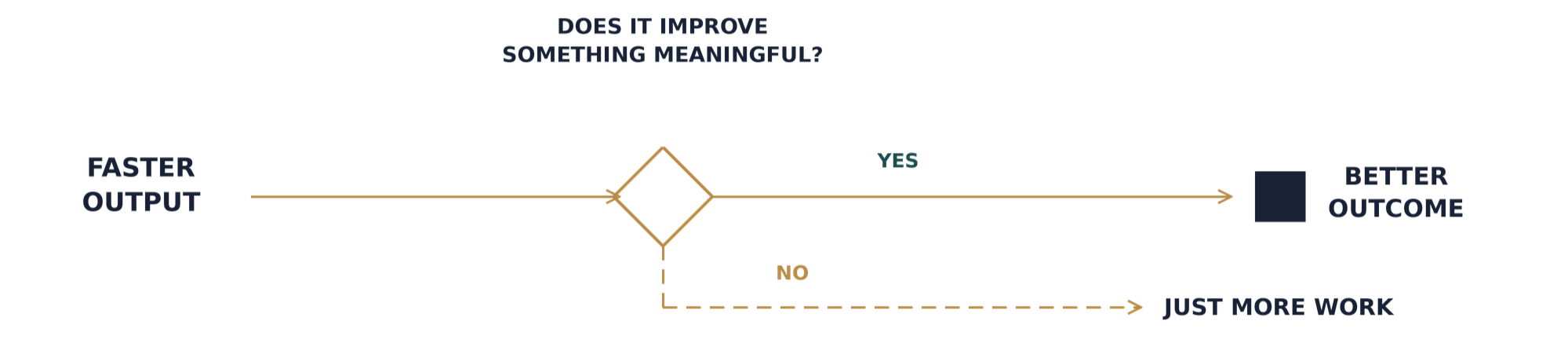
Speed is only leverage when something meaningful improves
AI is often evaluated at the point of creation.
How quickly did it write the first draft?
How many records did it enrich?
How many meeting notes did it summarize?
How many messages did it generate?
Those measures describe output.
They do not show whether the business made a better decision, continued a relationship more effectively, removed a bottleneck, protected quality, returned capacity, or improved revenue movement.
Real leverage changes the relationship between effort and outcome.
The business gets a better or faster result without adding equal amounts of review, correction, coordination, risk, and maintenance somewhere else.
“AI creates leverage when it removes friction from a system the business understands. It creates mess when it adds output to a system no one owns.” -Sarah Fuller
AI can reduce visible work while increasing invisible work
The time saved by AI is usually easy to see.
The new burden is often distributed.
A marketer spends less time writing, but leadership spends more time correcting tone and strategy.
A salesperson receives an automated account summary, but still has to open three systems to determine whether it is accurate.
A meeting assistant creates notes, but no one converts the decisions into owned actions.
A CRM tool enriches records, but operations now has to resolve duplicates and conflicting values.
A chatbot answers more questions, but difficult conversations reach the team without the context needed to continue them.
The work did not disappear.
It changed shape and moved to someone else.
That is why AI value cannot be measured only by the task it performs. The business has to follow the output through the full workflow.

Six places AI can create real leverage
01
Turning long information into a decision-ready view
AI can summarize meeting history, research, account activity, feedback, documentation, or a large source set into a focused view.
The leverage comes from designing the summary for a specific next decision, rather than making the source shorter for its own sake.
02
Preparing a strong first draft from governed context
AI can create a useful starting point for follow-up, proposals, briefs, documentation, sales enablement, content, and internal communication.
It works best when the purpose, audience, source material, standards, and reviewer are already clear.
The goal is not to remove human thinking. It is to stop spending human capacity on the blank page.
03
Classifying repeatable signals at useful scale
AI can identify themes, intent, fit, urgency, risk, requests, and recurring patterns across information that would be slow to review manually.
The categories still need business definitions. The result still needs a destination.
Classification becomes leverage when it changes routing, prioritization, or action.
04
Retrieving the right context at the moment of work
Teams lose time searching for policies, proof points, account history, approved language, process documentation, and prior decisions.
AI can make governed knowledge easier to access.
The leverage is not merely finding information faster. It is reducing rediscovery, inconsistency, and dependence on the one person who remembers where everything lives.
05
Monitoring for exceptions that deserve attention
AI can watch for missing information, overdue commitments, unusual patterns, risk signals, or movement outside the expected path.
This allows people to focus on the exception instead of manually checking every standard case.
The system should surface the reason the item needs attention instead of simply creating another alert.
06
Preserving continuity across a handoff
AI can help transfer the original context, decisions, commitments, and next action when work moves between marketing, sales, operations, delivery, and leadership.
This is valuable when the handoff already has a clear owner and destination.
It is less useful when AI generates a summary that becomes one more document no one is required to use.
Six places AI often creates more mess
Before introducing AI, the business should be able to explain seven operating conditions.
01
Producing more content without a distribution or conversion system
The business can publish more articles, posts, emails, and sales material than ever before.
If the positioning is unclear, the content has no defined role, and no one measures what it changes, AI increases volume without increasing authority or demand.
02
Automating a workflow the team cannot explain
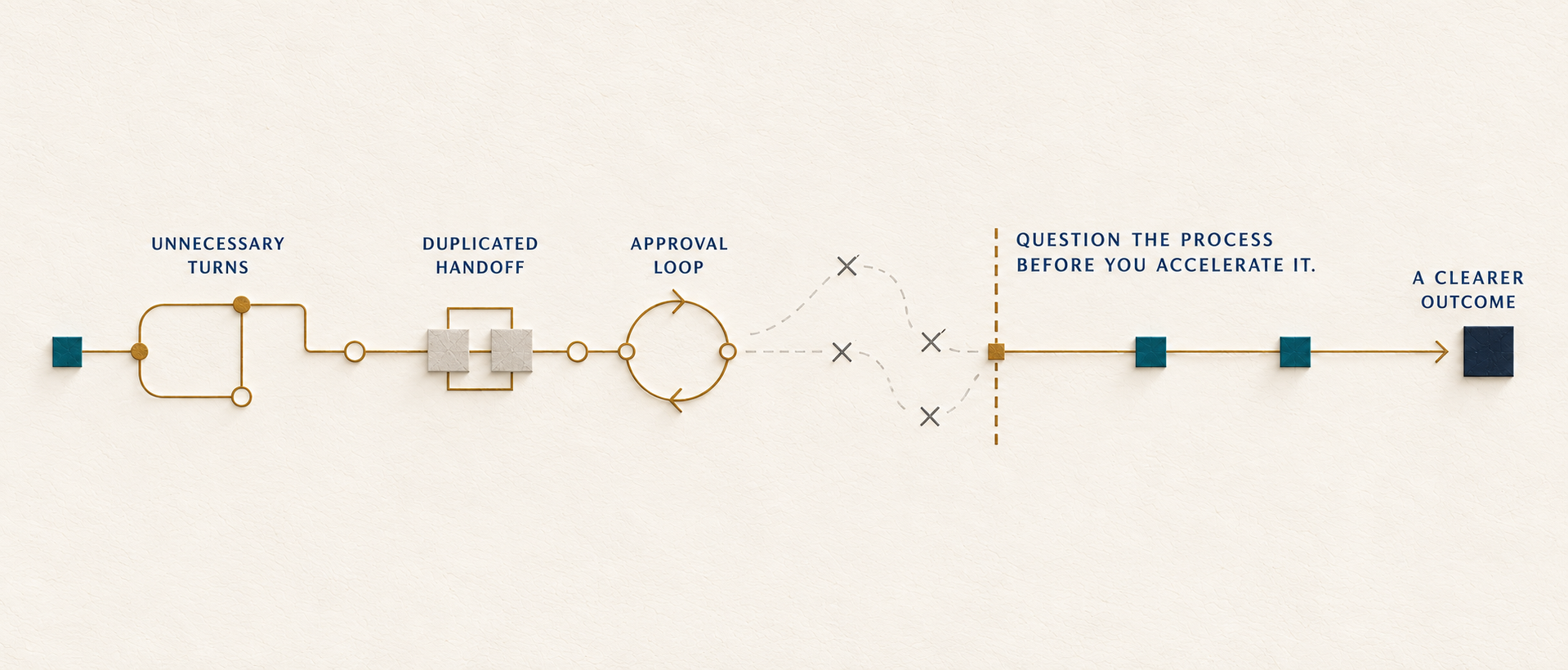
If people disagree about the current process, the automation will formalize one version while the work continues to happen another way.
The business gains a new technical layer without gaining operational clarity.
03
Using unreliable data as if it were complete context
AI can analyze what it receives.
It cannot recover context that was never captured, resolve definitions the business never agreed on, or make stale records current through confidence alone.
Poor inputs can produce polished but unreliable output.
04
Adding tools without defining a system of record
Every new AI product can create another place where information, prompts, drafts, decisions, and history live.
Without a clear operating architecture, the stack becomes more fragmented precisely when the business believes it is becoming more advanced.
05
Removing human review from a decision that still requires judgment
Some work can be governed by stable rules. Some can be supported by a recommendation. Some requires relationship awareness, leadership context, financial authority, legal review, or professional judgment.
AI creates risk when the business treats those categories as interchangeable.
06
Launching experiments no one is responsible for operationalizing
Individual experimentation can reveal useful possibilities.
But if no one decides which use cases should become part of the operating system, the company accumulates private tools, inconsistent practices, duplicated subscriptions, and ungoverned information.
Experimentation creates learning only when someone turns the learning into a decision.
A Useful Starting Point
Find the work where AI can improve the system instead of merely increasing the output.
A Growth Architecture Audit examines how information, decisions, ownership, CRM, AI, and human judgment move through the business. It identifies where AI can remove meaningful friction, where it would amplify an unclear process, and which workflow should be improved first.
Requesting an Audit begins with a short fit call. The fit call confirms whether the paid Audit is appropriate; it is not a free diagnostic session. If the Audit is the right next step, I will confirm the goals, scope, timing, and payment before work begins.
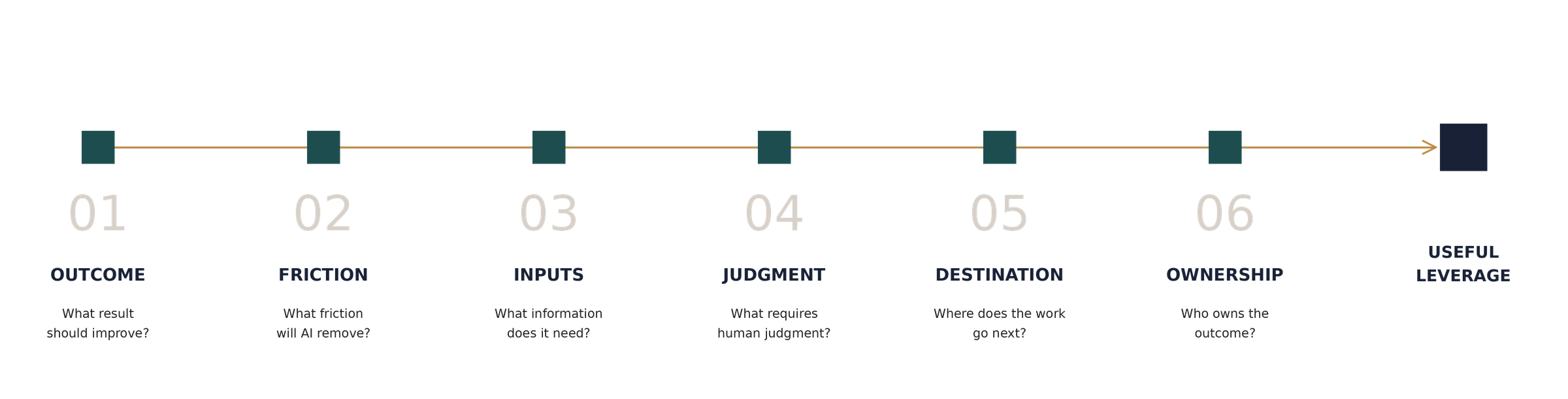
The AI Leverage Test
Before expanding an AI use case, test whether it improves the full operating system.
01
Outcome
What business result should improve?
Name the decision, movement, capacity, quality, continuity, risk, or revenue outcome rather than merely the output AI will create.
“Generate a summary” is a capability.
“Help the account owner recognize risk and decide the next action” is an outcome.
02
Friction
What meaningful work will AI remove or improve?
The use case should address a real constraint: repetitive preparation, slow retrieval, inconsistent documentation, manual classification, lost context, or exception monitoring.
If the work is occasional, low-cost, or already easy, the automation may create more operating burden than value.
03
Inputs
Does the system have the information required to produce a trustworthy result?
The business should know which sources are authoritative, whether they are current, what the AI may access, and what happens when information is incomplete or contradictory.
Useful AI is built on governed context. More data alone does not guarantee better understanding.
04
Judgment
Where should the AI act, recommend, prepare, or stop?
The business needs to distinguish stable rules from professional judgment, relationship context, sensitive decisions, and high-cost risk.
Human review should protect a defined decision. It should not be a vague promise that someone will check everything later.
05
Destination
Where will the output go, and what happens next?
A summary should enter the account record. A classification should change routing. A draft should reach a named reviewer. A risk signal should create an owned action.
If the output has no operational destination, AI has created another object to manage.
06
Ownership
Who is accountable for the result after launch?
Someone must own quality, exceptions, access, version changes, adoption, measurement, and the decision to stop or redesign the workflow.
AI can perform work.
It cannot own the operating consequence.
The leverage equation
Useful AI should create more value than the complexity it introduces.
BETTER OUTCOME + CAPACITY RETURNED
- REVIEW BURDEN - NEW COMPLEXITY - UNMANAGED RISK
= USEFUL LEVERAGE
The equation is not a financial model.
It is a decision discipline.
If a use case saves three hours of creation but adds four hours of review, correction, coordination, and maintenance, the business has not created leverage.
If it returns capacity but degrades trust, the cost is not fully captured by time.
If it produces a good output that never enters the workflow, the value remains theoretical.
Creation is not completion
AI performs exceptionally well at beginnings.
A first draft. An initial analysis. A list of options. A summary. A proposed classification. A recommended response.
Businesses often mistake the speed of that first step for completion of the work.
But a proposal must still reflect the commercial situation. A follow-up must continue the actual relationship. A report must support a decision. Content must be published, distributed, and connected to the buyer journey. A summary must create owned next actions.
The workflow should account for everything between AI output and business outcome.
That is where review burden, lost context, and unowned work usually appear.
More output can make the business slower
Every piece of output asks for attention.
More ideas require prioritization. More drafts require review. More reports require interpretation. More outreach creates replies and exceptions. More automation creates alerts, logs, and maintenance.
When the organization increases the supply of work without increasing its capacity to decide, the bottleneck moves downstream.
AI may make the first person faster while making the next person overwhelmed.

Real leverage improves the movement of work through the system.
It does not maximize what enters the queue.
Choose the smallest useful insertion point
The strongest AI use case is often smaller than the initial vision.
The business does not need to automate the entire sales process. It may need to summarize discovery notes into the fields and next actions the account owner already uses.
It does not need an autonomous content engine. It may need to turn one approved strategic brief into a disciplined first draft.
It does not need AI to manage every client exception. It may need to detect which cases fall outside the standard path and prepare the context for a person to decide.
A narrow insertion point makes the outcome, information, decision boundary, owner, and measure easier to control.
It also makes failure easier to see before the business expands the workflow.

What useful leverage looked like in practice
In one growth-stage B2B company, the opportunity was not to “add AI” across the business.
The company already had capable people, a CRM, marketing tools, sales activity, technical expertise, and growing demand.
The constraint was continuity.
Information entered through events, forms, conversations, inboxes, and leadership relationships. Context was inconsistent. Follow-up depended on memory. Reporting required reconstruction. Content and sales enablement repeatedly started from a blank page.
The highest-value use of AI was not a separate innovation project.
It was supporting specific points inside a clearer architecture: preparing structured first drafts, translating technical expertise into usable material, organizing information for follow-up, improving documentation, and reducing repeated rediscovery.
The leverage came from connecting the capability to a real workflow, a defined owner, and an existing business outcome.
The work became easier to continue instead of simply becoming easier to generate.
Measure movement, not novelty
An AI use case should be measured by the change it creates in the operating system.
Useful measures may include:
Time returned after review and correction
Reduction in repeated or duplicate work
Faster access to trusted information
More complete handoffs
Fewer missed next actions
Better consistency without loss of judgment
Shorter time from signal to decision
Higher adoption by the people doing the work
Exceptions identified before they become failures
Improvement in the downstream business outcome
Usage is not value.
Output is not value.
Novelty is not value.
The question is whether the business can now do something important with less friction, less dependence, better context, and clearer ownership.
The best AI system may feel surprisingly ordinary
It may not look like transformation.
The right information appears before a conversation. A useful draft is ready when the work begins. A missing action becomes visible. A handoff carries the original context. A recurring exception reaches the right owner. A report answers a decision instead of displaying more activity.
The capability becomes part of how the business works.
That is the point.
AI creates real leverage when it makes the operating system more capable without making it harder to understand, govern, or trust.
If it creates more output, more tools, more review, more fragmentation, and more unowned decisions, it has not solved the problem.
It has made the mess move faster.
Put AI where it makes the business easier to operate.
The Growth Architecture Audit identifies where AI can return capacity, improve continuity, and strengthen decision-making. It also shows where the business needs clearer workflow, information, or ownership before adding more technology.

Sarah Fuller
Growth Architect
I help founder-led B2B companies connect brand, website, CRM, AI workflows, and revenue operations into a growth system the business can actually use. I diagnose the architecture, rebuild the disconnected parts, test how they work together, document the system, and establish clear ownership for what comes next.