When the Founder Becomes the System
Founder knowledge can hold a business together, but when every decision, exception, relationship, and next step still depends on one person, the problem is not simply delegation. It is architecture.

THE SHORT VERSION
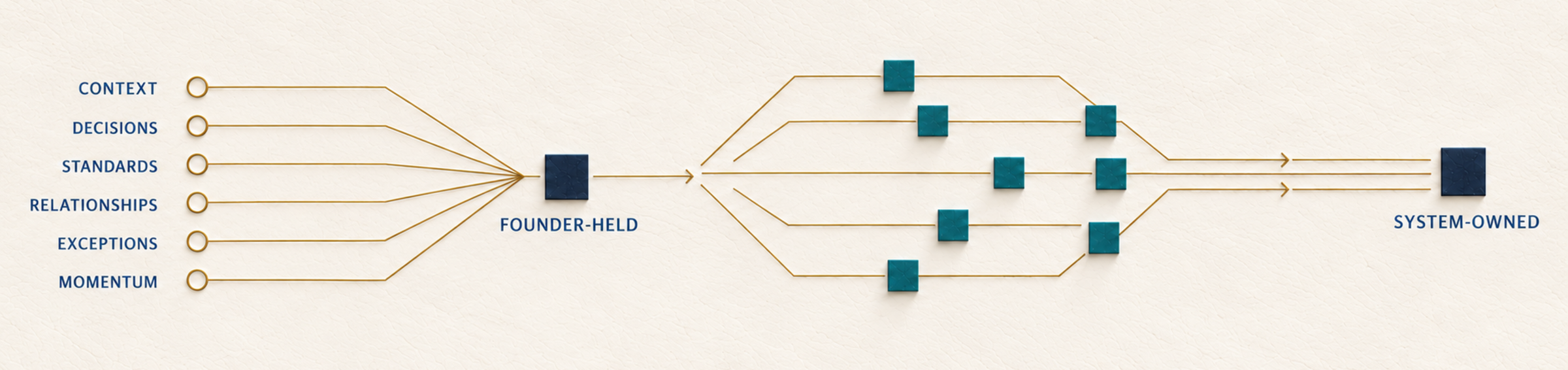
Founder dependence develops when critical context, decision logic, quality standards, relationships, exceptions, and momentum still live primarily with the founder.
__________
Delegating tasks does not solve the problem if the team still needs the founder to interpret, approve, connect, or rescue the work.
__________
The goal is not to remove the founder from the business. It is to move repeatable operating logic into documented, owned, visible systems so the founder can lead without functioning as the infrastructure.
The team is capable. The business is growing. And nearly everything important still finds its way back to the founder.
A prospect needs an answer only the founder knows how to frame. A proposal needs the founder's interpretation before it can move. A client exception reaches the founder because no one is sure who has authority. Marketing waits for the founder to clarify the message. Sales asks which opportunities are real. Operations needs context that was never documented. Leadership asks the founder what is actually happening because the systems cannot show it clearly.
The founder is not merely leading the business.
The founder is translating, connecting, approving, remembering, prioritizing, and rescuing it.
The founder has become the system.
Founder knowledge is an asset until it becomes the only infrastructure
In an early company, founder dependence is often rational.
The founder knows the customer, the offer, the standards, the history, the relationships, and the reason behind the decisions. Speed comes from having one person hold the whole picture.
That concentration of context can be a competitive advantage.
Then the company grows.
More people enter. More clients need attention. More offers develop. More tools are added. More decisions happen simultaneously. Work moves farther from the founder's direct view.
But the operating logic does not move with it.
The business adds capacity without distributing understanding.
People perform tasks. The founder still makes the work make sense.

“The founder should remain important to the business. The founder should not remain the only place where the business makes sense.” -Sarah Fuller
The company can look scalable while remaining founder-dependent
Founder dependence does not always look chaotic.
The company may have a leadership team, CRM, project platform, standard operating procedures, dashboards, recurring meetings, and capable specialists.
Work gets done.
But the systems may capture activity without preserving the logic behind it.
The CRM shows the deal, but the founder knows whether the relationship is real.
The project plan shows the tasks, but the founder knows what the client actually expects.
The brand guide shows the visual rules, but the founder decides whether the message feels right.
The dashboard shows the numbers, but the founder explains what they mean.
The business has systems.
The founder remains the integration layer between them.

Six roles the founder may be performing invisibly
01 Source of truth
The most accurate context lives in the founder's memory, inbox, private notes, and relationships.
When the team needs to understand why a decision was made, what a client meant, how an offer should be positioned, or which version is current, it asks the founder.
The founder is functioning as the business's knowledge system.
02 Decision engine
The team can identify the issue but cannot confidently decide.
Which lead is worth pursuing? Which exception should be approved? Which message should be used? Which client request fits the scope? Which work should take priority?
The decision criteria remain implicit, so the founder becomes the default authority for both important and routine choices.
03 Quality-control layer
Work is completed, then sent to the founder to determine whether it is good enough.
The review may be necessary because the founder holds expertise, relationship context, or strategic judgment.
It becomes a bottleneck when the standard exists only as the founder's reaction.
04 Relationship bridge
Important relationships may belong to the founder more than they belong to the company.
The founder remembers the history, understands the personalities, knows what was promised, and can read the unwritten signals.
When that context does not move into shared systems, every handoff weakens the relationship or routes it back through the founder.
05 Exception handler
Standard work may move without the founder.
Anything unusual comes back.
A nonstandard request. A difficult client. A pricing question. A stalled deal. A delivery risk. A conflict between teams.
If exceptions have no defined path or decision rights, the founder becomes the permanent escalation system.
06 Momentum keeper
The founder notices when follow-up has stalled, when a commitment is drifting, when a decision has been avoided, or when a priority is losing energy.
The company moves because the founder keeps pushing it forward.
Without visible ownership, next actions, and operating rhythms, momentum remains personal rather than structural.
A Useful Starting Point
Find where the business still depends on the founder to function.
A Growth Architecture Audit examines how context, decisions, ownership, standards, handoffs, CRM, AI workflows, and leadership visibility operate across the business. It identifies where the founder is still functioning as the system, what logic needs to become visible, and which dependency the company should address first.
Requesting an Audit begins with a short fit call. The fit call confirms whether the paid Audit is appropriate; it is not a free diagnostic session. If the Audit is the right next step, I will confirm the goals, scope, timing, and payment before work begins.
The Founder Dependency Test
The business should be able to answer six questions without relying on the founder to reconstruct the system.

01 Context
Can the work continue without the founder translating the history, intent, or current situation?
The relevant people should be able to find the information that gives the work meaning: what happened, why it matters, what was promised, what has already been decided, and what should happen next.
Context does not require documenting every conversation.
It requires preserving what the next person needs to act well.
02 Decisions
Does the team know which decisions it can make, which criteria should guide them, and which decisions truly require the founder?
Clear decision rights reduce unnecessary approvals without removing appropriate leadership authority.
The goal is not to predetermine every answer. It is to prevent uncertainty from automatically becoming founder work.
03 Ownership
Is one person accountable for the outcome and next action?
Shared awareness can support the work. Shared ownership often hides the fact that no one is required to move it.
The owner should have the information, authority, and operating support needed to act. A task assignment in a system is not enough.
04 Standards
Can capable people evaluate quality without waiting for the founder's reaction?
Standards may include examples, principles, required evidence, decision criteria, brand boundaries, service expectations, and known failure conditions.
The strongest standards preserve judgment while making the founder's expectations usable by others.
05 Exceptions
Is there a visible path for work that falls outside the standard process?
The system should define what qualifies as an exception, who receives it, what context must be provided, and who has authority to decide.
Not every exception belongs with the founder.
06 Visibility
Can leadership see movement, risk, ownership, and stalled work without asking the founder to explain what is really happening?
Useful visibility allows the founder to lead from the operating picture rather than personally supplying it.
If every dashboard still requires the founder's interpretation, the system is reporting activity without creating shared understanding.
Delegation fails when only the task moves
Founders are often told to delegate more.
The advice sounds simple.
Give the work to someone capable. Stop interfering. Trust the team.
But a task can move while the operating logic remains with the founder.
The team receives the responsibility but not the context.
It receives the deadline but not the decision criteria.
It receives the client but not the relationship history.
It receives the process but not the exception authority.
It receives the output standard but not the evidence that defines good work.
The founder steps back, the work weakens, and everyone concludes that delegation failed.
The real failure happened in the transfer architecture.

Delegation is not the movement of tasks.
It is the movement of context, authority, standards, and ownership with the task.
Founder control and structural dependence are not the same thing
It is easy to describe a founder as controlling when every decision returns to them.
Sometimes the founder does need to release decisions others are ready to own.
But sometimes the system gives the team no reliable way to make those decisions.
The offer is still evolving. The CRM does not preserve the relationship context. Roles overlap. Standards are implied. Reporting cannot be trusted. Escalation paths do not exist. Leadership meetings surface problems but do not assign durable ownership.
The founder intervenes because the architecture is incomplete.
Telling the founder to “let go” without strengthening the system transfers risk rather than authority.
The business needs both:
The founder must be willing to make the logic visible.
The system must make good ownership possible.
Hiring more leaders does not automatically remove the bottleneck
A senior hire can add judgment, capacity, and ownership.
But even an excellent leader will struggle if the role enters a business where the founder remains the only reliable source of context.
The new leader spends months decoding the company.
They attend more meetings to gather information. They ask for approvals because the boundaries are unclear. They build a private spreadsheet to see what the systems do not show. They create a new process beside the old one. The founder becomes frustrated that the leader is not taking enough ownership.
The leader becomes frustrated that ownership has never been fully transferred.
Adding leadership to unclear architecture can create another expensive handoff.
Before deciding that the role or person failed, examine whether the business gave them a system they could actually lead.
Document the logic without documenting every thought
Founder independence is not created by turning every action into a long standard operating procedure.
Excessive documentation creates its own burden. It becomes outdated, difficult to navigate, and disconnected from the moment of work.
The most useful documentation captures operating logic:
The purpose of the work
The outcome it should create
The source of truth
The decision criteria
The owner and authority
The quality standard
The expected next action
The known exception path
The evidence that shows the work is complete
Documentation should make judgment easier to apply.
It should not attempt to replace judgment with an encyclopedia.
The founder should choose what remains founder-held
Not every founder-held responsibility is a problem.
Some decisions belong with the founder because they shape enterprise direction, capital allocation, ownership, leadership structure, strategic risk, or the future of the company.
Some relationships should remain founder-led because the founder's involvement creates meaningful trust or commercial value.
Some creative and strategic judgments may remain central to the founder's role.
The problem is not that the founder owns important work.
The problem is that important and routine work have never been separated.
For each founder-held responsibility, decide:
Keep
The responsibility belongs with the founder because it requires the founder's authority, position, or unique strategic contribution.
Transfer
The responsibility can move when the context, criteria, authority, standard, and owner move with it.
Stop
The activity exists because of habit, unclear ownership, a former need, or a workaround the business no longer needs.
The founder should not delegate unnecessary work.
The business should remove it.
Systems need ownership as well as documentation
A process can be documented and still fail.
A CRM can be configured and still become unreliable.
A dashboard can exist and still be ignored.
An AI workflow can run and still create more work.
Every part of the operating system needs an owner with authority to maintain the logic, resolve exceptions, monitor use, and adapt the system as the business changes.
Without ownership, the system slowly returns to the founder.
The founder notices the gaps. The founder creates the workaround. The founder becomes the source of truth again.
Ownership is what keeps the system outside the founder's head.

AI can distribute founder knowledge or scale founder dependence
AI can help turn recorded conversations, documentation, decisions, and expertise into more accessible operating knowledge.
It can prepare briefs, retrieve context, support consistent first drafts, summarize account history, document recurring decisions, and surface exceptions.
That can reduce dependence on the founder.
But AI can also create a more sophisticated version of the same bottleneck.
If every workflow relies on the founder's private prompt, every output still requires founder approval, and no one else owns the source material or standards, the company has not distributed the operating system.
It has placed a technical layer around founder dependence.

AI should make business logic more accessible, governed, and usable.
It should not make the founder the hidden administrator of another tool.
What moving from founder-held to system-owned looks like
In a founder-led growth-stage company, the problem was not a lack of talented people or technology.
The business had specialists, leadership, a website, CRM, marketing activity, sales relationships, and delivery systems.
But important work still depended on one person connecting the pieces.
Website messaging, lead capture, sales context, follow-up, reporting, events, content, and internal priorities were all active. They were not operating as one owned system.
The improvement came from making the architecture visible: clarifying the path from demand to follow-up, structuring the CRM around decisions, documenting recurring logic, creating reusable standards, establishing ownership, and giving leadership a clearer operating view.
The founder did not become irrelevant.
The business became less dependent on founder intervention to continue ordinary work.
That is the shift.
Measure how often the business needs the founder to reconstruct reality
Founder independence is not measured by the number of tasks removed from the founder's calendar.
A better measure is how often the business still needs the founder to supply missing context, make routine decisions, correct preventable quality problems, reconnect handoffs, resolve predictable exceptions, and explain what the systems cannot show.
Useful signals include:
Fewer routine approvals reaching the founder
Fewer stalled decisions waiting for founder context
More work moving with a clear owner and next action
Stronger quality before founder review
Fewer handoffs that lose intent or relationship history
Exceptions reaching the correct decision-maker
Leadership seeing risk without manual reconstruction
Senior hires operating with real authority
More founder time directed toward strategic work
The goal is not founder absence.
It is founder leverage.
The founder's next role is to architect the system rather than remain inside every transaction
The founder often built the original operating system through instinct, memory, relationships, and direct involvement.
That work created the company.
The next stage requires a different contribution.
The founder must help turn what is known implicitly into a business that can see, decide, act, learn, and maintain quality without routing ordinary work through one person.
That does not diminish the founder's importance.
It increases the value of where the founder chooses to remain involved.
The founder moves from being the system to shaping the system.
The company gains the ability to grow without requiring the founder to carry every connection personally.
Build a business that can use what the founder knows.
The Growth Architecture Audit identifies where context, decisions, ownership, standards, CRM, AI workflows, and leadership visibility still depend on the founder. It also shows what the company should move into the operating system first.

Sarah Fuller
Growth Architect
I help founder-led B2B companies connect brand, website, CRM, AI workflows, and revenue operations into a growth system the business can actually use. I diagnose the architecture, rebuild the disconnected parts, test how they work together, document the system, and establish clear ownership for what comes next.