When Everyone Owns Growth, No One Owns the System
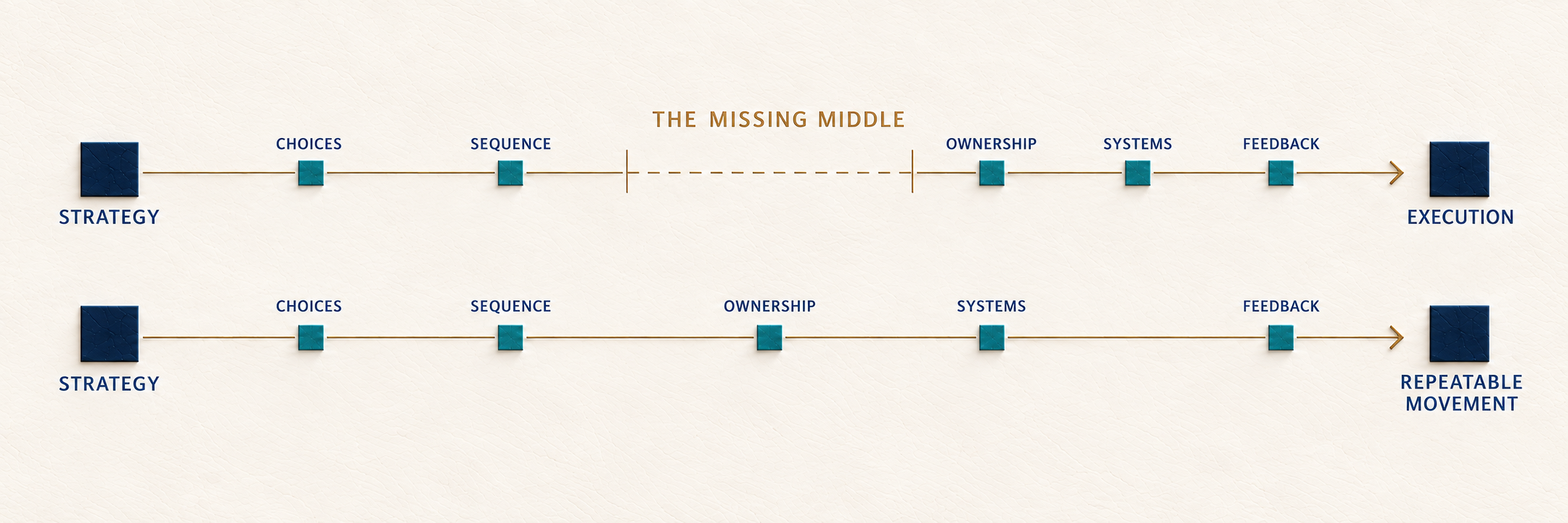
Growth may be a shared responsibility, but shared responsibility is not the same as system ownership. When no one owns how strategy, brand, demand, sales, CRM, delivery, and learning work together, every team can perform its role while the full system still breaks.

THE SHORT VERSION
Growth is cross-functional, but the system behind it still needs a named owner who can see and improve the complete path.
__________
Department owners naturally protect their part of the work. Without architectural ownership, local improvements create disconnected tools, conflicting metrics, weak handoffs, and unowned gaps.
__________
Effective ownership requires direction, architecture, domain accountability, handoff accountability, execution standards, and a review rhythm with authority to change the system.
Ask who owns growth and the answer often sounds reassuring. Everyone.
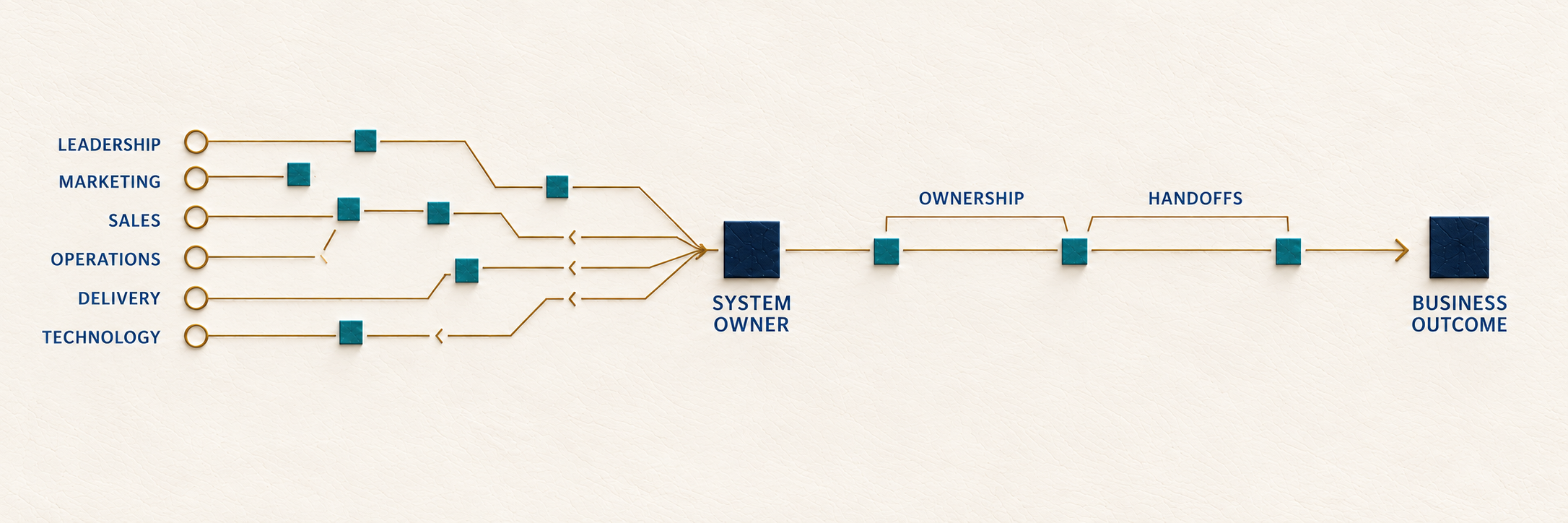
Leadership sets the targets. Marketing creates demand. Sales converts opportunity. Operations supports the process. Delivery creates the client experience. Finance watches the numbers. Technology manages the tools. The founder keeps everyone aligned.
Every function contributes.
Then ask who owns the complete system between first signal and retained revenue.
Who owns the way positioning becomes a website message?
Who owns the path from website interest into the CRM?
Who owns the context transferred from marketing to sales?
Who owns the definitions behind the pipeline report?
Who owns what delivery learns and how that learning improves the offer?
Who can change the system when the handoffs stop working?
The answer becomes less clear.
Everyone owns growth.
No one owns the system.
Shared commitment is valuable. Shared accountability is dangerous.
Growth should not belong to one department.
Marketing cannot create sustainable growth without a relevant offer, a credible sales process, operational capacity, strong delivery, and leadership decisions. Sales cannot compensate indefinitely for unclear positioning, weak proof, poor lead capture, or a CRM the team does not trust. Delivery affects retention, reputation, referrals, and the next version of the offer.
The company should share responsibility for the outcome.
But accountability becomes weaker when everyone can reasonably assume someone else owns the connection.
Marketing owns the campaign, but not what happens after the lead enters the CRM.
Sales owns the opportunity, but not the form, routing, source data, or nurture path.
Operations owns the tool, but not the commercial logic inside it.
Leadership owns the target, but not the architecture required to produce it.
Each statement may be defensible.
Together they create an unowned system.

“Growth can belong to the whole company. The system that produces it still needs named ownership.” -Sarah Fuller
Department ownership creates local strength without automatic integration
Capable leaders improve the areas they control.
Marketing builds a content process. Sales adjusts pipeline stages. Operations adds automation. Delivery creates a client tracker. Leadership requests a dashboard. Technology approves another platform.
Each improvement may solve a real problem.
But each team sees the system from a different position.
Marketing optimizes for attention and qualified demand.
Sales optimizes for progression and closed revenue.
Operations optimizes for consistency and efficiency.
Delivery optimizes for quality and client outcomes.
Finance optimizes for predictability and margin.
Leadership optimizes for enterprise performance.
No individual function naturally owns the full set of tradeoffs.
Without architectural ownership, the company can create strong departments connected by weak assumptions.

Six signs no one owns the growth system
01 No one can draw the complete path
Different teams can explain their section of the process.
No one can clearly show how a buyer moves from first awareness through inquiry, qualification, decision, delivery, retention, and learning, including the systems, owners, information, and decisions required at each stage.
The absence of a complete view makes gaps difficult to see and easier to defend as someone else's responsibility.
02 Handoffs are treated as the receiving team's problem
Marketing delivered the lead. Sales received the contact. Sales closed the client. Delivery received the scope.
The transfer is considered complete because an object moved.
But source, intent, history, promises, decision context, and next actions may not have moved with it.
Both teams completed their task. The handoff still failed.
03 Tool ownership is mistaken for system ownership
An administrator may own CRM configuration, website updates, automation rules, or reporting access.
That does not mean the person owns the business logic the tool is expected to support.
Software administration keeps the platform functioning.
System ownership determines what the platform should reveal, enable, protect, and connect.
04 Metrics are reported without an owner for the decision
The company tracks traffic, leads, meetings, pipeline, conversion, revenue, retention, and activity.
When a metric changes, teams explain their part.
No one owns the cross-functional decision required to improve the whole result.
The dashboard creates visibility without creating movement.
05 Changes create downstream surprises
Marketing changes a form without understanding lead routing. Sales changes a stage without considering reporting. Operations adds a required field without considering adoption. Leadership introduces an offer without updating the website, CRM, proof, or delivery handoff.
The change makes sense locally.
The system absorbs the consequences later.
06 The founder becomes the default integrator
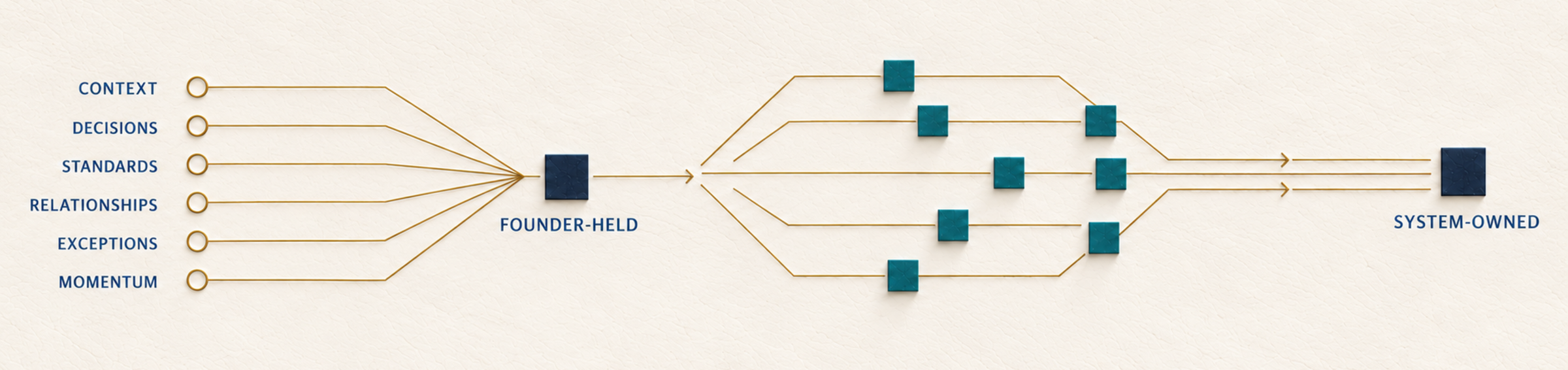
When ownership is fragmented, the founder or senior leader connects the pieces personally.
They clarify the message, identify the real opportunity, repair the handoff, reconcile the numbers, decide the exception, and remind teams what matters.
The system appears cross-functional.
Its integration still depends on one person noticing what no role formally owns.
A Useful Starting Point
Identify who owns the connections between departments.
A Growth Architecture Audit examines how strategy, brand, website, CRM, AI workflows, sales, delivery, data, and leadership decisions operate as one growth system. It identifies where accountability disappears between functions, which handoffs are unowned, and what system-level ownership the business needs next.
Requesting an Audit begins with a short fit call. The fit call confirms whether the paid Audit is appropriate; it is not a free diagnostic session. If the Audit is the right next step, I will confirm the goals, scope, timing, and payment before work begins.
The Growth Ownership Chain
A connected growth system needs six forms of ownership.

01 Direction
Who defines the business outcome, priority, constraints, and acceptable tradeoffs?
Executive leadership should establish what the company is trying to achieve and why it matters now.
Direction prevents the system from becoming a collection of unrelated departmental goals.
02 Architecture
Who owns how the complete growth system fits together?
This owner sees across brand, website, demand, CRM, sales, AI workflows, reporting, delivery feedback, and leadership decisions.
The role does not perform every task or replace domain expertise.
It owns the integrity of the connections.
03 Domains
Who owns each major part of the system?
Brand, website, marketing, CRM, sales process, revenue operations, AI workflows, and delivery feedback need named owners with clear outcomes and boundaries.
Domain ownership makes expertise and maintenance explicit.
04 Handoffs
Who is accountable for what crosses from one domain into another?
A handoff needs both a sender and a receiver, but one person must own the condition of the transfer: what information moves, when it moves, how completion is confirmed, and how exceptions are handled.
If a handoff belongs to both teams equally, it often belongs to neither operationally.
05 Execution
Who performs the work, and what standard allows the owner to trust it?
Operators need usable processes, tools, context, decision rights, and a clear escalation path.
Execution ownership should be close to the work. It should not require every decision to return to leadership.
06 Review
Who examines whether the complete system is producing the intended result and authorizes changes?
The review rhythm should connect performance, exceptions, adoption, learning, and emerging constraints.
Review is where the business improves the architecture rather than merely reports activity.
The owner of a tool is not automatically the owner of the system
This distinction matters because growth systems are built inside tools.
Someone needs administrative access. Someone needs to configure fields, workflows, forms, permissions, integrations, dashboards, and automations.
But technical control does not create business ownership.
The website owner may be able to publish a page without owning the offer strategy.
The CRM administrator may be able to change a stage without owning the sales definition.
The automation builder may connect two systems without owning the handoff logic.
The reporting analyst may create a dashboard without owning the decision it should support.
System ownership answers a different set of questions:
What business outcome should this enable?
Which information matters?
Which definition is authoritative?
Who owns the next action?
What happens when the standard path fails?
Which downstream process will this change affect?
How will the system remain useful as the business evolves?
Administration keeps the mechanism running.
Ownership keeps the mechanism relevant.
A committee can coordinate the system without owning it
Cross-functional meetings are useful.
They surface constraints, share context, and create agreement.
They can also create the appearance of ownership without the authority required to act.
Everyone attends. Everyone contributes. Everyone leaves with a different interpretation of what was decided.
The committee discusses the issue. A named owner still needs to decide, document, assign, and verify what changes.
No one owns a system by attending its meetings.
The group can advise and coordinate.
Accountability still needs a name.
Ownership without authority is only responsibility for the failure
A person may be told they own growth operations, CRM, marketing performance, or the client journey.
But can they change the process?
Can they resolve conflicting definitions?
Can they require the information the system needs?
Can they challenge a departmental workaround?
Can they set a standard for the handoff?
Can they stop an automation that creates risk?
Can they bring a system-level decision to leadership and receive a clear answer?
Ownership requires authority proportional to the outcome.
Without authority, the owner becomes the person who notices the failure and explains it afterward.
The handoff needs an owner in addition to a sender and receiver
Most growth-system failures occur between capable teams.
The website captured the information. Marketing qualified the signal. Sales held the conversation. Operations configured the workflow. Delivery started the engagement.
The gap is rarely that no one worked.
The gap is that no one owned the quality of movement between the work.
A strong handoff defines:
The trigger for transfer
The required information and context
The sender's responsibility
The receiver's confirmation
The owner of the next action
The expected timing
The exception path
The evidence that the transfer is complete
Handoff ownership converts departmental completion into system continuity.
Shared metrics need named decisions
A cross-functional metric can reveal the health of the system.
Qualified-pipeline movement may involve positioning, traffic, conversion, qualification, follow-up, sales judgment, proof, offer design, and CRM discipline.
Because many functions affect the number, no single team can improve it alone.
But the metric still needs a decision owner.
Who decides which constraint matters most?
Who determines whether the problem is demand, fit, response, progression, offer, or reporting?
Who assigns the system change and confirms whether it worked?
Shared metrics should bring teams together around one operating decision.
They should not become a shared reason no one is accountable.

A Growth Architect owns integration across departments
The purpose of Growth Architecture is not to centralize every task under one person.
It is to create a coherent system across work that will remain distributed.
A Growth Architect diagnoses the complete path, clarifies the architecture, connects the domains, defines the handoffs, establishes ownership, and helps the business operationalize what was built.
Domain leaders remain responsible for their expertise and outcomes.
The Growth Architect protects the integrity of how those outcomes work together.
This role becomes especially valuable when the company has capable people and active tools but no one with the scope, time, or authority to own the complete growth system.
The problem is not a lack of contribution.
It is a lack of integration.

What named system ownership changed in practice
In one founder-led growth-stage company, marketing, sales, technology, operations, and leadership were all contributing to growth.
The company had strong expertise, active campaigns, important events, sales relationships, a website, a CRM, reporting, and growing demand.
But ownership stopped at functional boundaries.
Website inquiries did not always preserve context. CRM structure did not consistently support the decisions leadership needed. Event follow-up depended on individual memory. Content, sales enablement, and reporting were produced across separate requests rather than one operating plan.
The improvement did not come from asking everyone to care more about growth.
It came from treating the work as one system: mapping the buyer and revenue path, rebuilding the website and CRM connections, defining fields and stages, creating reusable standards, connecting follow-up to source and intent, and giving leadership a clearer view of movement and risk.
Named system ownership made the gaps visible and made cross-functional improvement possible.
AI will not resolve ownership the business has avoided
AI can summarize cross-functional information, recommend next actions, classify signals, document decisions, monitor exceptions, and make operating knowledge easier to access.
It cannot decide who is accountable for the outcome.
If several teams assume the AI workflow belongs to someone else, the output becomes another unowned handoff.
If no one owns the source information, the system uses inconsistent context.
If no one owns the decision boundary, automation quietly expands into judgment the business never assigned.
If no one owns review, the workflow continues after it stops creating value.
AI can support system ownership.
It cannot substitute for it.

Measure ownership by what continues without rescue
An ownership chart can look complete while the operating system remains ambiguous.
The stronger evidence appears in the work.
Can a handoff move without leadership intervention?
Can a system change be evaluated across its downstream effects?
Can a metric trigger a named decision?
Can an exception reach the right authority?
Can teams use the same definitions?
Can the owner maintain the system without rebuilding it privately?
Useful signals include:
Fewer unowned next actions
Fewer cross-functional issues routed to the founder
Clearer decision rights
Faster resolution of handoff failures
Fewer duplicate tools and workarounds
More consistent definitions and reporting
Changes reviewed for downstream impact
Named owners maintaining what was built
Leadership discussions focused on decisions rather than reconstruction
Ownership becomes real when the system continues without someone repeatedly rescuing the gaps.
Growth needs collective contribution and singular clarity
Growth should involve the whole company.
The brand promise must be delivered. The website must create understanding. Marketing must create relevant demand. Sales must continue the right conversations. CRM and revenue operations must make movement visible. Delivery must produce the outcomes the company sold. Leadership must choose the direction and constraints.
Collective contribution is essential.
Singular clarity is equally essential.
Someone must be able to see the complete architecture, recognize where the parts conflict, and own the decision to improve the system.
When everyone owns growth, the business should not conclude that no one needs to own the system.
It should name the ownership that allows everyone's contribution to work together.
Give the growth system a clear owner.
The Growth Architecture Audit identifies where strategy, brand, website, CRM, AI workflows, sales, delivery, reporting, and leadership decisions are disconnected. It also identifies the ownership needed to make the system work as one.

Sarah Fuller
Growth Architect
I help founder-led B2B companies connect brand, website, CRM, AI workflows, and revenue operations into a growth system the business can actually use. I diagnose the architecture, rebuild the disconnected parts, test how they work together, document the system, and establish clear ownership for what comes next.