Why Growing Businesses Get Stuck Between Strategy and Execution
Most growing businesses do not lack strategy or effort. They lack the operating architecture that translates direction into priorities, decisions, ownership, systems, and learning. The gap between knowing what should happen and making it happen repeatedly is where growth begins to stall.

THE SHORT VERSION
The strategy-execution gap is usually a translation problem: the business has direction, but it has not converted that direction into shared priorities, decision rights, sequences, handoffs, and operating systems.
__________
More effort does not repair the gap. Without architecture, teams move faster in different directions, leaders repeat decisions, and urgent work continually displaces important work.
__________
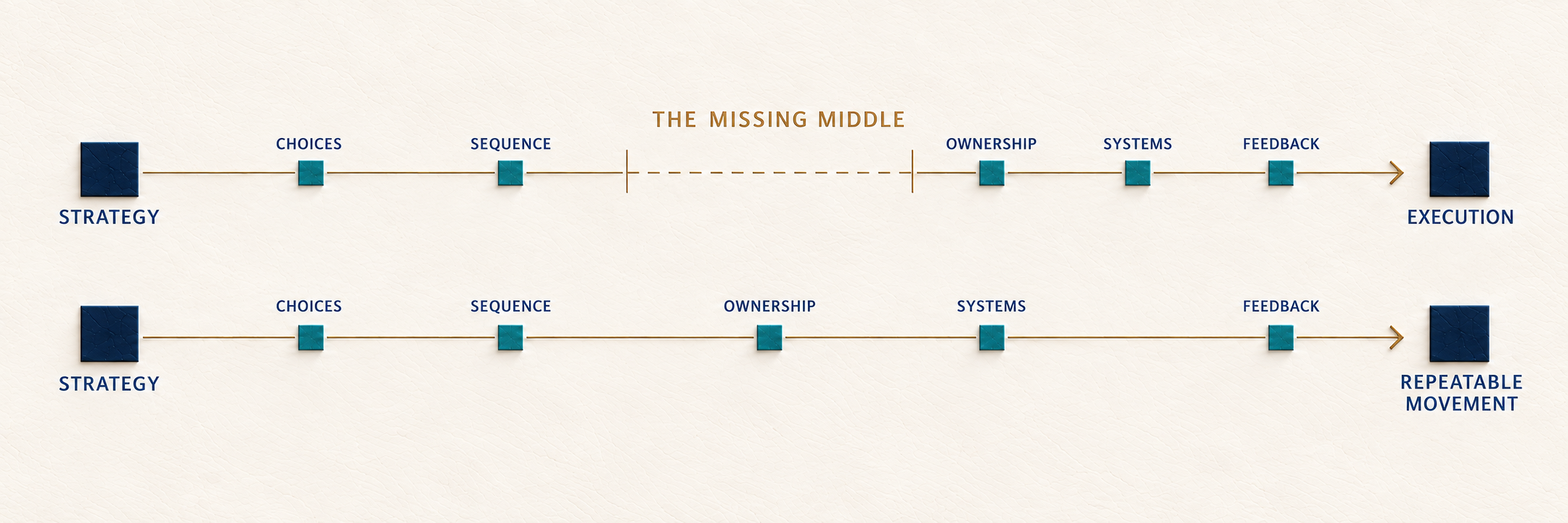
A reliable bridge from strategy to execution connects six elements: Outcome, Choices, Sequence, Ownership, Systems, and Feedback.
The leadership meeting ends with clarity. Then Monday arrives.
The priorities are ambitious but reasonable. The team agrees on the direction. The plan reflects what the business needs next. Everyone leaves understanding why the work matters.
Sales needs a proposal revised. Marketing needs approval. A client escalation changes the schedule. Operations is repairing a workflow. The CRM report raises questions no one has time to resolve. A new opportunity appears important enough to interrupt the plan.
By the end of the week, the strategy still exists.
So does the work.
They are no longer connected.
This is often described as an execution problem.
The team needs more accountability. Leaders need to communicate more clearly. People need to move faster. The company needs another project-management tool, a tighter meeting cadence, or more visible deadlines.
Sometimes those changes help.
But growing businesses are rarely stuck because no one is working.
They are stuck because the business has not designed the middle between strategy and execution.
Strategy creates direction. It does not automatically create movement.
A strategy should clarify where the business is going, what advantage it intends to create, which customer it will serve, and what it will prioritize.
That is essential.
It is also incomplete.
The people responsible for execution still need to know:
What changes first
Which work matters most when priorities compete
Which decisions have already been made
Who can make the next decision
What each team owns
What must cross between teams
Which systems should support the work
How progress will be evaluated
What happens when reality challenges the plan
If those questions remain unanswered, the strategy is forced to travel through individual interpretation.
Each leader translates it for their department. Each team translates it into its current workload. Each person makes reasonable choices based on the context available to them.
The result is not necessarily resistance.
It is fragmentation.
“Strategy fails in execution when the business leaves the most important translation work to assumption.” -Sarah Fuller
The missing middle is operating architecture
There is a dangerous space between a strategic decision and a completed result.
Inside that space, the business has to convert intention into an operating model.
An objective becomes a set of choices.
Choices become a sequence.
The sequence becomes owned work.
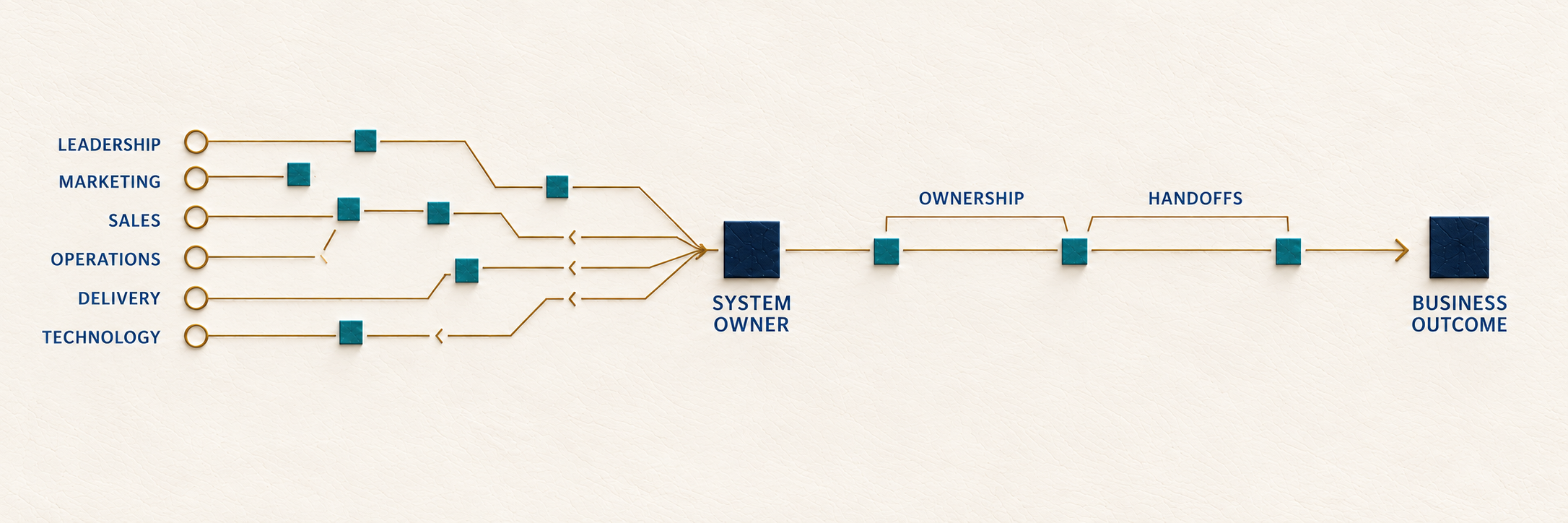
Owned work moves through systems and handoffs.
The results create information.
That information changes the next decision.
This is operating architecture: the structure that allows strategy to become coordinated action without requiring leadership to personally translate every step.
When the architecture is clear, the team can move with autonomy and still remain aligned.
When it is missing, the business compensates with meetings, escalation, urgency, memory, and founder intervention.
The company appears busy because it is continuously rebuilding the connection between what it intended and what people should do next.

Six signs the business is stuck between strategy and execution
01
The same priority produces different work in every department
Leadership says the company needs to improve qualified growth.
Marketing increases campaign activity. Sales asks for more leads. Operations adds fields to the CRM. Delivery focuses on retention. Finance watches acquisition cost.
Each response may be logical.
But no one translated the strategic priority into one shared operating outcome, a defined constraint, and a coordinated sequence.
The business is aligned at the level of language and misaligned at the level of action.
02
Urgent work repeatedly defeats important work
The strategy depends on rebuilding the website, clarifying the offer, cleaning the CRM, standardizing follow-up, or redesigning a client handoff.
Those projects matter.
They also lose every contest against a proposal due today, an unhappy client, a founder request, or a visible short-term opportunity.
The problem is not merely discipline.
Strategic work has not been protected through capacity, sequence, ownership, and decision rules. It remains important in theory and optional in the operating system.
03
Leadership keeps making the same decisions
The same questions return in different forms.
Which leads are qualified? Who follows up? Which offer should be emphasized? What information belongs in the CRM? Who approves the exception? Which metric is authoritative?
A decision is made in a meeting.
It is not translated into a definition, workflow, field, standard, owner, or documented boundary.
The next situation reopens it.
Leadership is not making progress. It is repeatedly renting clarity.
04
People own tasks but not outcomes
A person may own the new page, the campaign, the automation, the dashboard, or the follow-up email.
They can complete the assignment without being accountable for whether the work produces the intended business result.
Task ownership answers, “Who will do this?”
Outcome ownership answers, “Who will make sure this works?”
Growing businesses often have the first and assume it creates the second.
05
The tools do not reflect the strategy
The company says it wants a more focused market position, a more consultative sales process, better-fit clients, faster decisions, or a more consistent experience.
But the website still presents the old offer. Forms collect generic information. CRM stages reflect activity rather than buyer progress. Automations accelerate the previous workflow. Dashboards report what is easy to count rather than what leadership needs to decide.
The strategy changed.
The infrastructure did not.
06
Progress becomes visible only after leadership reconstructs it
The work lives across meetings, inboxes, project boards, spreadsheets, CRM notes, private documents, and individual memory.
When leadership asks what is moving, someone has to gather updates and explain the story manually.
The business has activity data.
It does not have a reliable view of strategic movement.
If the status of the strategy has to be reconstructed, execution is still dependent on interpretation.
A Useful Starting Point
Diagnose the missing bridge behind the stalled work.
A Growth Architecture Audit examines how strategy moves through brand, website, CRM, AI workflows, sales, delivery, data, and leadership decisions. It identifies where intent is being lost, which priorities compete, where ownership becomes ambiguous, and which parts of the operating system need to change.
Requesting an Audit begins with a short fit call. The fit call confirms whether the paid Audit is appropriate; it is not a free diagnostic session. If the Audit is the right next step, I will confirm the goals, scope, timing, and payment before work begins.
The Strategy-to-Execution Bridge
Strategy becomes repeatable execution through six connected elements.

01 Outcome
What must be materially different when the work succeeds?
An outcome is not “launch the website,” “implement the CRM,” or “create the campaign.” Those are outputs.
The outcome describes the business change the outputs must create: clearer buyer understanding, more reliable qualification, better pipeline visibility, faster handoffs, stronger conversion, less founder dependence, or more consistent delivery.
If the outcome is vague, teams optimize for completing their assignments.
02 Choices
What will the business prioritize, defer, stop, or refuse?
Strategy becomes useful through constraint.
A company cannot simultaneously pursue every customer, message, channel, offer, workflow improvement, market opportunity, and internal request with equal seriousness.
Choices protect the outcome from dilution.
They also give the team a basis for saying no without requiring a new executive decision every time.
03 Sequence
What must happen first, and what depends on it?
Growing businesses often attempt the right work in the wrong order.
They automate before defining the process. Drive traffic before clarifying the website. Add CRM fields before deciding which questions matter. Hire people before clarifying ownership. Build dashboards before agreeing on definitions.
Sequence turns a collection of good ideas into a buildable path.
04 Ownership
Who owns the outcome, the decisions, the domains, and the handoffs?
Execution slows when every meaningful decision climbs back to leadership or several people assume someone else is responsible.
Ownership should name who decides, who performs, who contributes context, and who must be informed.
The owner also needs enough authority to resolve tradeoffs and maintain what is built.
05 Systems
How will the work move consistently?
The operating system includes processes, standards, tools, fields, automations, templates, meeting rhythms, documentation, and escalation paths.
These mechanisms should carry the strategic choices into everyday work.
The purpose is not bureaucracy.
It is to reduce the amount of strategy that must be remembered, re-explained, or reinvented in the moment.
06 Feedback
How will the business know what is working, what is changing, and what to adjust?
Execution is not blind compliance with an annual plan.
The business needs signals that connect performance and exceptions to a decision owner. Feedback should reveal whether the outcome is advancing, where the system is resisting, and which assumption needs to change.
Without feedback, the company either clings to the original plan or abandons it based on the loudest recent event.
Together, these six elements form the bridge.
A plan is not the bridge
A plan can organize projects, dates, deliverables, and dependencies.
That makes it valuable.
But a detailed plan can still sit on top of unresolved strategic and operating questions.
The team may know when a page is due without knowing which buyer decision the page should support.
It may know who is configuring the CRM without knowing which sales behavior the system should reinforce.
It may know when a campaign launches without knowing whether the offer, follow-up path, and delivery capacity are ready.
The plan describes the work.
The architecture explains how the work creates the outcome.
When a project stalls, adding more task detail will not fix an unmade choice, an unowned decision, a broken handoff, or a system that contradicts the strategy.
Execution usually breaks at translation points
The largest failures rarely occur inside a single, clearly owned task.
They occur where one kind of information must become another kind of action.
Positioning has to become website language.
Website interest has to become a qualified CRM record.
A sales conversation has to become a reliable forecast.
A signed proposal has to become delivery context.
Client experience has to become offer and messaging intelligence.
Leadership direction has to become decisions teams can make without leadership present.
Each translation point needs definitions, context, ownership, and a standard for completion.
Otherwise, the business passes a lead, task, document, or client to the next team without transferring the meaning required to continue the strategy.
More accountability cannot repair impossible architecture
Leaders often respond to weak execution by demanding more ownership.
But people cannot own an outcome they cannot see, influence, or decide.
If priorities conflict, authority is unclear, information is incomplete, capacity is fictional, and systems create friction, accountability becomes pressure without leverage.
The team may respond by working longer, communicating more defensively, or escalating decisions faster.
None of those responses repairs the structure.
Before asking why a person failed to execute, examine whether the business gave them:
A specific outcome
Clear priorities and constraints
The authority to make the required decisions
Access to the necessary context
A workable sequence
Reliable handoffs
Tools that support the process
A visible path for exceptions
Feedback tied to the result
Accountability becomes useful when the architecture makes success possible.
The workflow should carry the strategy
A strong operating system makes the strategy visible in ordinary decisions.
The positioning determines what the website emphasizes.
The ideal-client definition determines what the form asks.
The qualification standard determines which CRM stage a lead enters.
The sales process determines what information must be captured before a proposal.
The delivery promise determines what context crosses into onboarding.
The leadership priorities determine what the dashboard surfaces.
The feedback rhythm determines which patterns change the next decision.
This is where strategy becomes real.
Not in the slide deck.
In the definitions, tools, handoffs, and decisions the business uses every day.

Meetings should support the operating system without replacing it
Meetings are useful for decisions, judgment, conflict, and shared understanding.
They become expensive when they are the only place the strategy exists.
The weekly meeting should not be required to remind the team which opportunities matter, recreate the status of every initiative, reinterpret the same definitions, or personally route every next step.
If work only stays aligned while the right people are in the room, the meeting is acting as a temporary integration layer.
The goal is not fewer meetings at any cost.
It is to move stable logic into the system so meeting time can focus on exceptions, tradeoffs, learning, and decisions.
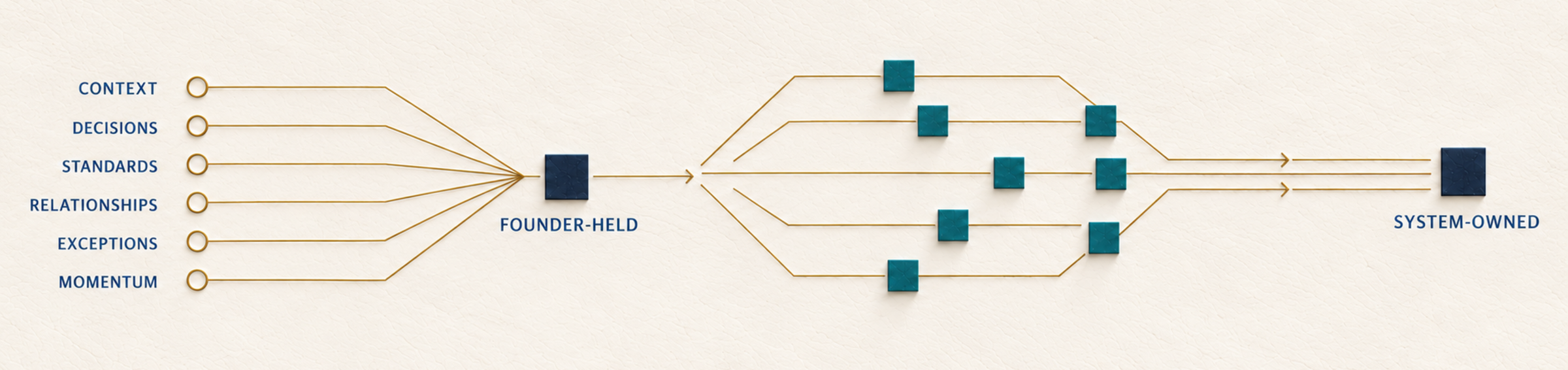
The founder should not remain the live translation layer
In a founder-led business, the strategy often makes sense because the founder carries the complete context.
They know which client is a fit, why the offer evolved, what a prospect really meant, which exception is worth making, and how one decision affects five other parts of the company.
That knowledge is valuable.
It becomes a constraint when execution depends on the founder translating the strategy inside every transaction.
The team waits for clarification. Leaders protect themselves from making the wrong decision. Systems capture activity without capturing the reasoning behind it. The founder becomes the bridge between intention and action.
The answer is not to remove the founder from strategy.
It is to architect enough of the operating logic that the business can continue moving when the founder is not interpreting every step.
What changed when the missing middle was designed
In one founder-led growth-stage company, the strategic direction was not the problem.
Leadership wanted a more coherent market position, a stronger website, a more useful CRM, better follow-up, clearer reporting, and a more connected path from demand to revenue.
The company also had capable people doing meaningful work.
But initiatives arrived as separate requests. The website, CRM, events, content, sales materials, automations, and reporting moved at different speeds and reflected different assumptions. Important decisions lived in conversations. Each new priority created more work because the existing systems had not been designed to carry it.
Progress accelerated when the work was treated as one architecture.
The strategy was translated into a build sequence. Website structure connected to buyer questions. Forms connected to CRM fields and routing. Pipeline stages connected to real sales movement. Event capture connected to source, intent, follow-up, and reporting. Reusable standards reduced the number of decisions that had to return to leadership.
The improvement did not come from a more forceful reminder to execute.
It came from building the missing middle between direction and delivery.
AI can accelerate the bridge or widen the gap
AI can help translate strategy into briefs, document decisions, draft operating standards, summarize feedback, classify information, identify exceptions, and reduce repetitive coordination.
That creates real leverage when the underlying choices are clear.
When they are not, AI makes ambiguous execution faster.
It generates more tasks from a vague priority. It scales inconsistent messaging. It automates a workflow no one has validated. It summarizes data with conflicting definitions. It produces plausible answers where the business still needs an accountable decision.
AI belongs inside the strategy-to-execution bridge after the business defines the outcome, choices, sequence, ownership, and system logic.
It can strengthen translation.
It cannot decide what the company truly means.

Measure execution by movement rather than volume
Growing businesses can produce enormous amounts of visible activity.
Campaigns launch. Pages publish. Meetings happen. Tasks close. Automations run. Dashboards populate.
The better question is whether the strategic outcome is moving.
Useful evidence includes:
Teams making consistent decisions from the same priorities
Important work protected from avoidable interruption
Fewer decisions returning to leadership
Clear owners for outcomes and handoffs
Systems reflecting the current strategy
Less manual reconstruction of progress
Faster resolution of exceptions
Learning changing the next operating decision
Completed work producing the intended downstream effect
Execution is not the amount of motion the company can create.
It is the business's ability to convert direction into results repeatedly.
The answer is not more strategy or more effort. It is a better bridge.
Growing businesses often have enough ideas.
They often have enough work.
What they lack is a designed connection between the two.
Strategy should establish direction and constraint.
Architecture should translate that direction into outcomes, choices, sequence, ownership, systems, and feedback.
Execution should move through that architecture without requiring the company to reconstruct the plan in every meeting or the founder to interpret every decision.
When the bridge is strong, strategy does not sit above the business.
It becomes visible in how the business works.
Build the bridge between what the business intends and how the work moves.
The Growth Architecture Audit identifies where strategy is lost as it moves from leadership decisions into brand, website, CRM, AI workflows, sales, delivery, reporting, and everyday execution. It clarifies the architecture the business needs next.

Sarah Fuller
Growth Architect
I help founder-led B2B companies connect brand, website, CRM, AI workflows, and revenue operations into a growth system the business can actually use. I diagnose the architecture, rebuild the disconnected parts, test how they work together, document the system, and establish clear ownership for what comes next.