The Hidden Cost of Disconnected Growth Systems
The systems that made growth possible can become the same systems that make the next stage harder.

THE SHORT VERSION
The largest cost of a disconnected system is often the work people perform to compensate for the gaps between its parts.
__________
Each department may appear functional while the business loses time, margin, opportunity, visibility, and customer trust in the handoffs.
__________
Before buying another tool or adding more activity, identify where information, ownership, or movement breaks down.
Most business costs are easy to recognize. Disconnected systems are more difficult to see because the cost is distributed.
An invoice arrives. A salary appears in payroll. Software renews. A campaign has a budget. A lost client has a value.
It appears in the fifteen minutes someone spends finding the right document. The lead that waits two days because ownership was unclear. The meeting used to reconcile two reports. The proposal rewritten because the website, sales deck, and current offer no longer agree. The founder stepping back into work that was supposed to belong to the system.
No single moment feels large enough to trigger a rebuild.
Across a growing business, those moments accumulate.
The hidden cost is not limited to inefficient software. It is the time, attention, margin, opportunity, and confidence the business spends compensating for the spaces between brand, website, CRM, workflow, revenue operations, and leadership.
Disconnection can look functional from the outside
A disconnected system does not always look chaotic.
The website is live. Forms submit. Contacts enter the CRM. Sales holds pipeline meetings. Marketing publishes content. Leadership receives reports. The team completes the work.
Every part appears to function.
The cost becomes visible when you follow the movement between those parts.
Does the website capture the information sales needs? Does the CRM show who owns the next action? Does the reporting reflect the same definitions the team uses? Does the automation support the actual workflow? Can leadership see what is happening without asking someone to assemble the answer manually?
If each handoff requires interpretation, memory, re-entry, or intervention, the business is paying for disconnection even when the individual tools appear to work.
“The most expensive part of a disconnected system is rarely the software. It is the work people perform to compensate for the gaps between it.” -Sarah Fuller
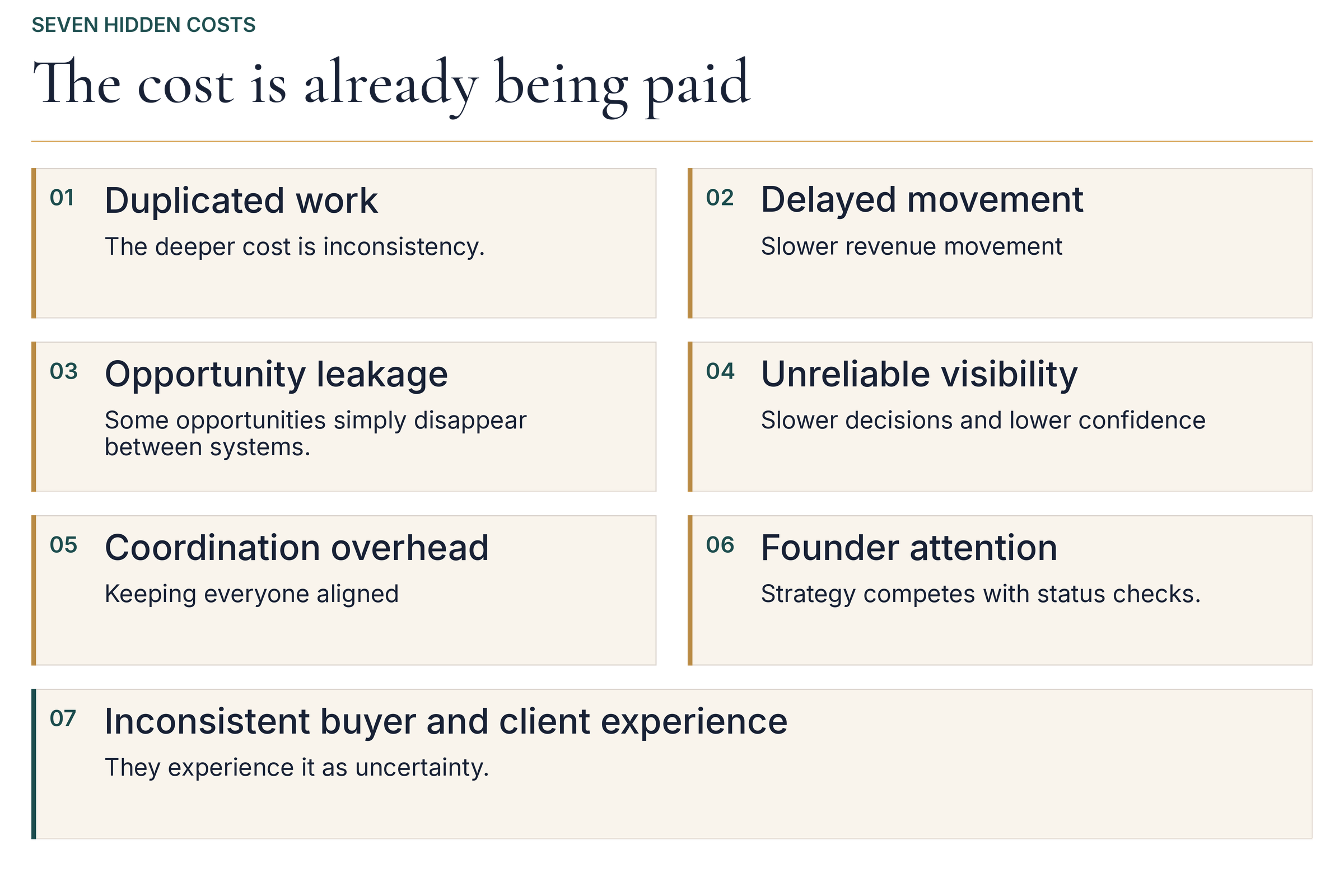
01 The cost of duplicated work
Disconnected systems make the business complete the same work more than once.
A form collects information that someone retypes into the CRM. Sales rewrites a service description because the website language does not fit the conversation. Marketing recreates information that already exists in a proposal. Leadership maintains a second spreadsheet because the CRM report cannot be trusted.
The visible cost is the time required to repeat the task.
The deeper cost is inconsistency.
Every time information is copied, translated, or rebuilt, the business creates another opportunity for it to change. Names are formatted differently. Stages mean different things. Offer language drifts. Context disappears. One system becomes more current than another, but no one is certain which one should be trusted.
Rework is not only inefficient. It gradually weakens the integrity of the entire system.
02 The cost of delayed movement
Growth depends on movement.
A visitor moves from recognition to interest. An inquiry moves to qualification. An opportunity moves to a defined next step. Information moves from the person who has it to the person who needs it. Leadership moves from visibility to a decision.
Disconnected systems slow that movement because every handoff introduces another pause.
Someone waits for access. Someone asks for context. Someone checks whether the task belongs to them. Someone searches for the latest version. Someone confirms whether the CRM stage is accurate. Someone schedules a meeting to decide what the system should already make clear.
The business may still reach the outcome. It reaches it later and with more coordination.
Delay matters because opportunity has its own timing. Buyers lose urgency. Teams lose context. Follow-up becomes less relevant. Decisions that could have been made this week move into the next reporting cycle.
The cost of delay rarely appears as a line item. It appears as slower revenue movement and a business that feels heavier each time it grows.
03 The cost of opportunity leakage
Not every missed opportunity is rejected explicitly.
Some opportunities simply disappear between systems.
A referral remains in an inbox. An event lead never enters a follow-up sequence. A form submission lacks enough context to route correctly. A promising conversation is recorded as a contact but never becomes an opportunity. A deal stalls because no next action is assigned.
These losses are difficult to measure because the system never captured enough information to show what happened.
The business may respond by trying to generate more demand. That adds volume to the same structure that allowed the earlier opportunity to disappear.
More leads do not solve leakage. They increase the number of handoffs the system has to manage.
Before increasing the top of the funnel, the business needs to know whether the middle can carry what already enters it.
04 The cost of unreliable visibility
Leadership cannot make a confident decision from information it does not trust.
When the website, CRM, spreadsheets, inboxes, and reporting tools hold different versions of reality, every number arrives with a qualification.
The pipeline total includes opportunities that should have been closed. Lead-source information is incomplete. Stages are applied inconsistently. Marketing reports activity while sales reports conversations. Revenue projections depend on information only one person knows how to interpret.
The result is not simply imperfect reporting.
It changes how the business makes decisions.
Leaders delay investments because the forecast feels uncertain. They add activity because they cannot see where movement stopped. They question the data instead of discussing what the data means. The reporting meeting becomes a debate about definitions.
Visibility is part of the operating system. When it is unreliable, leadership pays through slower decisions and lower confidence.
05 The cost of coordination overhead
Disconnected systems require people to coordinate work that connected systems would make visible.
Meetings multiply. Messages ask for status. Managers translate between departments. Team members maintain private lists so nothing gets lost. Progress depends on someone checking several places and assembling the answer.
This coordination may look like collaboration. Often, it is compensation.
Good collaboration creates judgment, alignment, and better decisions. Compensation meetings exist because the system cannot show ownership, status, context, or the next action without a conversation.
The distinction matters.
When the business adds another employee, tool, offer, or market, coordination demands increase. Without better architecture, growth creates more connections for people to manage manually.
Capacity is added, but an increasing share of that capacity is consumed by keeping everyone aligned.
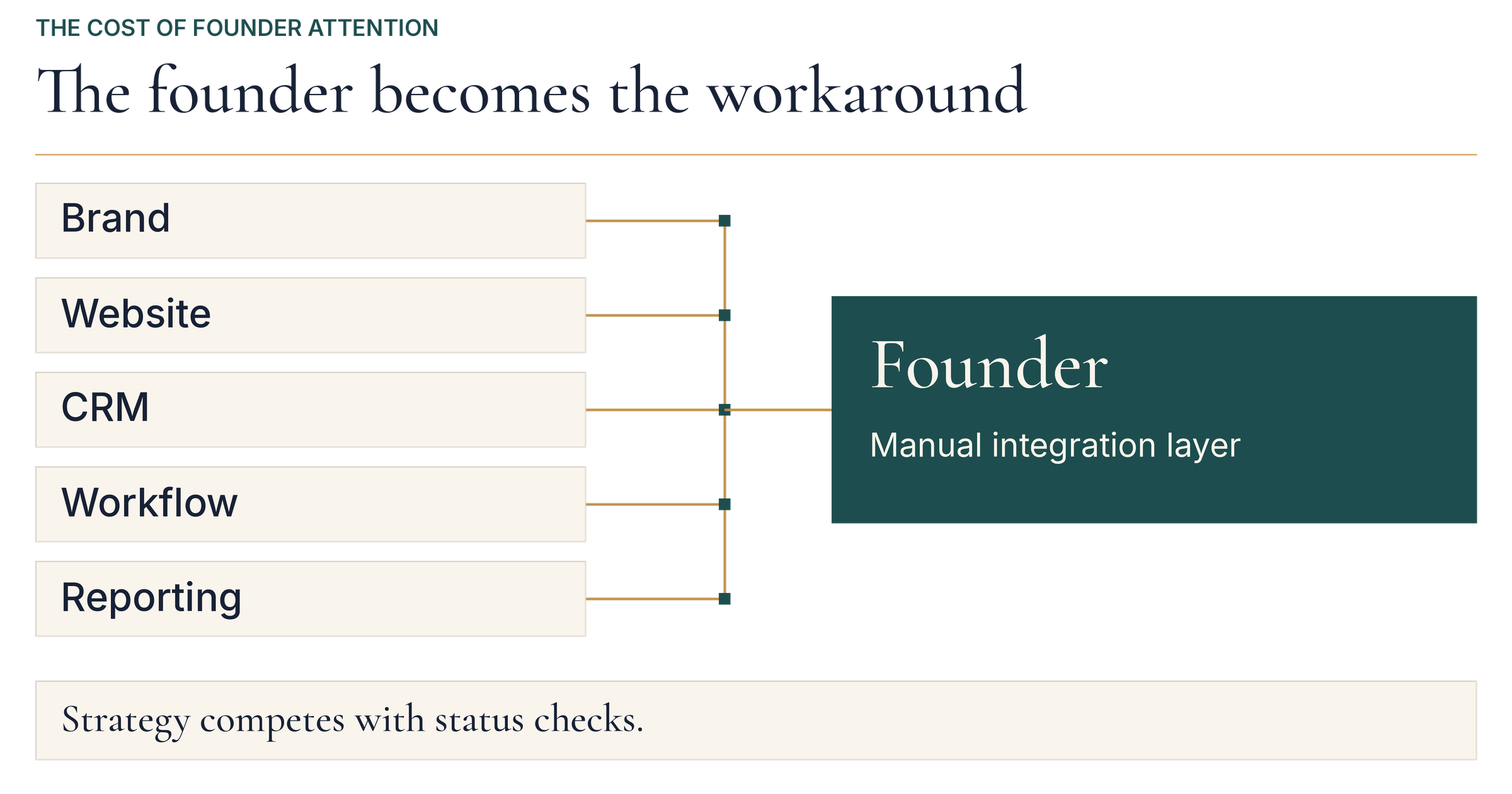
06 The cost of founder attention
The founder often becomes the most effective workaround in the company.
They know which message is current, which opportunity matters, what the client meant, why the number looks wrong, who should own the next step, and where the missing information probably lives.
That knowledge allows the business to keep moving.
It also makes the founder the manual integration layer between otherwise disconnected systems.
Every clarification, exception, approval, and correction pulls attention away from the work only the founder can do. Strategy competes with status checks. Growth decisions compete with file searches. Leadership time is spent translating the business back to itself.
The cost is not only the founder’s time. It is the strategic work that cannot receive that time.
07 The cost of an inconsistent buyer and client experience
Internal disconnection eventually becomes visible outside the company.
The website promises one experience while sales describes another. A prospect repeats information already submitted. Follow-up arrives late or without context. The proposal uses different language from the service page. A client receives conflicting instructions from different people.
The customer rarely identifies the architecture problem directly.
They experience it as uncertainty.
Do these people understand what I need? Is this the right service? Did anyone read what I sent? Who owns this? What happens next?
Trust is built through consistency. When the systems behind the experience are disconnected, the business asks individual employees to create that consistency manually in every interaction.
That works until volume, complexity, or turnover makes manual consistency impossible.
A Useful Starting Point
Find where the business first starts compensating for the system.
A Growth Architecture Audit examines the connections across brand, website, CRM, AI workflow, revenue operations, and growth leadership. It identifies what is working, what is missing, what is disconnected, and what should be addressed first.
Requesting an Audit begins with a short fit call. If the Audit is the right next step, I will confirm the goals, scope, timing, and payment before work begins.
Why another tool rarely solves the underlying problem
When a system feels inefficient, software is an appealing answer.
A new platform promises cleaner data, better automation, stronger reporting, and fewer manual steps. Those benefits may be real. But software cannot resolve decisions the business has not made.
It cannot decide what qualifies an opportunity, who owns follow-up, which information matters, how stages should work, where exceptions belong, or what leadership needs to see.
If those questions remain unanswered, the new tool inherits the same ambiguity.
The interface changes. The architecture does not.
This is why a technology migration can consume months and still leave the business with familiar frustrations. The old mess has been moved into a cleaner system.
Technology should support the operating decision. It should not be asked to make the decision on the business’s behalf.
How to locate the highest-cost disconnect
You do not need a perfect calculation before addressing the problem.
Start by looking for repeated compensation:
Where is information entered, copied, or corrected more than once?
Where does work wait because ownership or the next action is unclear?
Where does leadership need someone to reconstruct the answer?
Where do prospects or clients have to repeat information?
Where does the founder routinely intervene to keep movement from stopping?
Where has the business added software without removing manual work?
Where do two teams use the same word to mean different things?
The most expensive disconnect is not always where frustration is loudest.
A clumsy task may be irritating but low impact. A quiet handoff failure between inquiry and follow-up may affect every new opportunity. A reporting gap may consume little time but lead to expensive decisions. A positioning problem may appear to be a website issue while affecting sales, content, qualification, and conversion.
The right starting point is the earliest meaningful break in the system—not necessarily the most visible symptom.
What connected Growth Architecture changes
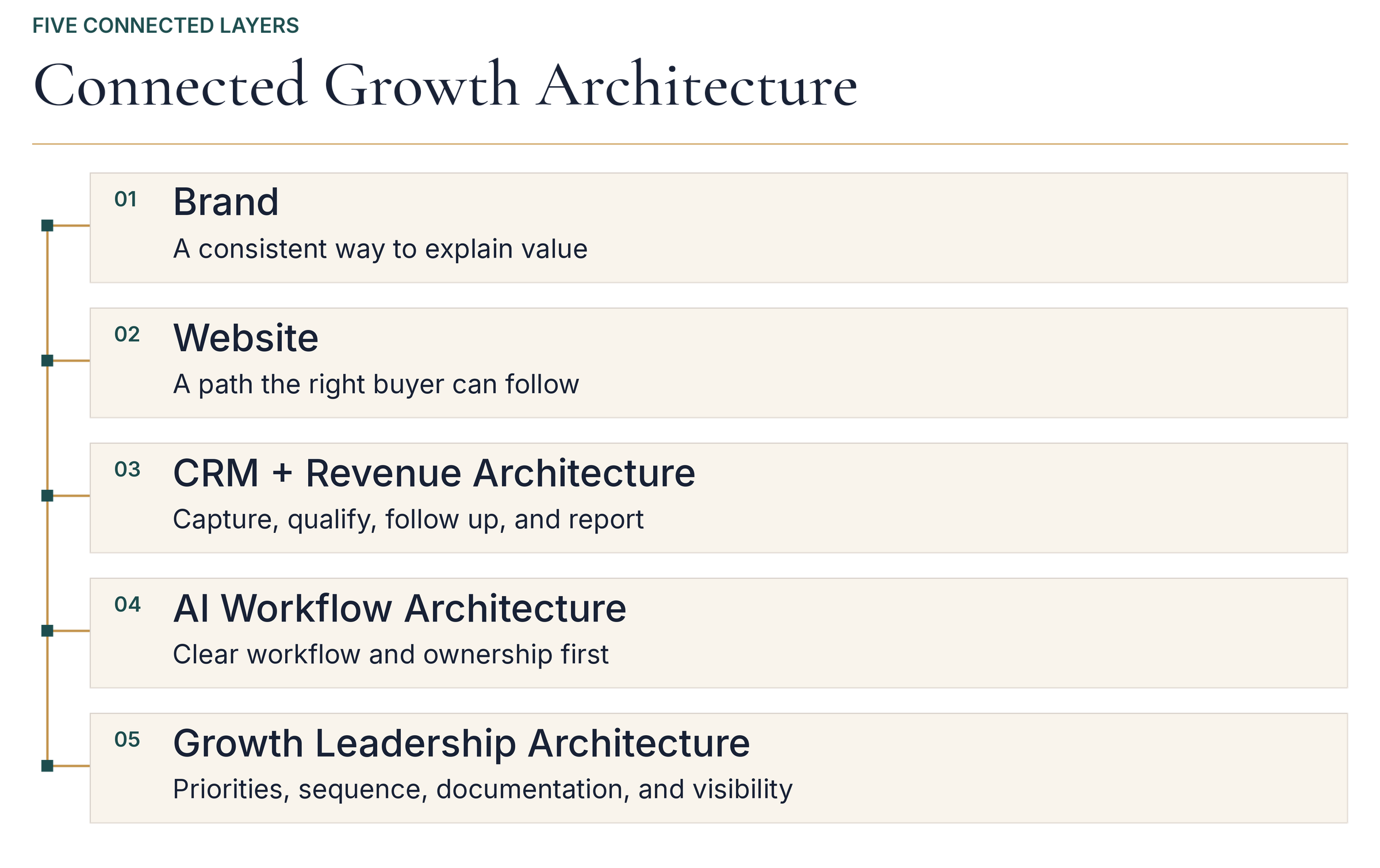
Growth Architecture connects the strategy, structure, messaging, systems, and execution layer supporting growth.
Brand gives the business a consistent way to explain its value.
The website turns that clarity into a path the right buyer can follow.
CRM and Revenue Architecture define how interest is captured, qualified, moved, followed up, and reported.
AI Workflow Architecture reduces work after the workflow and ownership are clear.
Growth Leadership Architecture establishes priorities, sequence, documentation, and the visibility required to keep the system working.
The goal is not perfect integration for its own sake. It is to reduce the amount of human effort required to make the business behave like one company.
In one growth-stage B2B technology business, website structure, messaging, lead capture, CRM architecture, follow-up, reporting, sales enablement, and event conversion had to be treated as parts of the same system. The value was not limited to the individual deliverables. It was in the connections those deliverables created.
You can read the full Case Study here.
The cost is already being paid
Disconnected systems can feel less expensive than rebuilding because the business is not writing one large check for the problem.
It is paying in smaller amounts every day.
In repeated work. Slower movement. Missed opportunity. Unreliable data. Extra coordination. Founder intervention. An experience the customer has to work harder to trust.
The question is not whether improving the architecture will require an investment.
The question is what the current architecture is already costing—and whether the business can carry that cost into its next stage of growth.
START HERE
See what the system actually needs.
The Growth Architecture Audit gives you a clear view of what is working, what is broken, what is missing, what is disconnected, and what the business should address first.

Sarah Fuller
Growth Architect
I help founder-led B2B companies connect brand, website, CRM, AI workflows, and revenue operations into a growth system the business can actually use. I diagnose the architecture, rebuild the disconnected parts, test how they work together, document the system, and establish clear ownership for what comes next.