Your Business Does Not Have a Marketing Problem. It Has an Architecture Problem.
When growth starts exposing cracks across the business, another campaign will not solve what is happening underneath.


THE SHORT VERSION
More marketing amplifies the system already in place. It does not repair what happens after attention is created.
__________
The visible problem may appear in the website, CRM, sales process, reporting, or team, but the friction usually lives between those parts.
__________
Before adding another campaign, tool, hire, or automation, diagnose the architecture supporting growth.
A company decides it needs more leads, so it hires a marketer.
The message still feels unclear, so it rebuilds the website.
Leads begin coming in, but follow-up is inconsistent, so it buys a CRM.
The team is still overwhelmed, so it adds automations and AI tools.
Each decision makes sense on its own. Together, they can become an expensive collection of disconnected fixes.
The website says one thing. Sales says another. The CRM captures information no one uses. Follow-up depends on who notices. Reporting requires a manual explanation. AI automates workarounds that were never designed properly in the first place.
Marketing is blamed because marketing is where the symptoms are easiest to see.
But the problem is usually larger than marketing.
The problem is the architecture supporting growth.
Marketing is often where the problem becomes visible
When leads are inconsistent or revenue slows, the instinct is usually to increase activity.
Publish more content. Run another campaign. Change the messaging. Buy more software. Hire someone to manage it. Add AI so the existing team can move faster.
Activity feels productive because it is visible. It creates deliverables, meetings, dashboards, and numbers to watch.
But activity cannot compensate for a system that does not carry opportunity forward.
If the positioning is unclear, more people will encounter a message they do not understand.
If the website does not create a useful next step, more traffic will produce more exits.
If the CRM does not reflect the real sales process, more leads will create more records without creating more visibility.
If ownership is unclear, more automation will move confusion faster.
Marketing can create attention. It cannot, by itself, repair everything that happens before and after that attention arrives.

The problem usually lives between the parts
Most growing companies already have many of the pieces they need.
They have a brand. A website. A CRM. A sales process. A handful of automations. Reports. Content. People doing their best to keep opportunity moving.
The issue is not always that a piece is missing. The issue is that the pieces were built at different times, by different people, for different versions of the business.
The brand evolved, but the website did not.
The website generates inquiries, but the CRM does not capture the information sales needs.
The CRM tracks activity, but leadership cannot see what is stalled or why.
The team uses AI, but the underlying process still depends on undocumented knowledge trapped in one person’s head.
No single breakdown explains the whole problem. The friction appears in the handoffs.
That is why hiring another specialist to fix one isolated part can produce a better part without producing a better system.
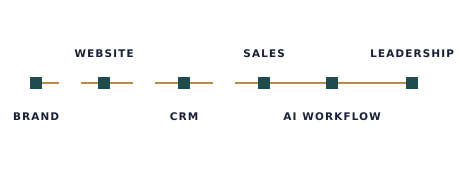

“The problem is not that the business needs more activity. It needs the systems underneath that activity to work together.”
This is Growth Architecture
Growth Architecture is the strategy, structure, messaging, systems, and execution layer that makes growth easier to see, sell, track, and scale.
It treats brand, website, CRM, AI workflow, revenue operations, and growth leadership as connected infrastructure rather than unrelated business functions.
The five layers are:

01
Brand Architecture
Brand Architecture creates the strategic clarity underneath the message.
It defines who the business is for, what problem it solves, why its approach is different, what it should be known for, and how that value is communicated consistently.
Without that clarity, the website becomes a collection of pages and sales conversations depend on individual interpretation.
02
Website Architecture
Website Architecture turns the strategy into a usable buyer journey.
It helps the right visitor understand where they are, recognize the problem, see the value of the approach, find proof, and take an appropriate next step.
A website should not simply describe the business. It should support how the business attracts, qualifies, educates, and moves opportunity.
03
CRM + Revenue Architecture
CRM and Revenue Architecture defines what happens after interest is created.
It establishes how leads enter, what information is captured, how opportunities are qualified, who owns the next action, how follow-up occurs, what stages mean, and what leadership needs to see.
A CRM should not be a database of names and completed tasks. It should show how revenue is moving and where it is getting stuck.
04
AI Workflow Architecture
AI Workflow Architecture applies automation where it creates real leverage.
That requires a defined process, reliable information, clear ownership, and a reason for the workflow to exist. AI can reduce repetitive work, improve consistency, and make information easier to use. It cannot decide what an unclear process was supposed to accomplish.
Automating an underbuilt workflow usually makes the underlying problem harder to see.
05
Growth Leadership Architecture
Growth Leadership Architecture connects decisions to execution.
It establishes priorities, sequence, ownership, documentation, and the visibility leadership needs to make informed choices. It also prevents the founder from remaining the manual connection point between every department, tool, exception, and next step.
This is the layer that keeps the architecture working after the initial build is complete.
Three areas to diagnose before adding more marketing
You do not need to rebuild everything at once. You do need to identify where the system first begins losing clarity or movement.
01
Branding + Positioning
Can the right buyer quickly understand what the business does, who it is for, why it matters, and why this approach is different?
Look for inconsistent descriptions, vague language, outdated offers, competing value propositions, and a sales team that has to translate the website during every conversation.
When the message is unclear, every downstream system inherits the ambiguity.
02
Website + Conversion
Does the website move the right visitor toward a useful next step?
Look beyond traffic and aesthetics. Examine the paths between the message, services, proof, calls to action, forms, and follow-up. A beautiful website can still fail if it does not help buyers understand what to do next—or help the business understand who raised their hand.
03
CRM + Revenue Movement
Can the business see what happened after the inquiry arrived?
Look at what is captured, how opportunities are categorized, who owns follow-up, whether stages reflect reality, where records stall, and what leadership can see without asking someone to manually reconstruct the story.
If the CRM cannot show movement, adding more leads may only increase the amount of opportunity the business cannot manage clearly.
A USEFUL STARTING POINT
Find the constraint before adding more activity.
A Growth Architecture Audit examines what is working, what is missing, what is disconnected, and what the business should address first. The goal is not to generate a longer list of projects. It is to establish the right sequence.
Requesting an Audit begins with a short fit call. If the Audit is the right next step, I will confirm the goals, scope, timing, and payment before work begins.
What happens when the architecture is clear
Clear architecture does not make growth effortless. It makes growth more understandable.
BRAND
The brand gives the business a consistent way to explain its value.
WEBSITE
The website turns that value into a path buyers can follow.
CRM
The CRM captures the right information and shows what is moving.
AI WORKFLOW
AI supports defined work instead of adding another layer of tools.
LEADERSHIP
Leadership can see where the constraint is, decide what matters next, and assign ownership without rebuilding the entire strategy in every meeting.
Marketing becomes more useful because it is no longer being asked to compensate for every weakness around it.
IN PRACTICE
In one growth-stage B2B technology business, the work could not begin and end with new website pages. Messaging, website structure, lead capture, CRM architecture, follow-up, reporting, sales enablement, event conversion, and leadership visibility had to be treated as parts of the same system.
The clearest proof was not one isolated deliverable. It was what those deliverables allowed the business to connect.
More is not always the next move
Growing businesses are often surrounded by people selling additions.

Sometimes more is appropriate. But adding to a disconnected system increases the number of things the business has to manage without improving how those things work together.
Before you build more, diagnose the architecture.
Find where the message loses clarity. Find where the buyer path breaks. Find where information stops moving. Find where ownership becomes ambiguous. Find the work that still depends on the founder noticing, remembering, translating, or intervening.
Then rebuild in sequence.
Your business may not be broken. Its current architecture may simply be underbuilt for the stage it has reached.
That is a different problem and a much more useful one to solve.
START HERE
See what the system actually needs.
The Growth Architecture Audit gives you a clear view of what is working, what is broken, what is missing, what is disconnected, and what the business should address first.

Sarah Fuller
Growth Architect
I help founder-led B2B companies connect brand, website, CRM, AI workflows, and revenue operations into a growth system the business can actually use. I diagnose the architecture, rebuild the disconnected parts, test how they work together, document the system, and establish clear ownership for what comes next.