Seven Signs Your Business Has Outgrown the Systems That Got It Here
The systems that made growth possible can become the same systems that make the next stage harder.

THE SHORT VERSION
A system does not have to fail completely to become a constraint. It can keep functioning while requiring more effort, memory, explanation, and intervention every month.
__________
The clearest signs appear in the handoffs: between message and website, inquiry and follow-up, activity and visibility, strategy and ownership.
__________
Do not replace everything at once. Find the first place clarity or movement breaks, then rebuild in sequence.
Nothing looks broken enough to justify rebuilding it.It just takes more effort than it should.
The website still works. Leads still come in. The CRM still contains records. Reports still get produced. Work still gets completed.
Someone has to remember the exception. Someone has to explain what a field actually means. Someone has to copy information from one place to another. Someone has to notice that a lead has been sitting untouched. Someone has to rebuild the numbers before leadership can trust them.
That is how a business can outgrow its systems without experiencing one dramatic failure.
The systems that helped the company reach this stage may have been entirely appropriate when the team was smaller, the offers were simpler, and the founder could see every opportunity personally. Growth changes the volume, complexity, and number of handoffs those systems have to support.
Eventually, the old structure keeps operating only because people are compensating for it.
These are the signs to watch.
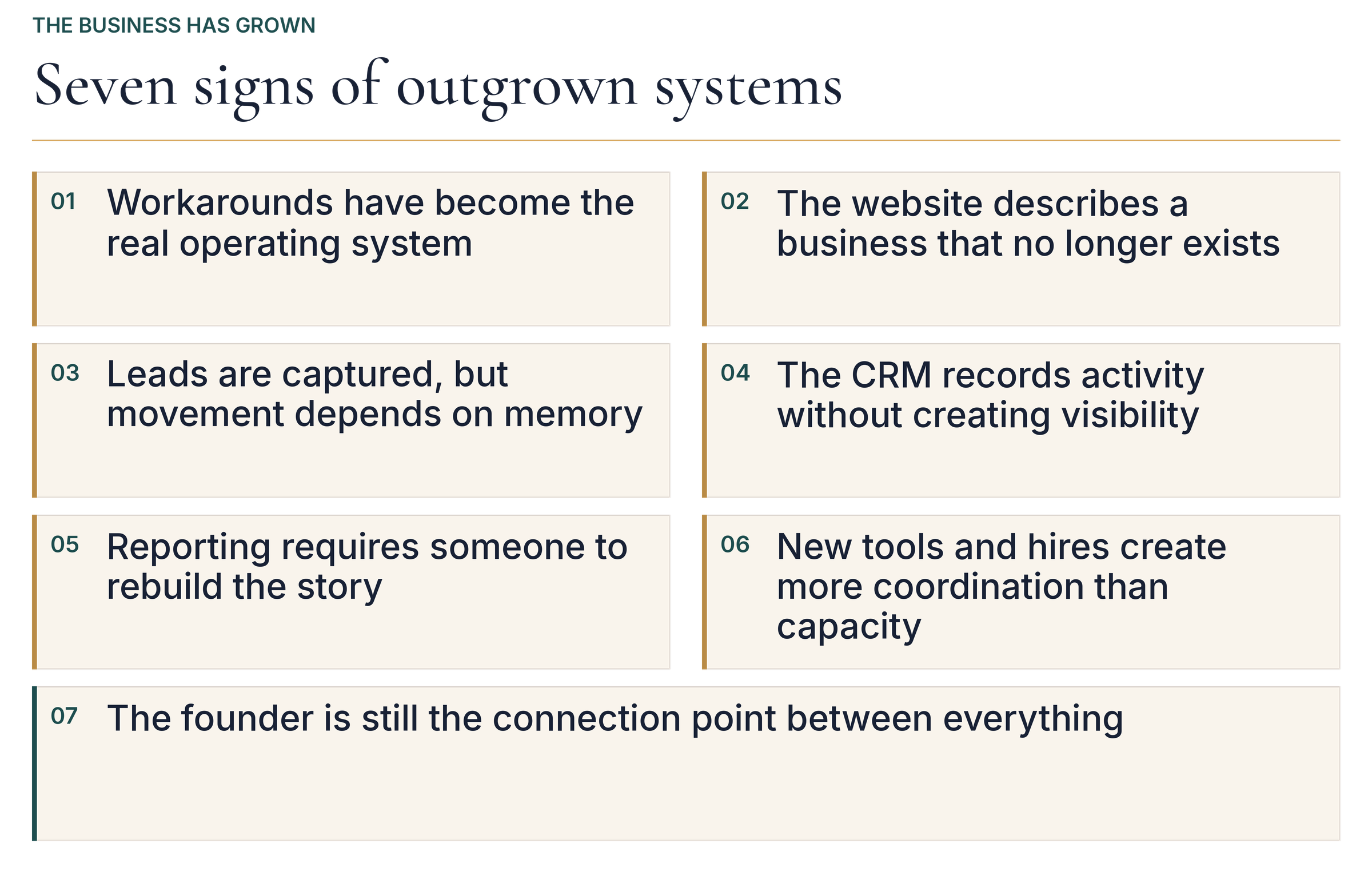
01 Workarounds have become the real operating system
Every company has a few workarounds. The problem begins when the workaround becomes the process.
A spreadsheet fills the gap between the form and the CRM. A private document explains what the official pipeline stages actually mean. A team member keeps a personal task list because the shared system does not show the next action. A recurring meeting exists primarily to reconstruct information that should already be visible.
Each workaround may appear reasonable. Together, they create a second operating system running beside the official one.
That hidden system is difficult to train, document, improve, or transfer. It also makes the business look more organized than it is because the output still appears—even though producing it requires constant manual intervention.
The question is not whether your team uses spreadsheets or has exceptions. The question is whether the business could keep moving if the people who understand those workarounds were unavailable.
If the answer is no, the system is no longer carrying the work. The people are.
02 The website describes a business that no longer exists
Growing businesses evolve faster than their websites.
The company adds services, moves into stronger markets, develops a sharper point of view, serves larger clients, or changes how work is delivered. The website continues describing the earlier version.
This creates a quiet credibility gap.
Prospects arrive through a referral and cannot find the capability they were told about. Sales has to explain that the website is outdated. The navigation reflects an old offer structure. The calls to action send every visitor toward the same generic contact form. The case studies prove work the company no longer wants to lead with.
The issue is larger than stale copy. The website is part of the revenue infrastructure. When it no longer reflects the business accurately, every campaign, referral, conversation, and search result begins with unnecessary translation.
If your team routinely says, “The website does not really show what we do now,” the business has outgrown more than a few pages. It has outgrown the architecture underneath them.
03 Leads are captured, but movement depends on memory
A form submission is not a lead-management system.
The real system begins after someone raises a hand.
Where does the inquiry go? What information arrives with it? Who decides whether it is qualified? Who owns the next action? How quickly does follow-up happen? What occurs if the first message receives no response? When does the opportunity become visible to leadership?
In an underbuilt system, those answers change depending on who receives the inquiry.
One person responds immediately. Another assumes someone else handled it. A third records the contact but not the context. Event leads live in a separate spreadsheet. Referral conversations remain in email. Follow-up stops when the person who remembers the next step gets busy.
The business may believe it needs more leads when it first needs a dependable way to move the leads it already has.
Growth becomes expensive when every new opportunity creates another decision the system cannot make visible.
04 The CRM records activity without creating visibility
A CRM can be full of data and still tell leadership almost nothing.
Records exist. Emails are logged. Deals have values. Tasks have been completed. Yet basic questions still require a meeting or a manual review:
Which opportunities are actually moving?
What is stalled?
What needs attention today?
Why are deals being lost?
Which lead sources are producing qualified conversations?
Where is follow-up inconsistent?
What revenue is reasonably visible?
If the CRM cannot answer those questions, it may be storing activity without supporting decisions.
This usually happens because the structure was built around the software rather than the business. Stages do not match the real buying process. Required information is unclear. Fields were added without a reporting purpose. Automations trigger activity without improving ownership. Different people use the same terms to mean different things.
The result is not simply a messy database. It is an incomplete view of how revenue moves.
05 Reporting requires someone to rebuild the story
Leadership should not need a narrator every time it asks what is happening.
When systems are disconnected, reporting becomes a reconstruction exercise. Someone exports CRM data, checks a spreadsheet, looks at website analytics, searches email, asks sales for context, and then explains why the numbers do not quite match.
The final report may be polished. The process underneath it is fragile.
This creates two risks.
First, decisions are delayed because the business has to assemble visibility before it can act.
Second, the person who builds the report becomes the only person who understands how the information fits together.
Reliable reporting begins before the dashboard. It begins with consistent definitions, useful fields, clear ownership, and systems designed to capture the information leadership will eventually need.
If the business cannot trust a number without asking how it was produced, the reporting problem started upstream.
06 New tools and hires create more coordination than capacity
Adding capacity should reduce pressure. Sometimes it does the opposite.
A new tool introduces another login, another data source, another workflow, and another place information may become inconsistent. A new hire inherits undocumented decisions, scattered files, unclear ownership, and processes that live in other people’s heads.
The tool is not necessarily wrong. The hire may be excellent. The architecture around them is underbuilt.
This is especially visible with AI and automation. A company purchases software to make the team faster, but no one has defined the process, the inputs are unreliable, and exceptions still require human judgment. The automation adds activity without removing ambiguity.
Technology creates leverage when it supports a clear system. Without that clarity, it creates another layer the business has to coordinate.
The same is true of people. A new employee cannot create durable ownership inside a structure that has never defined what ownership means.
07 The founder is still the connection point between everything
Founder involvement is not automatically a problem. Founder dependence is.
The difference becomes clear when work cannot move without the founder interpreting, approving, locating, introducing, correcting, or remembering something.
The founder knows why the offer changed. Which prospect needs special handling. What the pipeline stage really means. Where the latest document lives. Which client conversation matters. Why the report looks wrong. What should happen next.
That knowledge can hold a growing business together for a long time.
It also creates a ceiling.
When the founder remains the manual connection between brand, marketing, sales, operations, and leadership, every additional person or opportunity increases the number of decisions flowing back toward one point.
The business does not need the founder to care less. It needs the system to carry more of what the founder has been carrying personally.
A Useful Starting Point
Find where the business first starts compensating for the system.
A Growth Architecture Audit examines the connections across brand, website, CRM, AI workflow, revenue operations, and growth leadership. It identifies what is working, what is missing, what is disconnected, and what should be addressed first.
Requesting an Audit begins with a short fit call. If the Audit is the right next step, I will confirm the goals, scope, timing, and payment before work begins.
Why these problems appear during growth
Most businesses do not intentionally build disconnected systems.
They solve the problem directly in front of them.
The first website needs to launch quickly. The first CRM needs to hold contacts. The first salesperson creates a follow-up process that works for one person. The founder fills the gaps because doing so is faster than documenting every decision. New tools are added when the old ones become frustrating.
This is often practical in the early stages.
The problem is that temporary decisions accumulate. The business grows around them. Volume increases. More people participate. Buyers take different paths. Leadership needs stronger visibility. What once felt flexible begins to feel inconsistent.
The business has not failed. The requirements changed.
Growth Architecture is the work of redesigning the strategy, structure, messaging, systems, and execution layer for the business that exists now—not the smaller company those systems were originally built to support.
Do not treat every sign as a separate project
Seven visible signs do not necessarily require seven separate solutions.
An outdated website, inconsistent sales language, and poor lead quality may share a positioning problem.
Missed follow-up, unreliable pipeline reporting, and founder intervention may trace back to the same CRM structure and ownership gaps.
Too many tools, manual reporting, and ineffective automation may all begin with one undefined workflow.
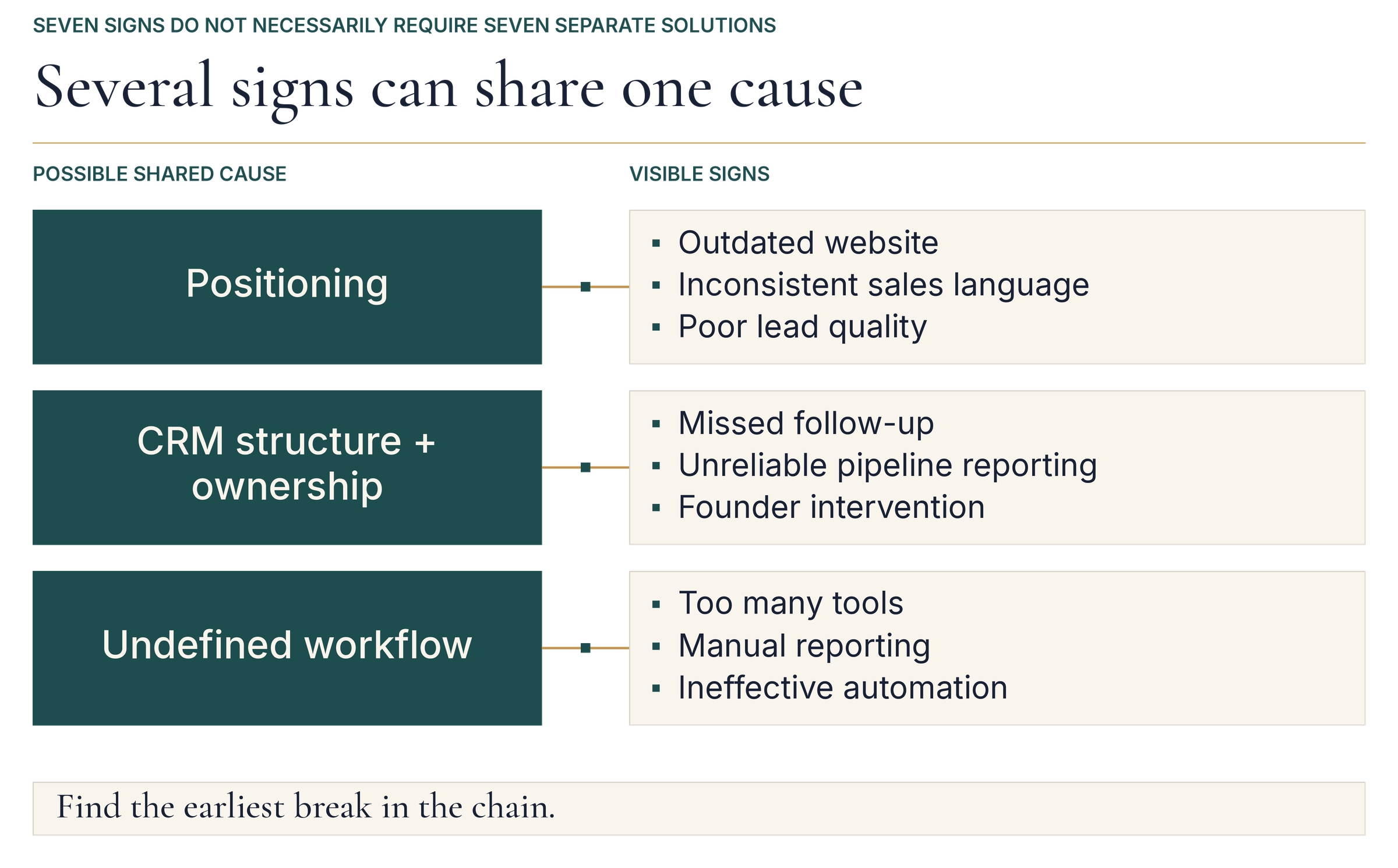
This is why sequence matters.
If you replace the website before clarifying the positioning, the new site will reproduce the old ambiguity in a better design.
If you automate follow-up before defining qualification and ownership, the business will send messages faster without improving the buyer experience.
If you build dashboards before standardizing the information entering the CRM, the report will make unreliable data easier to look at.
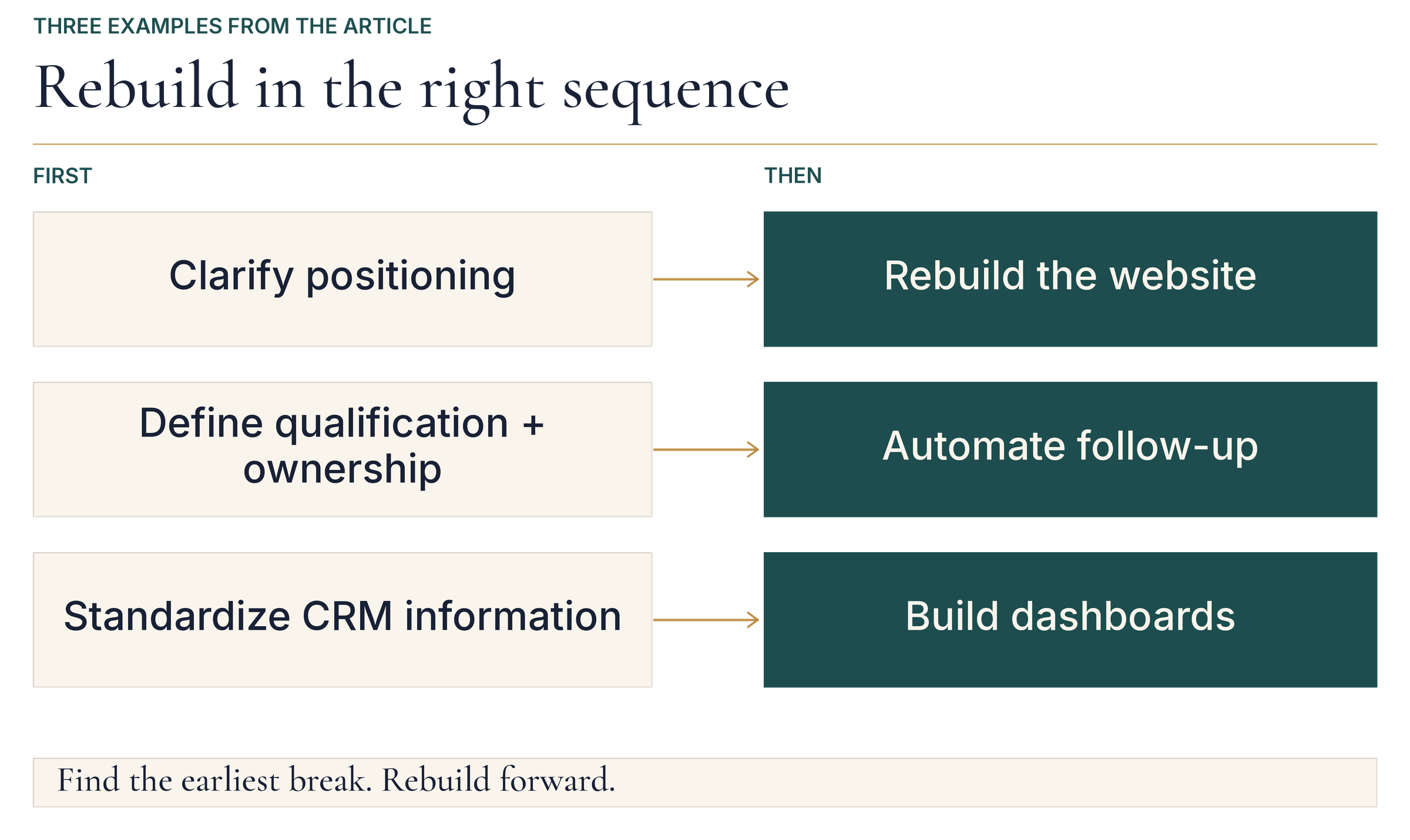
The first job is to find the earliest break in the chain.
Then rebuild forward from there.
What changes when the system can carry the growth
The team stops relying on private knowledge to complete shared work.
The website reflects the company that prospects are actually considering.
Leads enter with useful context and move through a defined process.
The CRM shows the next action, not only the last activity.
Reports support decisions without requiring a separate investigation.
AI and automation remove work because the workflow underneath them is clear.
The founder remains strategically involved without serving as the routing layer for the entire business.
In one growth-stage B2B technology company, the clearest progress came from treating messaging, website structure, lead capture, CRM architecture, follow-up, reporting, sales enablement, and event conversion as parts of one system. The individual deliverables mattered. What mattered more was what they allowed the business to connect.
You can read the full Case Study here.
Outgrowing a system is evidence of progress
The phrase “outgrown systems” can sound like criticism. It is often evidence that the business has moved beyond the conditions those systems were designed for.
What worked for five people may not work for twenty-five. What worked with one offer may not work with six. What worked when the founder knew every prospect may not work when several people own parts of the relationship.
The answer is not to preserve every familiar process because it helped the business get here.
The answer is to identify what still serves the company, what now creates friction, and what the next stage requires.
The systems do not need to be more complicated. They need to be more intentional.
START HERE
See what the system actually needs.
The Growth Architecture Audit gives you a clear view of what is working, what is broken, what is missing, what is disconnected, and what the business should address first.

Sarah Fuller
Growth Architect
I help founder-led B2B companies connect brand, website, CRM, AI workflows, and revenue operations into a growth system the business can actually use. I diagnose the architecture, rebuild the disconnected parts, test how they work together, document the system, and establish clear ownership for what comes next.